


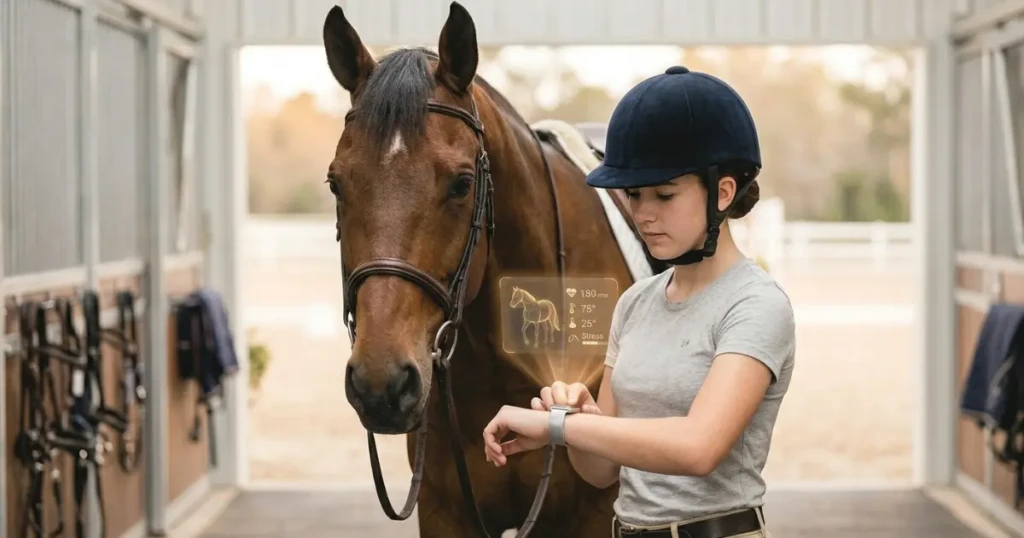

Equestrian technology in 2026 falls into three honest groups: safety equipment that measurably protects the rider, of which the equestrian air vest is the clearest example, monitoring tools that reveal something about the horse you could not otherwise see, and expensive novelties. Knowing which group a product belongs to before buying is what separates a useful purchase from an expensive shelf ornament.
An equestrian air vest is a wearable airbag that inflates in roughly 80 milliseconds when a fall is detected, cushioning the neck, spine and ribs before impact. It is the one piece of riding technology on this list whose value is not really a matter of opinion.
Everything else deserves more scrutiny. Simulators, stall cameras, biometric girths and tracking robots all promise to make you a better horseperson, and some of them genuinely do. Below is what each one actually does, with links to the manufacturers so the specifications can be checked rather than taken on trust.
What Is an Equestrian Air Vest and How Does It Work?
An air vest is a shell worn over or under riding clothes, containing a folded airbag and a small CO₂ canister. When the system detects that the rider has separated from the horse, the canister fires and the bag inflates around the torso, neck and lower back.
There are two triggering systems. Tethered vests connect to the saddle with a lanyard, so leaving the saddle pulls a pin and inflates the bag. They cost less and are mechanically simple, but they need re-arming after every dismount, and they are famously good at inflating when a rider forgets to unclip before hopping off.
Electronic vests are the 2026 story. The Helite e-Turtle 2 uses a 360-degree sensor suite to detect a fall on its own, with no lanyard and nothing to remember. Inflation takes about 80 milliseconds, which is faster than a rider reaches the ground from a standard jump height. Learn more: Helite Electronic Air Vests
Air Vest or Body Protector: Which Do You Actually Need?
They solve different problems, and for many riders the honest answer is both.
| Air vest | Body protector | |
|---|---|---|
| Protects against | Impact force, spinal compression, neck injury | Crush, kick, puncture |
| When it works | Only once inflated, so the fall must be detected | Always on, no trigger required |
| Bulk in the saddle | Slim until deployed | Noticeably padded |
| Ongoing cost | A CO₂ canister per deployment | None |
| Typical use | Cross-country, jumping, hacking | Cross-country (often required), young horses |
| Certification | CE / EN 1621 or equivalent | BETA level 1 to 3 |
A body protector is passive armour that never fails to activate. An air vest is a system that has to correctly detect a fall before it helps at all. That difference is why most eventers wear the vest over the body protector rather than instead of it, and why several disciplines require the protector regardless of what else you have on.
The layer underneath matters more than people expect. A bulky show jacket changes the fit of a vest completely, so size it over the kit you actually ride in rather than over a t-shirt in a shop. That single detail separates a vest that works from one that rides up.
What Should an Equestrian Air Vest Cost, and When Is the Cheaper One Fine?
Tethered vests sit at the lower end of the market and electronic ones considerably higher, with the sensor package accounting for most of the difference.
The cheaper option is genuinely fine for a rider who hacks and schools, rarely dismounts mid-ride, and will reliably clip in every time. The electronic version earns its price for anyone jumping regularly, riding young or unpredictable horses, or teaching, because those are the situations where you are on and off constantly and a lanyard stops being a safety feature and starts being an annoyance. Safety equipment only protects you if you can be bothered to wear it properly, which is an unglamorous truth that applies equally to helmets.
What Can You Use on the Ground?
Ground-based technology in 2026 is built to refine rider biomechanics and monitor equine health outside the saddle.
Riding Simulators
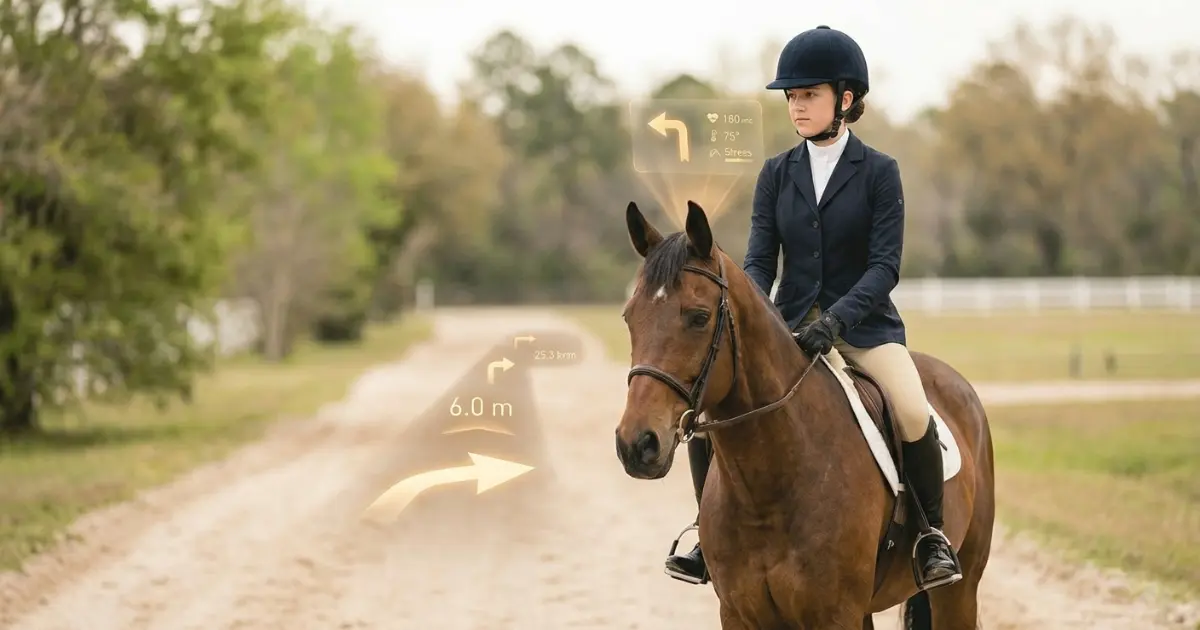
Racewood remains the reference point for off-horse training, used by professional athletes and physical therapists to refine posture and support injury recovery. Their dressage model reproduces lifelike motion for advanced movements including piaffe and passage, with on-screen sensors giving immediate feedback on seat position and rein contact. Learn more: Racewood Equestrian Simulators
It is worth being realistic about this one. Simulators are barn and training-centre equipment, not something that turns up at your house. Most riders will meet one at a clinic or a rehabilitation facility.
AI Stable Monitoring
Stable technology has moved well past a camera pointed at a stall. The Horcery Stall Monitor runs an onboard neural processor that recognises specific behaviours such as rolling, lying down or unusual stillness, and flags them as early warning signs. It tracks temperature and noise levels as well. Learn more: Horcery Stall Monitor
For anyone who has ever driven back to the barn at midnight because something felt off, this is the product that buys the most peace of mind per dollar.
AI Video Tracking
For riders who school alone, tracking robots have quietly replaced the friend holding a phone. The Pivo Pod uses Horse Tracking 2.0 to keep the camera centred on horse and rider throughout the session, and it has become standard for remote lessons and honest self-critique. Learn more: Pivo Equestrian
Nothing corrects a heel position faster than watching yourself in slow motion and realising your trainer was right all along.
What Do Biometric Sensors Actually Measure?
Biometric sensors track the horse’s physiological load, including heart rate, speed, symmetry and effort, then turn it into numbers you can compare from week to week.
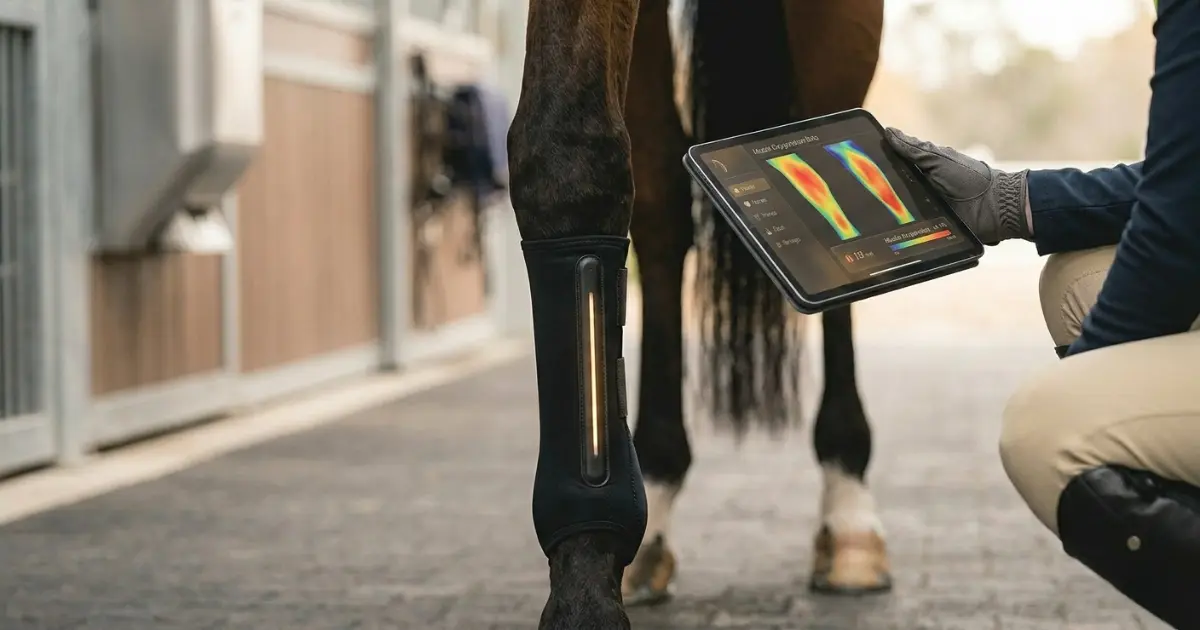
The Seaver CEEFIT attaches to any girth and records heart rate, speed, jump symmetry and calorie expenditure, so workout intensity becomes visible in real time. Learn more: Seaver CEEFIT Sensor
The Equisense Motion S takes a biomechanics-first approach instead, measuring cadence, elevation and symmetry to surface the subtle gait changes that often appear before visible lameness. Learn more: Equisense Motion S
The real value is not any single ride. It is the baseline. A horse whose symmetry has quietly drifted three per cent over a fortnight is telling you something that is very hard to feel from the saddle and very obvious in a chart.
Can Your Smartwatch Keep Up?
Yes. Both Seaver and Equisense ship dedicated smartwatch apps, which turn an Apple Watch or Samsung Watch into a live dashboard for heart rate and pace without breaking stride to find a phone. It sounds like a minor convenience, but it decides whether the data gets used at all, because a device you have to dismount to read is a device you will stop reading.
Does Any of This Make You a Better Rider?
Not on its own, and anyone selling it that way is overpromising. What technology does is replace guesswork with evidence.
A simulator shows a seat fault that a mirror flatters. A stall monitor catches a colic that would otherwise have been found at six in the morning. A biometric girth reveals that the easy hack was harder work for the horse than the schooling session was. None of that makes a decision for you. It means your decisions are made with better information, and across a season that is the difference between managing a horse and reacting to one.
What Should You Buy First?
For most riders the order is straightforward.
- A correctly fitted helmet. Nothing else on this page outranks it.
- A body protector, if your discipline calls for one.
- An equestrian air vest, the largest genuine safety upgrade available and the piece most worth stretching for.
- A biometric sensor, once safety is handled and the goal becomes training quality.
- Everything else, including cameras, monitors and simulators, when a real situation calls for them.
Buying in that order means every purchase protects something before it optimises anything.
Frequently Asked Questions
How long does an equestrian air vest take to inflate?
Around 80 milliseconds for a modern electronic vest, which is faster than a rider reaches the ground from typical jump height.
Can I reuse an air vest after it deploys?
Yes. Replace the spent CO₂ canister, repack the airbag according to the manufacturer’s instructions, and the vest is ready again. Keep a spare canister in the trailer.
Do I need a body protector if I wear an air vest?
For most disciplines yes, and many competitions require one. The two guard against different things, impact versus crush and puncture, so eventers commonly wear the vest over the protector.
Is it safe to buy a secondhand air vest?
It can be, provided the history is clear. Check whether the vest has ever deployed and, if it has, that it was professionally serviced and re-armed afterwards. Inspect the canister seal, the trigger mechanism and the stitching, and confirm the model is still supported by the manufacturer. A vest bought from a seller who can answer those questions is a sound buy. One with no history at all is the thing to walk away from.
Will an air vest fit over a show jacket?
It should be fitted over whatever you actually ride in. Sizing over a thin layer and then wearing it over a jacket produces a vest that sits too high and rides up.
Do biometric sensors work with any saddle?
Girth-mounted sensors such as the CEEFIT are designed to attach to standard girths across disciplines. Check the manufacturer’s compatibility notes for treeless or unusual setups.
The Takeaway
Equestrian technology in 2026 has stopped being a novelty and started being useful, though unevenly. The equestrian air vest has a clear physical case behind it. The sensors and monitors are genuinely valuable to riders who will actually read the data. The simulators are extraordinary and belong to training centres.
Buy safety first, buy data second, and let everything else wait until there is a real problem it solves.
Reequestrian is the US peer-to-peer marketplace where riders buy and sell English apparel and tack directly. Good gear should keep riding, so when the show coat is outgrown or the breeches no longer suit the discipline, list them with us and let them find their next rider. Browse the shop to see what riders are passing along right now, including tops and show apparel and breeches and jodhpurs.
—


