



Ask ten riders when they last replaced their horse riding helmet. You will get a few honest shrugs.
It is the one piece of kit that does its entire job in a fraction of a second you hope never arrives. The rest of the time it hangs on a hook looking perfectly fine. That is the trap. A helmet can be completely finished protecting you and still look brand new.
Safety in this sport is not a box you tick once. It is a running practice of stewardship and attention, and as of March 2026 both the technology and the expectations placed on responsible horse owners have moved on considerably. Whether you compete or hack out at weekends, what follows is what actually matters when buying, fitting and retiring head protection, plus the stable habits that stop falls happening at all.
Some of it you will know already. The section on expiry dates catches almost everyone.
Safety and Educational Disclosure
This guide is educational. It does not replace professional instruction or a certified fitting. Riding carries a real risk of serious injury, and in rare cases death. No piece of safety equipment protects against every possible impact. Nothing on this page replaces a lesson with a qualified instructor, or a fitting done by somebody certified to do it. Reequestrian® pushes both, hard, and the fitting especially. Use what follows, but responsibility for your own safety and your horse’s stays with you.
Why a Horse Riding Helmet Only Works Once
Start here, because everything else is secondary: buy new. Not lightly worn. Not “only dropped the once”. Not from a friend clearing out the tack room. New.
What actually happens inside the shell
A riding helmet protects your brain by wrecking itself. The liner inside, usually expanded polystyrene, is built to crush. It collapses on impact and eats the kinetic energy that would otherwise have arrived at your skull. Engineers call this sacrificial destruction, a blunt name for a blunt idea. And it works exactly once.
Here is the cruel bit. That collapse happens on the inside, invisibly. A helmet that has been through a fall, or simply tipped off a tack trunk onto a concrete aisle, can be structurally spent with nothing whatsoever showing on the outside. No home inspection will tell you. Not squeezing it, not looking at the shell, not asking the previous owner.
Why we refuse helmet listings
Because that impact history can never be verified by a second owner, a helmet should never be bought or sold on a resale marketplace. Reequestrian® draws a hard line: helmets are not permitted on our peer to peer marketplace. We would rather forgo the listings than have a rider out there trusting foam that already did its job for somebody else.
ASTM F1163:23: What the 2023 Standard Changed
In the United States, equestrian helmet safety runs on a standard written by ASTM International and independently verified by the Safety Equipment Institute. That second part matters. An SEI seal means a third party tested the helmet. Without it, you are trusting the brand’s own homework.
The current benchmark is ASTM F1163:23, and it is genuinely tougher than the 2015 version it replaced. Standards were tightened to reflect newer research into head injuries. The headline change: a mandatory crush test. The shell now has to withstand a specified lateral force without folding inward onto the rider’s head.
Falls rarely arrive as a tidy vertical drop. Testing for side loading matters more than it sounds.
Reading the label before you pay
Turn the helmet over and look inside the shell. You want the SEI seal, and you want it referencing F1163:23 specifically. Plenty of stock sitting on shelves is still certified to the 2015 standard, and it is not always priced to reflect that. If the shop cannot tell you which standard applies, that tells you something about the shop.
MIPS and the Physics of a Real Fall
Traditional helmets were designed and tested against straight, linear impacts. Actual falls almost never behave that way. You come off at an angle, usually with forward momentum, and your head meets the ground with a glancing blow that twists the skull. Rotational force of exactly that kind is a leading cause of concussion and traumatic brain injury.
MIPS, the Multi-directional Impact Protection System, is the most significant advance in equestrian head protection of the past decade. Strip away the marketing and it is a slippery layer, sat between the comfort padding and the protective foam. Hit the ground and the shell is free to slide 10 to 15 millimetres, any direction, relative to your head. Tiny movement. It bleeds off the rotational energy that would otherwise travel straight into your brain. The idea came out of anatomy, borrowed from the way cerebrospinal fluid lets the brain shift a fraction inside the skull.
So is it worth paying for?
Yes. We would put it above almost anything else on the spec sheet. MIPS adds somewhere between thirty and eighty dollars to an equestrian helmet. Set that against what a concussion actually costs you, in money, in time out of the saddle, in the months some riders never quite get back, and it stops being a close call. Budget tight? Then buy the cheaper helmet with MIPS. Not the premium one without.
Choosing the Best Helmet for Horse Jumping
Jumping changes the maths in two ways. You are further from the ground when it goes wrong, and you are travelling, so the fall carries forward momentum instead of dropping you from standstill. Both of those should change what you reach for on the shelf.
What to look for
- Rotational protection. A jumping fall is an angled fall almost by definition. This is where MIPS earns its keep.
- Ventilation designed in, not added on. Cross country and jumper rounds generate real heat. You want vents that were part of the certification testing.
- A harness that holds under load. If the helmet shifts when you land in two point, it will shift in a fall.
- Your discipline’s rules. US Equestrian mandates certified headgear for many jumping activities, and eventing carries its own cross country requirements. Check before you buy, not after.
Skull caps stay popular for cross country precisely because there is no fixed peak to catch the ground and torque the head. In hunters and equitation, where turnout gets judged, riders tend toward a low profile certified helmet with a discreet harness.
Get Fitted by Someone Who Knows Heads
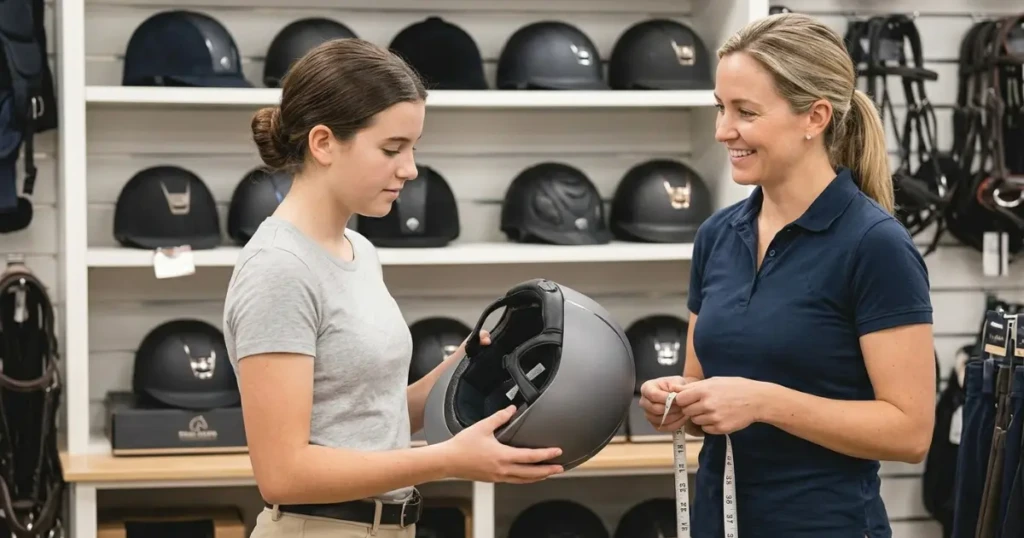
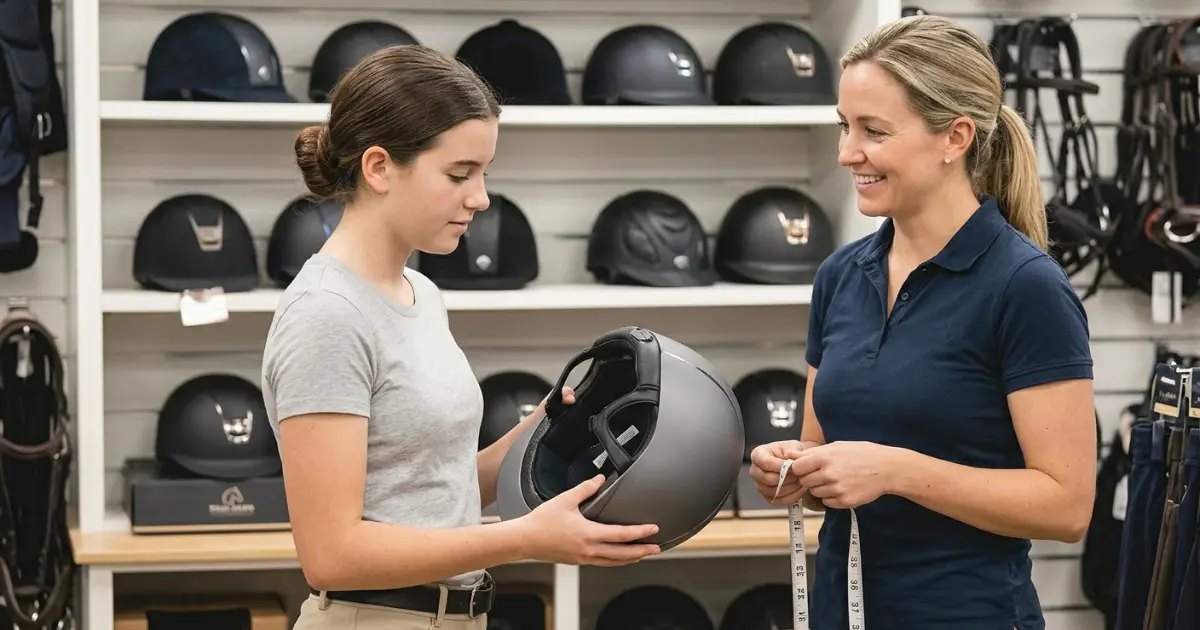
Online is convenient and we are not going to pretend otherwise. But your first fitting of any equestrian helmet belongs in a decent tack shop, with somebody trained doing the fitting. After that, once you know the model and the size that works on your head, reordering online is easy enough.
Shape beats size
Heads come in roughly three shapes: round, oval, long oval. Manufacturers build to those geometries, and most of them do not build to all three. Two helmets stamped with the same size can feel like completely different objects once they are on. A size chart on its own will never get you there.
A good fitter reads pressure points that riders habitually mistake for “snug”. Too tight brings headaches and distraction. Too loose is the worse failure, because the helmet shifts during a fall and can expose your forehead or the base of your skull at precisely the wrong moment.
The Five Point Fit Check
Once you have a helmet matched to your head shape, verify it against these five criteria. Repeat them whenever you buy, and again after a noticeable weight change, a new hairstyle, or when a helmet passes down to a growing junior.
- The level brow. The brim sits roughly two fingers’ width above your eyebrows, sitting level. It should not tilt back to expose the forehead or forward into your vision.
- The skin test. Rock the helmet gently, back and forth, and watch your eyebrows in a mirror. Forehead skin and eyebrows should shift with the helmet. If it glides over your hair instead, it is too big.
- The shake test. Chin strap undone, bend forward and shake your head. The helmet stays where it is.
- The harness V. The side straps meet in a V just below and slightly forward of your earlobes.
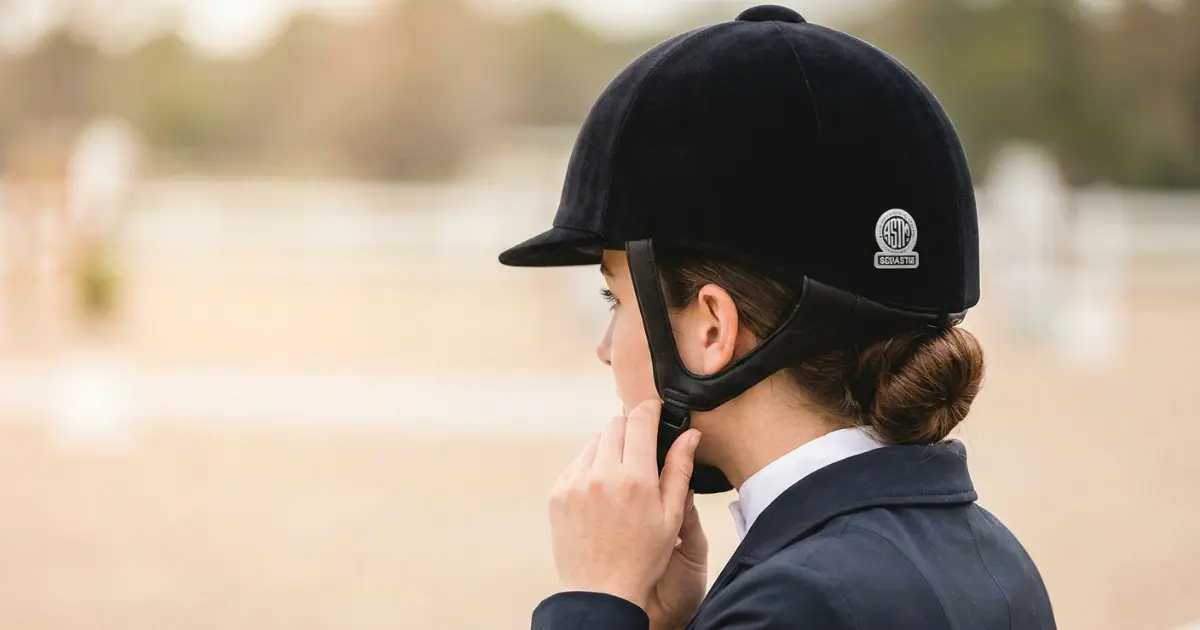
- Chin strap tension. One finger between strap and chin. Open your mouth wide and you should feel the helmet pull down slightly.
When to Replace Your Horse Helmet
Helmets expire. This is the point that surprises most riders, and it has nothing to do with whether you have ever hit the ground.
The resins, glues and foams inside the shell degrade over time whether you ride daily or twice a year. Industry guidance is replacement five years from first use, or five years from the manufacture date if you cannot remember when you started wearing it. That date is stamped inside the shell.
Heat, cold and where it lives
Temperature accelerates all of it. The back of a car in July is genuinely destructive: sustained exposure above roughly 120 degrees Fahrenheit can compromise the foam’s protective structure, and a helmet that has cooked should be replaced rather than trusted. Freezing tack rooms are no kinder. Keep it indoors, out of direct sun, and not buried under a saddle at the bottom of a trunk.
Inspecting Tack for Points of Failure
Safety is not only what you wear. It runs through every piece of equipment sitting between you and a thousand pounds of horse. Checking your tack over regularly is not fussiness. It is just part of looking after the animal and yourself.
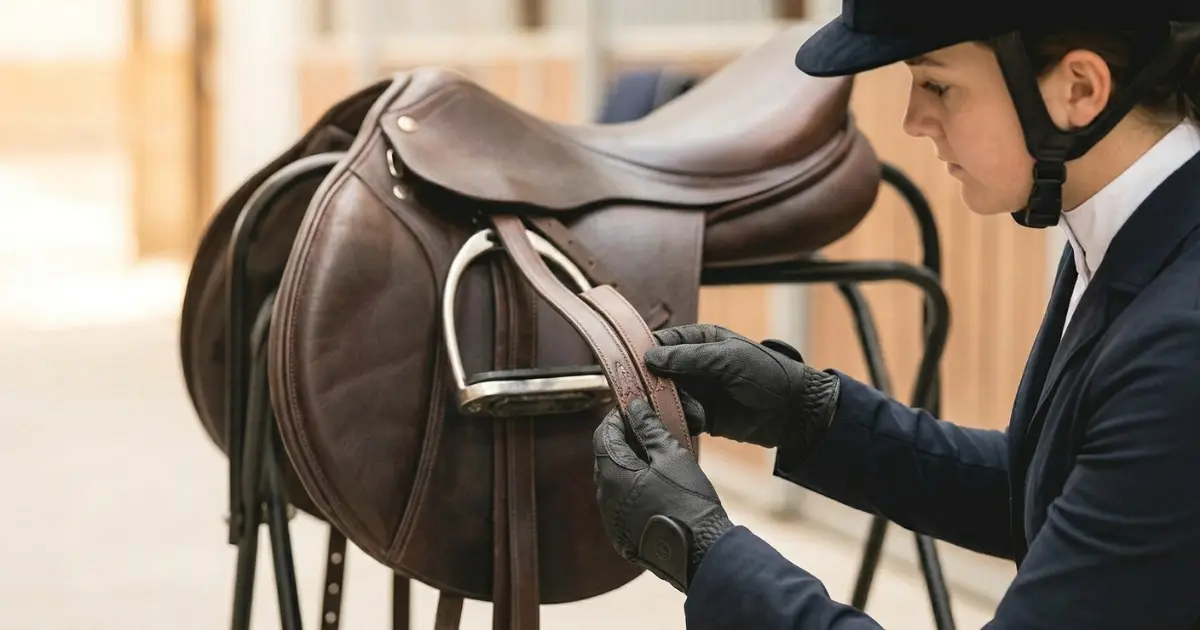
Pay closest attention wherever leather meets metal: bit attachments on the bridle, buckle areas on your stirrup leathers. You are hunting for dry rot, which shows up as fine cracking, and for leather that has gone brittle rather than supple. Either means it has lost structural strength and can snap under the load of a spook or a jump.
Then check the stitching on your girth billets. Those straps hold your saddle on. A failure there puts the saddle, and you, somewhere unplanned.
Ground Safety and Footwear
A striking share of equestrian injuries happen with both feet on the ground, during grooming, leading and tacking up. Footwear is your first line of defence in the barn.
Proper equestrian boots do two jobs. A reinforced toe, for the day a horse plants a foot on yours. And a defined heel, so your foot cannot slide straight through the stirrup. Sneakers, sandals and soft soled fashion boots manage neither. Around the stable, stand where you can move fast if the horse spooks, and speak before you approach from behind. Every time.
Arena Etiquette Is a Safety System
Share an arena and your safety stops being entirely yours. It now depends on everybody else behaving predictably. The conventions are not etiquette for its own sake. They exist to stop collisions and keep horses settled.
Pass left shoulder to left shoulder. Riders on the rail generally have right of way over those circling or working laterally. Call your intentions out loud: “entering”, “leaving”, “door” at a blind entrance. A quiet, focused arena keeps horses calm, and calm horses remain the single most effective accident prevention there is.
What Can and Cannot Be Resold Safely
The equestrian world took to the circular economy long before it had a name, and supporting that is exactly why Reequestrian® runs a peer to peer marketplace. Second season saddles, bridles and apparel get you quality kit for a fraction of retail, and they keep perfectly good equipment out of landfill.
Doing resale honestly means being clear about where the line falls, though. Leather goods, apparel, most tack: all of it can be inspected, assessed and passed on with confidence. Safety equipment built to a single impact, or carrying an expiry date, cannot. Helmets sit squarely on the wrong side of that line. So do body protectors and air vests, and they deserve exactly the same caution.
There is a practical dividend to holding that line. Buying your breeches, boots and show coats second season frees up enough budget to buy the best new protection money can get for your head and your body. Make that trade. Every time.
Horse Riding Helmet FAQs
How long does a horse riding helmet last?
Five years from first use. Or, if you genuinely cannot remember when you started wearing it, five years from the manufacture date stamped inside the shell. Any fall or hard knock and it goes straight away, whatever its age, however fine it looks.
Can you buy a second hand riding helmet?
You should not, and Reequestrian® does not permit helmets on our marketplace. The protective foam is engineered to crush once, and that damage is usually invisible from outside. Since a previous owner’s fall history cannot be verified, you would be trusting protection that may already be spent.
What is MIPS in an equestrian helmet?
A low friction layer inside the helmet. It allows 10 to 15 millimetres of movement relative to your head during an impact, which redirects the rotational forces linked to concussion. It is built for angled falls, and angled falls are what most riding falls actually are.
What does ASTM F1163:23 mean?
It is the current United States safety standard for equestrian helmets, updated in 2023. It is stricter than the 2015 edition and adds a mandatory crush test for lateral force. Look for it alongside the SEI seal inside the shell.
Does a helmet need replacing if I only dropped it?
Possibly. A drop from saddle height onto concrete can carry enough force to compress the liner. Manufacturers differ in their guidance, so contact them with the model and the circumstances. If you cannot get a clear answer, replace it.
Is an expensive horse riding helmet safer than a cheap one?
Not necessarily. Every certified helmet has to pass the same ASTM standard, so a budget certified model clears the same bar as a premium one. What the extra money usually buys you is ventilation, lower weight, a better finish and more fit options. The one exception worth paying for is rotational protection such as MIPS. That does change the safety picture.
Do children need a different helmet?
Same certification, same five point fit check. What changes is how often you run it. Heads grow. A junior helmet that sat properly in spring can be riding too high by autumn, so check it again at the start of every season.
Safety as a Reflection of Horsemanship
Real horsemanship shows up in the care you extend to your horse, and in the care you extend to yourself. None of what is above is a list of restrictions. It is what buys you the freedom to ride knowing you have taken out the risks that were yours to take out.
The kit available to riders now is better than anything the generation before us could buy. Use it properly. Get fitted by a professional. Keep half an eye on the calendar. And never, ever economise on the thing protecting your head.


