


Nobody tells you that learning to ride comes with learning a second language. You turn up for a first lesson, someone asks you to check the girth, tighten it a hole, and mind the horse’s off side, and you nod as though any of that meant something.
This is a glossary of the equestrian terms you’ll actually hear, grouped the way they come up rather than alphabetically, because nobody encounters vocabulary in alphabetical order. Where a word is commonly mispronounced, the pronunciation is here too. That part matters more than it sounds. Most beginners work out what a word means fairly quickly; what stops them using it is the fear of saying it wrong in front of people who have known it since childhood.
How Do You Pronounce the Difficult Ones?
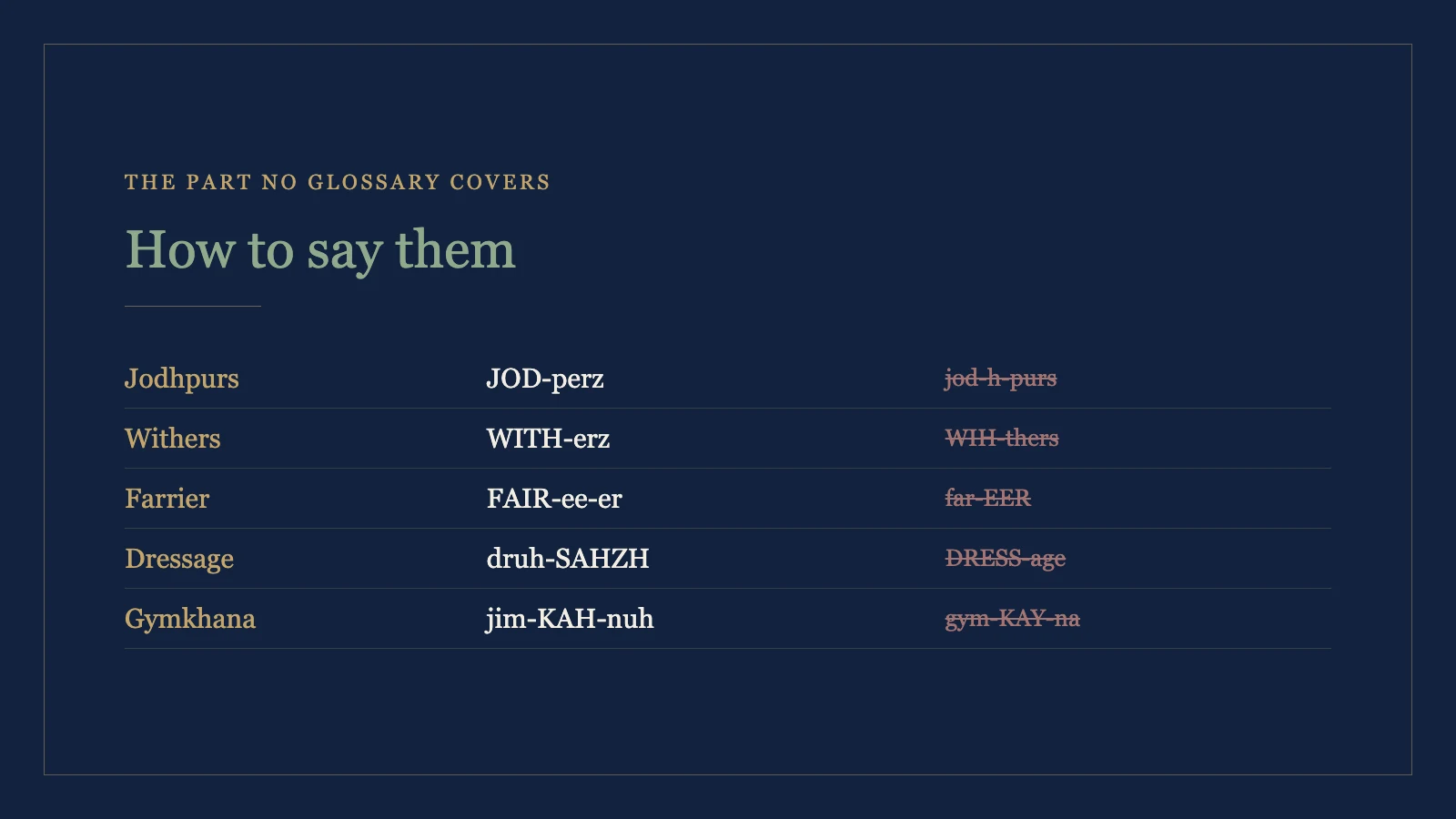
Start here, because this is the part no glossary covers and the part that keeps people quiet at the barn. All of these are as Merriam-Webster gives them.
| Word | Say it | Not |
|---|---|---|
| Jodhpurs | JOD-perz | jod-h-purs |
| Withers | WITH-erz (as in the, not think) | WIH-thers |
| Farrier | FAIR-ee-er | far-EER |
| Dressage | druh-SAHZH | DRESS-age |
| Cavesson | KAV-uh-sun | ka-VESS-on |
| Gymkhana | jim-KAH-nuh | gym-KAY-na |
| Equitation | ek-wih-TAY-shun | |
| Hackamore | HAK-uh-more | |
| Piaffe | PYAF (one syllable) | pee-AH-fay |
The one that catches almost everybody is jodhpurs. The h is silent, and it’s silent because the word came from Jodhpur in Rajasthan, where the riding trousers were made before British officers took the style home in the 1890s.
What Are the Words for the Horse Itself?
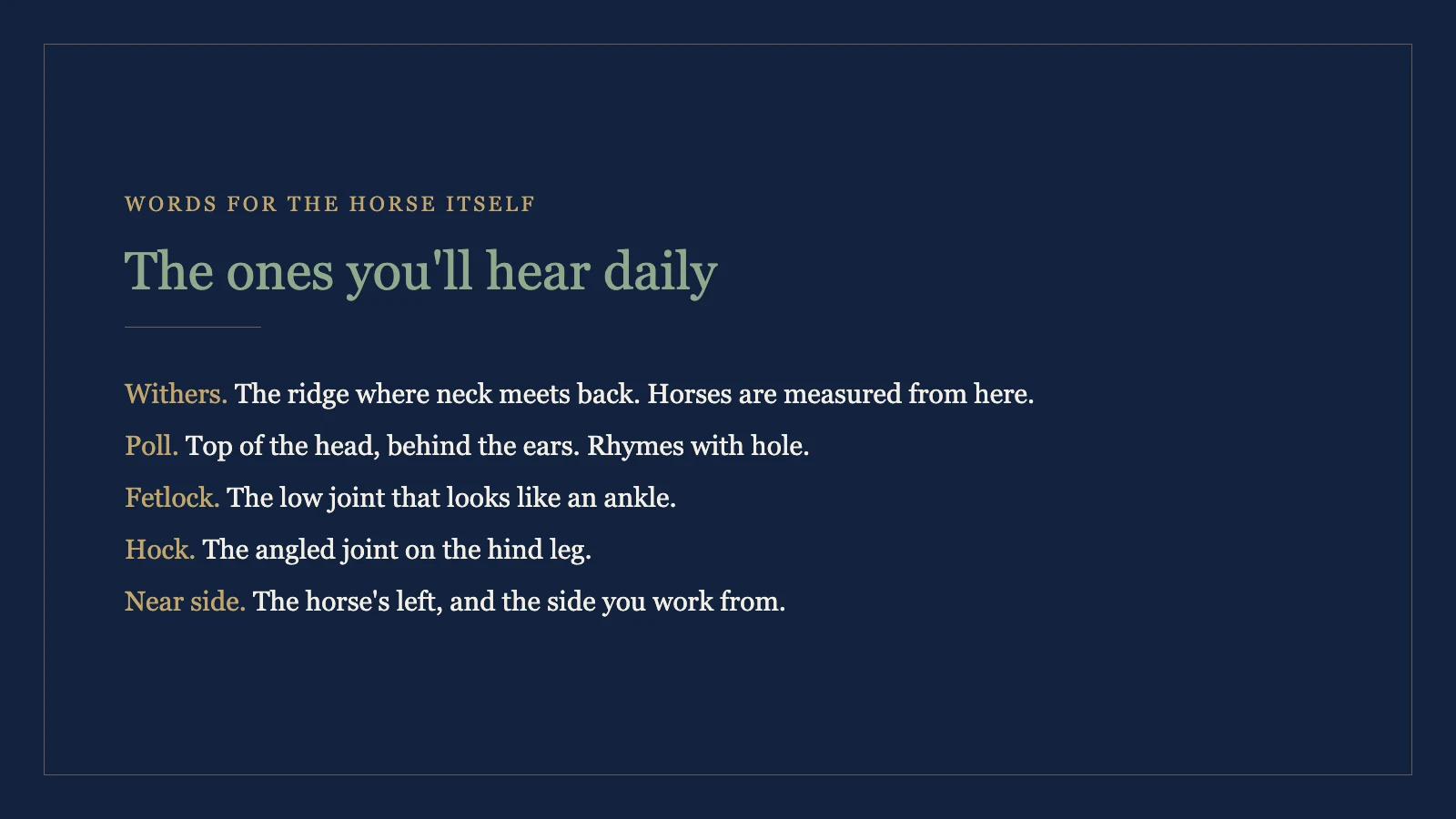
These describe the horse’s body, and you’ll hear them constantly because almost every instruction refers to a part of the horse.
Withers. The ridge at the base of the neck where it meets the back. It’s the fixed point a horse is measured from, and it’s why saddle fit is discussed in terms of wither clearance.
Poll. The top of the head, just behind the ears. Rhymes with hole.
Girth line. Where the girth sits, running just behind the front legs.
Barrel. The round part of the body between the front and back legs.
Hindquarters. The back end: hips, buttocks, upper hind legs. Often shortened to “quarters” or “the hind end”. This is where a horse’s power comes from, which is why instructors talk about riding “back to front”.
Fetlock. The joint low on the leg, the one that looks like an ankle.
Pastern. The short sloping section between the fetlock and the hoof.
Hock. The angled joint on the hind leg, roughly equivalent to a human ankle despite looking like a backwards knee.
Cannon. The long bone between knee (or hock) and fetlock.
Coronet. The band where hair stops and hoof begins.
Near side and off side. Left and right, as you sit on the horse. Horses are traditionally led, mounted and handled from the near side. It sounds like affectation until you realise everyone in the yard uses it and “left” gets ambiguous fast when two people are standing on opposite sides of a horse.
What Do You Call a Horse by Age and Sex?
Foal. A horse in its first year.
Weanling. A foal that has been weaned off its mother.
Yearling. A horse in its second year.
Colt. A young male horse that hasn’t been castrated.
Filly. A young female horse.
Gelding. A castrated male of any age. Most riding horses you’ll meet are geldings.
Mare. An adult female.
Stallion. An adult uncastrated male. You are unlikely to meet one as a beginner, and that is deliberate.
A word of caution the other glossaries won’t give you: the exact age at which a colt becomes a stallion, or a filly becomes a mare, depends on who you ask. General usage tends to say four. Thoroughbred racing conventionally says five. Breed registries vary. If you see a confident single number quoted somewhere, treat it as that source’s convention rather than a rule.
What Are the Gaits?
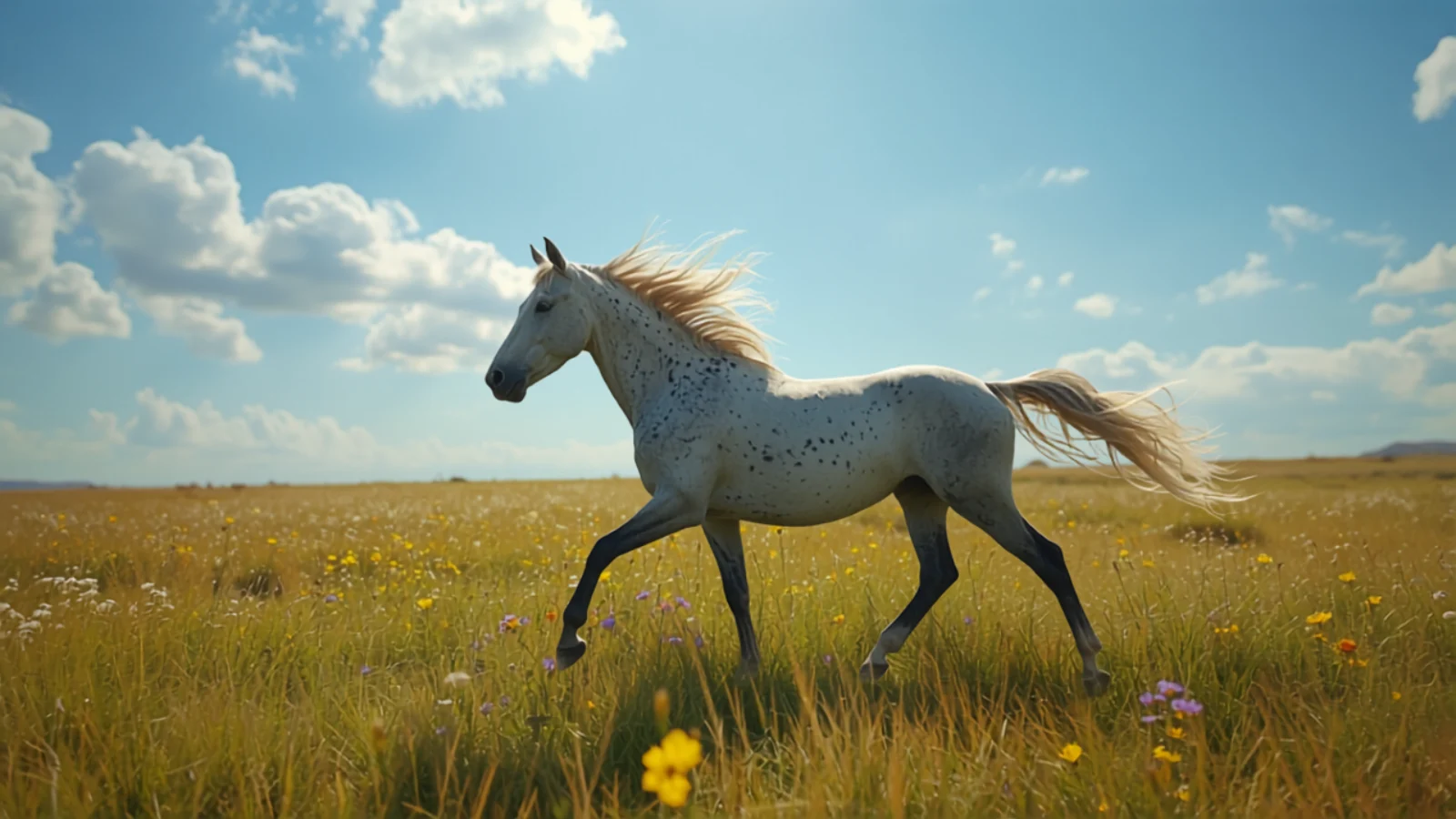
A gait is a way of moving, and each has a distinct rhythm you can hear.
Walk. Four beats, each foot landing separately.
Trot. Two beats, legs moving in diagonal pairs. This is the one that bounces you, and it’s why rising trot exists.
Rising trot (called posting trot in the US). Standing and sitting in time with the trot rhythm rather than absorbing every stride.
Sitting trot. Staying in the saddle throughout. Harder than it looks.
Canter. Three beats, rolling and much more comfortable than the trot.
Gallop. Four beats, flat out, all four feet off the ground at one point in the stride.
Transition. Any change between gaits, or between speeds within a gait. Most of a lesson is transitions.
Lead. At canter, which foreleg reaches further forward. On a circle a horse should be on the inside lead, and being told you’re “on the wrong lead” is one of the first corrections most riders get.
What Are the Tack Terms?
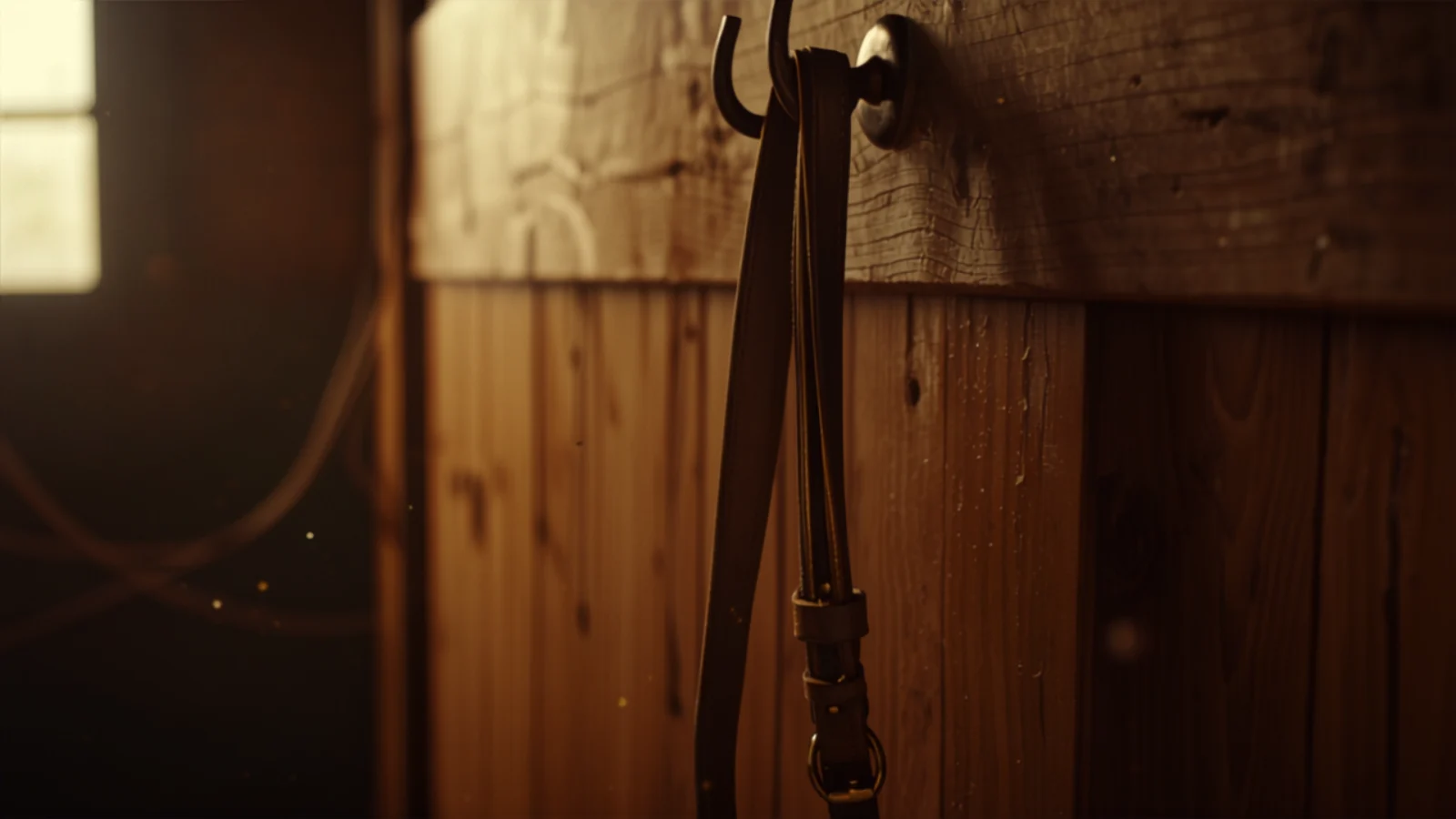
Tack is the collective word for the horse’s equipment. It’s also a verb: to tack up is to put it all on.
Bridle. The headgear that holds the bit and the reins.
Bit. The mouthpiece. A snaffle is the simplest and most common kind.
Noseband or cavesson. The strap around the nose.
Reins. What you hold.
Saddle. With an English saddle you’ll hear about the pommel (front), cantle (back), flap (the panel under your leg) and stirrup leathers (the straps holding the stirrups).
Girth. The strap under the belly that holds the saddle on. Called a cinch in Western riding.
Numnah or saddle pad. The padding between saddle and back.
Half chaps. Leg covers worn over paddock boots to protect the calf from the stirrup leathers, and the standard alternative to tall boots for everyday riding.
Martingale. A strap arrangement that limits how high a horse can throw its head.
Hackamore. A bitless bridle that works on pressure across the nose.
Headcollar or halter. Worn for leading and tying, with no bit.
What Do Riders Wear, and What Is It Called?
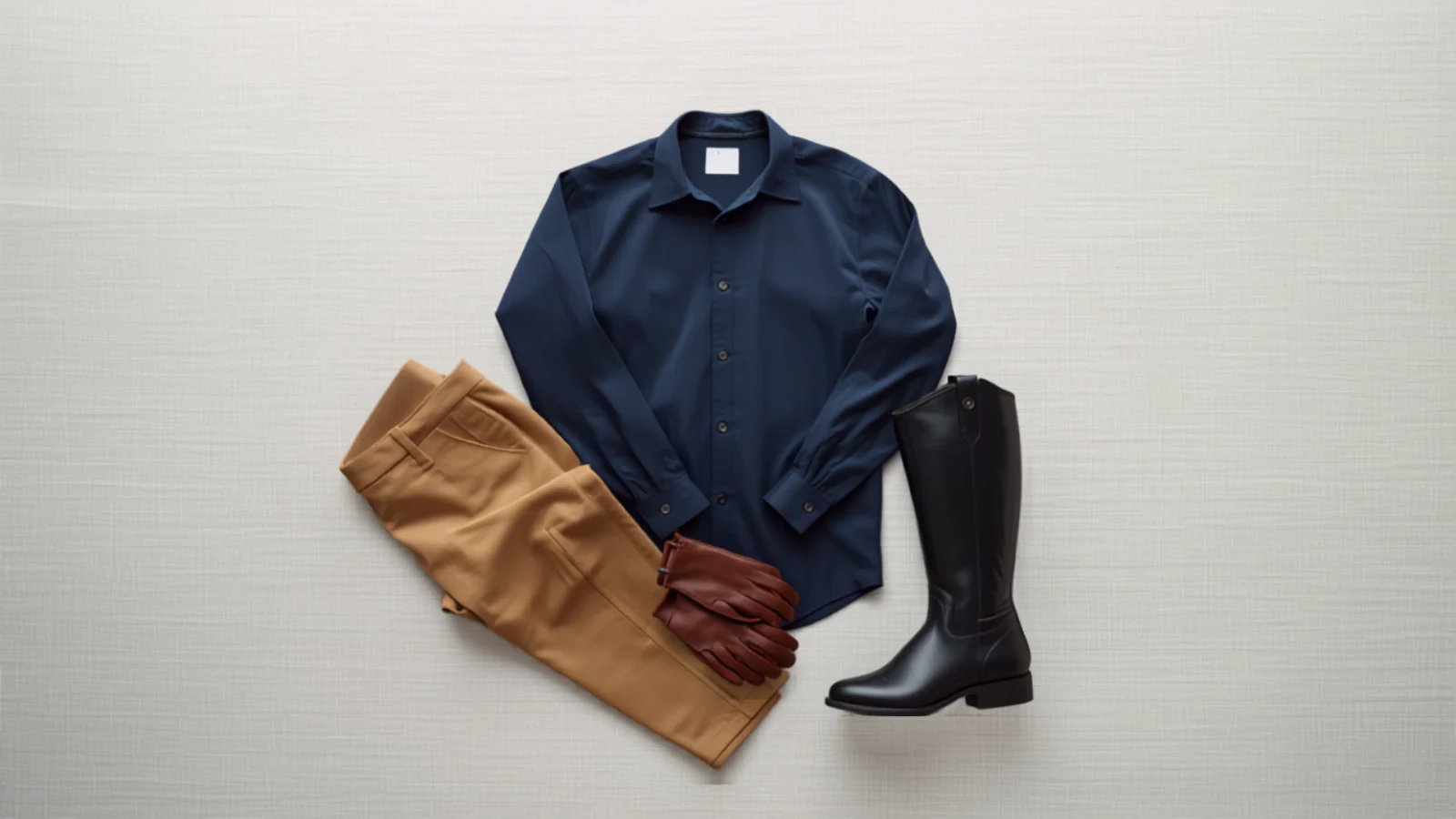
Breeches. Riding trousers, close-fitting, with either a knee patch or a full seat of grippy material. Full length, worn with tall boots or with half chaps.
Jodhpurs. In the US these are the ankle-length version worn by children in the show ring, with paddock boots and garter straps. In Britain the word covers everyday ankle-length riding trousers for anyone. Same word, different garment, depending which side of the Atlantic you’re standing on.
Tights. Modern stretch riding leggings, increasingly what people school in.
Paddock boots. Short ankle boots.
Tall boots. Knee-height. Field boots lace at the ankle; dress boots don’t and are the more formal of the two.
Show shirt. The collared competition shirt.
Show coat or hunt coat. The tailored jacket worn to compete.
Stock tie. The formal white neckwear worn with a shadbelly or in dressage.
Body protector. A padded vest. An air vest is the inflatable kind that deploys on a fall.
Most of this is what riders outgrow or replace long before it wears out, which is what a resale marketplace exists for. If you’re building a first wardrobe, our guide to what to wear for a first riding lesson covers what you genuinely need on day one, and the breeches and jodhpurs listings show the full range from children’s sizes upward.
What Are the English Riding Disciplines?
Dressage. Precision flatwork, judged on accuracy and quality of movement. Piaffe is one of its advanced movements, a trot on the spot.
Show jumping. Jumping a course of coloured fences against the clock, with faults for knockdowns.
Hunter. Jumping judged on style and smoothness rather than speed.
Equitation. Jumping or flatwork where the rider is judged rather than the horse.
Eventing. Dressage, cross-country and show jumping combined over one competition.
Cross-country. Jumping fixed obstacles across open ground.
Gymkhana. Mounted games, usually for children, and usually the most fun anyone has at a show.
Those are the one-line definitions. For the longer version, with what each one asks of the horse and the rider, our guide to the types of horse riding covers all eighteen US Equestrian disciplines, Western included.
What Do the Barn and Arena Terms Mean?
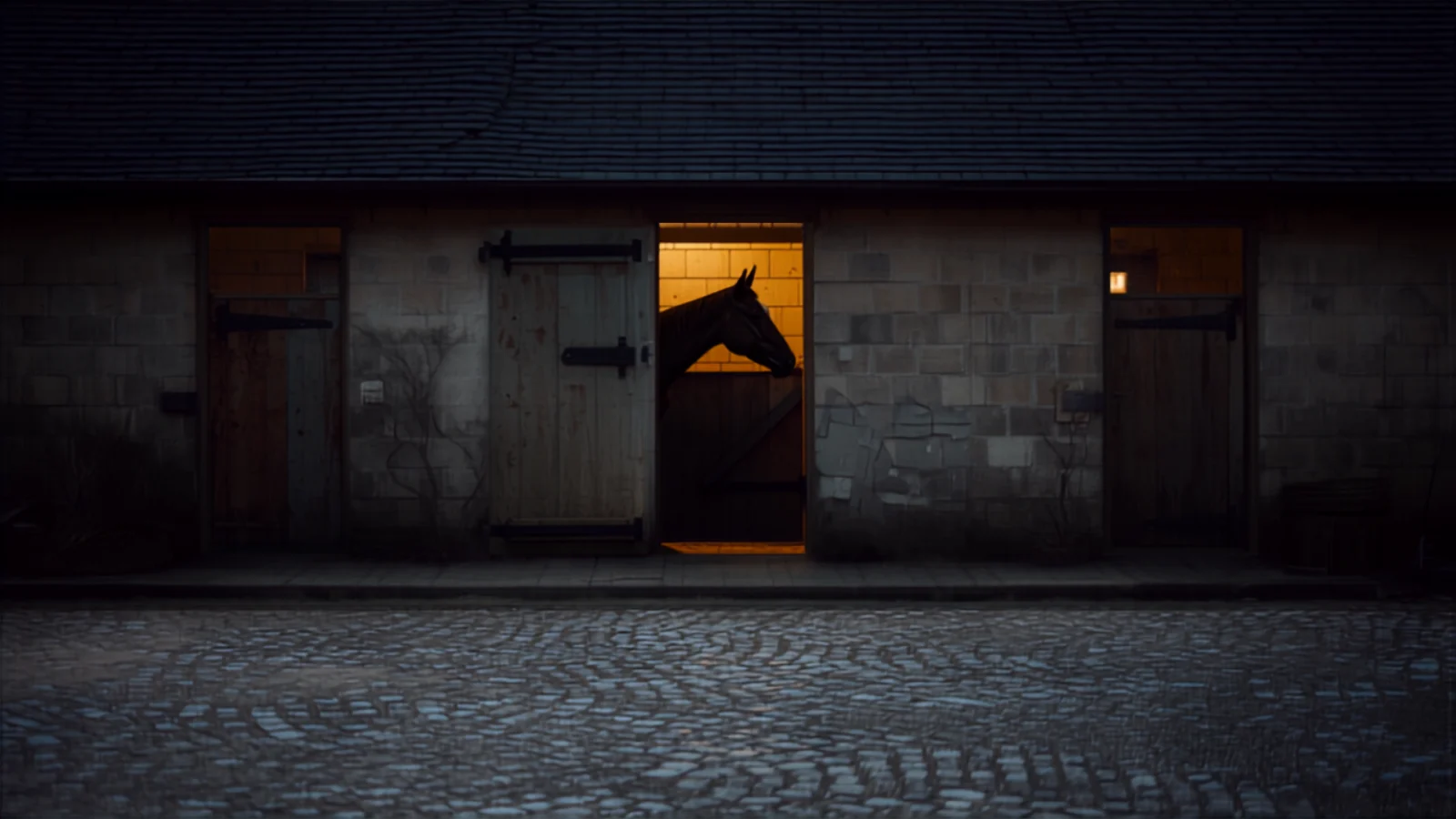
Arena or school. The enclosed area you ride in. An indoor is under cover; a manège is an outdoor school.
Paddock. A small fenced field.
Turnout. Time spent out in the field. “Has he been turned out?” means has he been outside today.
Stall or stable or box. Where a horse lives indoors.
Muck out. To clean the stall.
Tack room. Where equipment is kept.
Livery or boarding. Paying for a horse to be kept at someone else’s yard.
Farrier. The person who trims hooves and fits shoes, usually every six weeks or so.
Lunging. Working a horse in a circle on a long line, from the ground.
Hack. A ride out of the arena, on trails or roads. In the US you’re more likely to hear “trail ride”.
Why Do British and American Riders Use Different Words?
Because the sport developed in both countries and the vocabulary drifted. This catches beginners out constantly, because so much riding content online is British while so many riders are American, and nobody flags the switch.
| American | British |
|---|---|
| Arena | School or manège |
| Trail ride | Hack |
| Boarding | Livery |
| Stall | Box or stable |
| Blanket | Rug |
| Saddle pad | Numnah |
| Halter | Headcollar |
| Braiding | Plaiting |
| Posting trot | Rising trot |
| Barn | Yard |
| Jodhpurs (children’s show trousers) | Jodhpurs (everyday riding trousers) |
None of these are wrong. If you learn from British YouTube channels and ride at an American barn, you will simply be bilingual, which is no bad thing.
Frequently Asked Questions
A rider, or an equestrian. Equestrian is the broader word and covers anyone involved with horses, including owners and competitors who may not be riding that day. Horseman and horsewoman are older words still used, usually to describe someone with deep practical skill rather than simply someone who rides.
JOD-perz. The h is silent. Merriam-Webster gives it as ˈjäd-(ˌ)pərz. The word comes from Jodhpur in Rajasthan, where the style of riding trouser originated before it reached Britain in the 1890s.
Breeches are full-length riding trousers worn with tall boots or half chaps. In the United States jodhpurs are the ankle-length version worn by children in the show ring with paddock boots and garter straps. In Britain jodhpurs simply means everyday ankle-length riding trousers for riders of any age.
Tack is the collective term for a horse’s equipment: bridle, bit, reins, saddle, girth and so on. It works as a verb too. To tack up is to put the equipment on before riding, and to untack is to take it off afterwards.
Walk, trot, canter and gallop, in ascending order of speed. The walk has four beats, the trot two, the canter three and the gallop four. Some breeds have additional gaits of their own, such as the Icelandic tölt.
The left side as you sit on the horse. The right is the off side. Horses are traditionally led, mounted and handled from the near side, which is why instructors use these words instead of left and right.
Both are female. A filly is young and a mare is adult. The age at which one becomes the other depends on the context, with general usage tending toward four years and Thoroughbred racing using five, so treat any single figure as that source’s convention rather than a universal rule.
Where to Go From Here
You don’t need to memorise any of this. Vocabulary arrives on its own once you’re around horses regularly, and the fastest way through is simply to ask when you hear something unfamiliar. Every rider at that barn had to ask once, and most of them enjoy being asked.
Reequestrian is the US peer-to-peer marketplace where riders buy and sell English riding apparel and accessories directly. If you’re putting a first wardrobe together, have a look at what’s listed now, and if there’s outgrown kit in a cupboard at home, list it with us so it finds its next rider.


