


Buy a rider something that has to fit and you’re taking a gamble you can’t see the odds on. Buy them something that doesn’t, and you almost can’t lose. That’s the whole trick to gifts for horse lovers, and once you know it the rest of this is just detail.
The reason it works is that a rider’s world divides cleanly in two. There’s the fitted half, where helmets, boots and breeches are chosen through years of trial and quiet suffering, and there’s everything else. The fitted half is where well-meaning presents go to die in a tack trunk. Everything else is fair game, and it happens to be the half riders almost never spend money on for themselves.
The short version
- Safest bet: anything decorative. Jewelry, charms, bows, accessories. No size, no risk.
- Best value: an experience or a chunk of your own time. Costs you no product knowledge at all.
- Avoid: helmets, boots, breeches, saddles, gloves. All fitted, all personal, all easy to get wrong.
- If you’re stuck: ask. There’s a way to do it that doesn’t ruin the surprise, and it’s further down this page.
Start Here: What Do You Actually Know About Them?
Most gift guides sort by price. That’s the wrong first question, because your budget isn’t what’s stopping you. What’s stopping you is not knowing enough about a hobby you don’t share. So sort by that instead.
| What you know | What to buy |
|---|---|
| Almost nothing. You know they like horses | Decorative pieces, a book, an experience, or something for the barn rather than the rider |
| They ride, but you don’t know where or what | Jewelry, accessories, a gift toward lessons, anything for cold hands |
| You know their barn and their discipline | Anything in their barn colors, show-season practicalities, something for their horse |
| You know their sizes and their brands | You’ve earned the right to buy fitted kit. Most people haven’t |
If you’re in the top row, you’re in better shape than you think. The top row has the most options.
Do They Actually Ride, or Do They Love Horses?
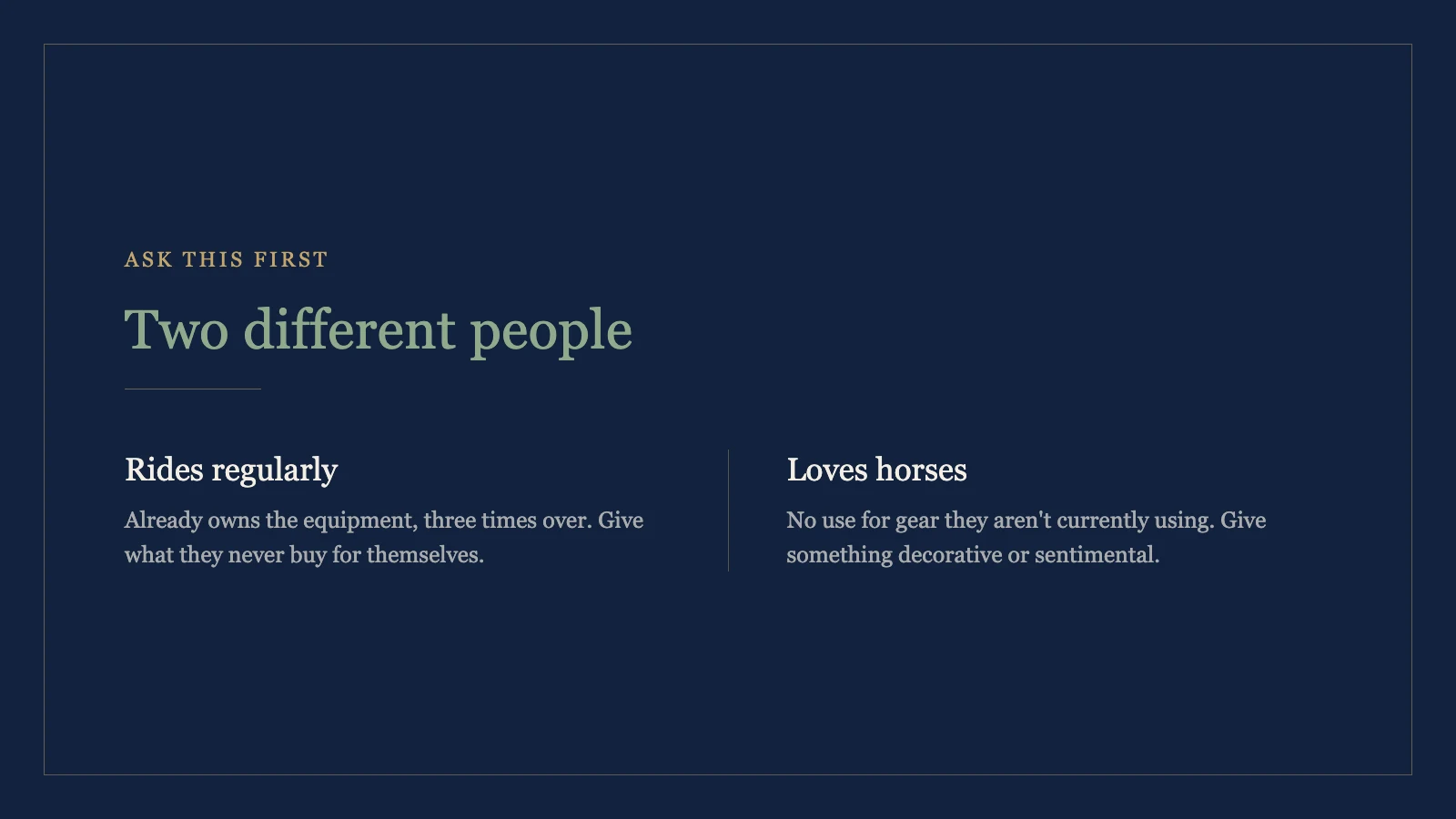
This is the distinction almost every gift guide misses, and it changes everything.
A great many people who love horses don’t ride, or don’t ride any more. They grew up at a barn, they follow the sport, they’d stop the car for a field of yearlings. Buying that person a pair of gloves is a small misfire, because you’ve given them equipment for a life they aren’t currently living. Buying them something horse-shaped and beautiful lands perfectly.
Riders are the reverse. They own the gear already, three times over, and what they lack is anything that isn’t practical. A rider will buy themselves a fifth hoof pick before they’ll buy themselves a necklace.
So the first question isn’t what to spend. It’s which of those two people you’re shopping for.
Which Gifts Can You Buy Without Knowing Anything?
Decorative pieces, and they work for both groups. Nothing here has a size, nothing needs a discipline, and nothing can be quietly returned in January.
Equestrian jewelry earns its place at the top of this list because of how it functions socially. The horse bit is the shared shorthand of English riding, so a bit bracelet or a bit motif necklace reads instantly to anyone who rides and passes as ordinary jewelry to everyone else. It’s a small private signal, wearable to an office, which is exactly why riders like it and exactly why they rarely think to buy it for themselves.
The pieces currently listed sit between $16 and $25, which makes the whole category unusually easy to shop. The Button Horse Bit Hoop Earrings and the Equestrian Symbols Bag Charm are $18. The Equestrian Linked Bracelet, the Linked Chain Horse Bit Bracelet and the Double Equestrian Chain Necklace in silver or gold are $20 each. The Glam Horse Bit Drop Necklace is $25. Bubble letter charms run $16, which is the simplest personalization there is when you know a name and nothing else about their wardrobe.
Hair bows are the other dependable choice and they’re more practical than they look from outside the sport. Anyone who shows keeps a rotation, they fray with use, and no one has ever complained about having spares. Seven patterns are listed at $40 each, two of which carry the same bit motif that runs through the jewelry, so they build into a set on purpose rather than by accident.
If you want the marketplace’s own name on it, the Reequestrian Signature Logo Hat comes in navy with a blue gingham bow or white with a green gingham bow, both at $75.
What Do You Buy Someone Who Owns a Horse?
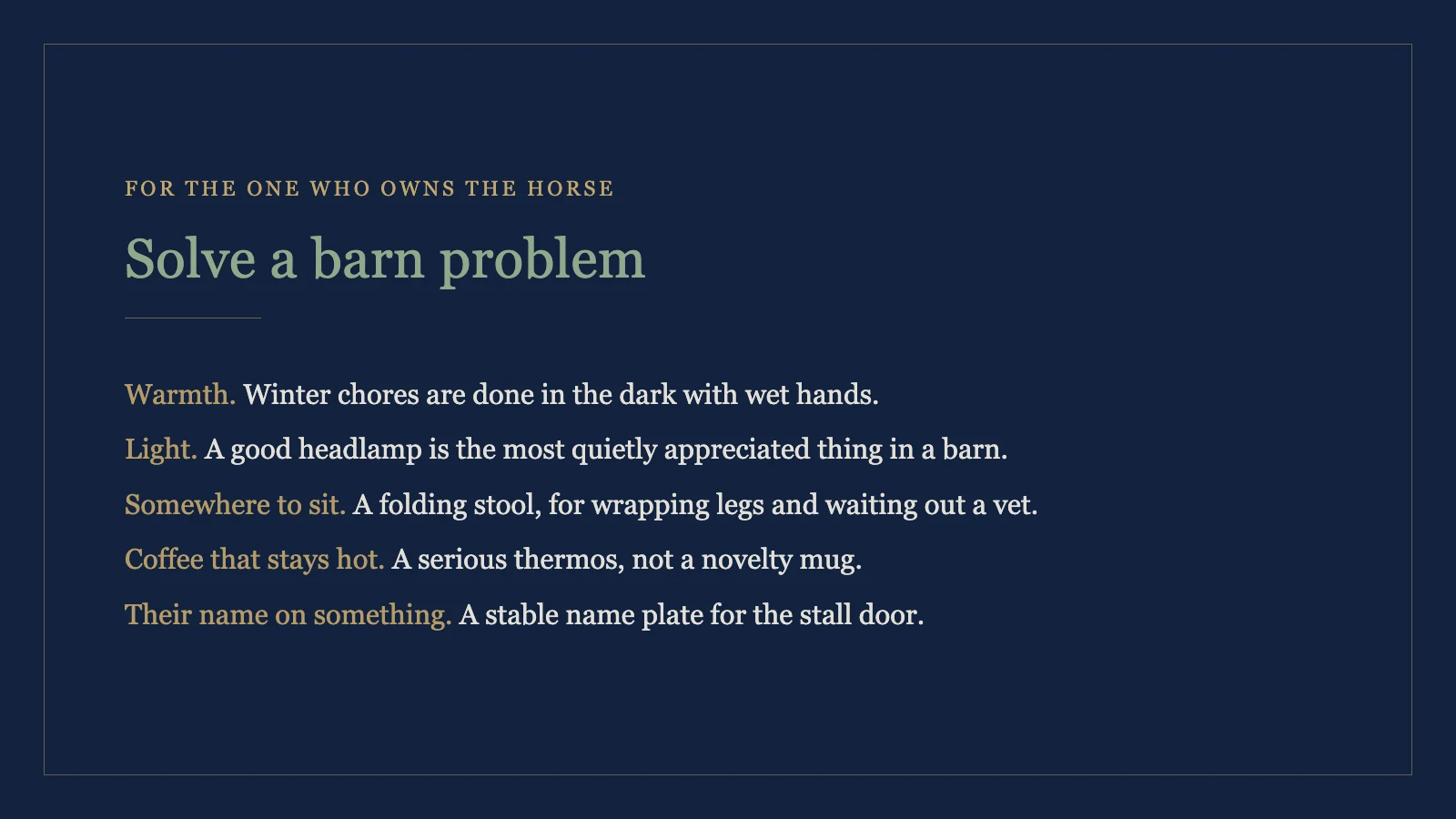
Something for the barn or something for the horse, because an owner’s problems are completely different from a rider’s.
People who lease or take lessons think about their kit. People who own think about mud, water buckets that freeze, hay that arrives on the wrong day, and a farrier who’s running late. Their pain points are logistical, and gifts that meet those points are remembered far longer than anything decorative.
The categories that work here need no product expertise from you at all:
- Warmth. Winter barn chores are done in the dark with wet hands. Anything that addresses that is welcome.
- Light. A good headlamp is the single most quietly appreciated object in a winter barn.
- Somewhere to sit. A folding stool, for wrapping legs, cleaning tack and waiting out a vet.
- Coffee that stays hot. A serious thermos, not a novelty mug.
- Storage. A bag for boots, a bag for helmets, anything that stops kit rolling loose in a car.
- Their name on something. A stable name plate for the stall door is inexpensive, permanent, and disproportionately loved.
None of that requires you to know a single measurement.
What Should You Buy for the Horse?
Treats, something for the horse’s head, or a service the owner has been putting off.
Buying for the horse is a strong move, because it tells the owner you understand where their affection actually sits. It also sidesteps human sizing entirely, though it introduces horse sizing, so stay in the categories where that doesn’t matter.
Safe ground includes treats, a stable name plate, an ear bonnet or browband in their barn colors, and grooming items that get used up. Riskier ground is anything fitted to the horse’s body, since a rug, a boot or a bridle has to fit an animal you’ve probably never measured.
The best version of this gift is usually a service rather than an object. Booking a session with a bodyworker, paying for a body clip before show season, or covering a farrier visit gives the owner something they genuinely need and would have felt guilty buying themselves. Check with them first, because horses have their own practitioners and owners are protective about who touches them.
What About Gifts for Men Who Ride?
The same rules apply, but almost no gift guide bothers to say so, which leaves men’s presents defaulting to a novelty mug year after year.
Men ride in the same disciplines, own the same horses and have the same cold hands in February. The decorative category is narrower in the sense that there’s less jewelry aimed at them, but everything else on this page transfers directly: the barn practicalities, the experiences, the gifts for the horse, the time-based gifts below. A stable name plate, a serious headlamp, a clinic entry or a bodywork session for the horse are all as good a gift for a man as for anyone else.
Where men’s gifts tend to go wrong is the same place everyone’s do. Fitted kit. Boots and breeches are no easier to guess for a man than for a woman.
What If You Want to Give an Experience Instead?
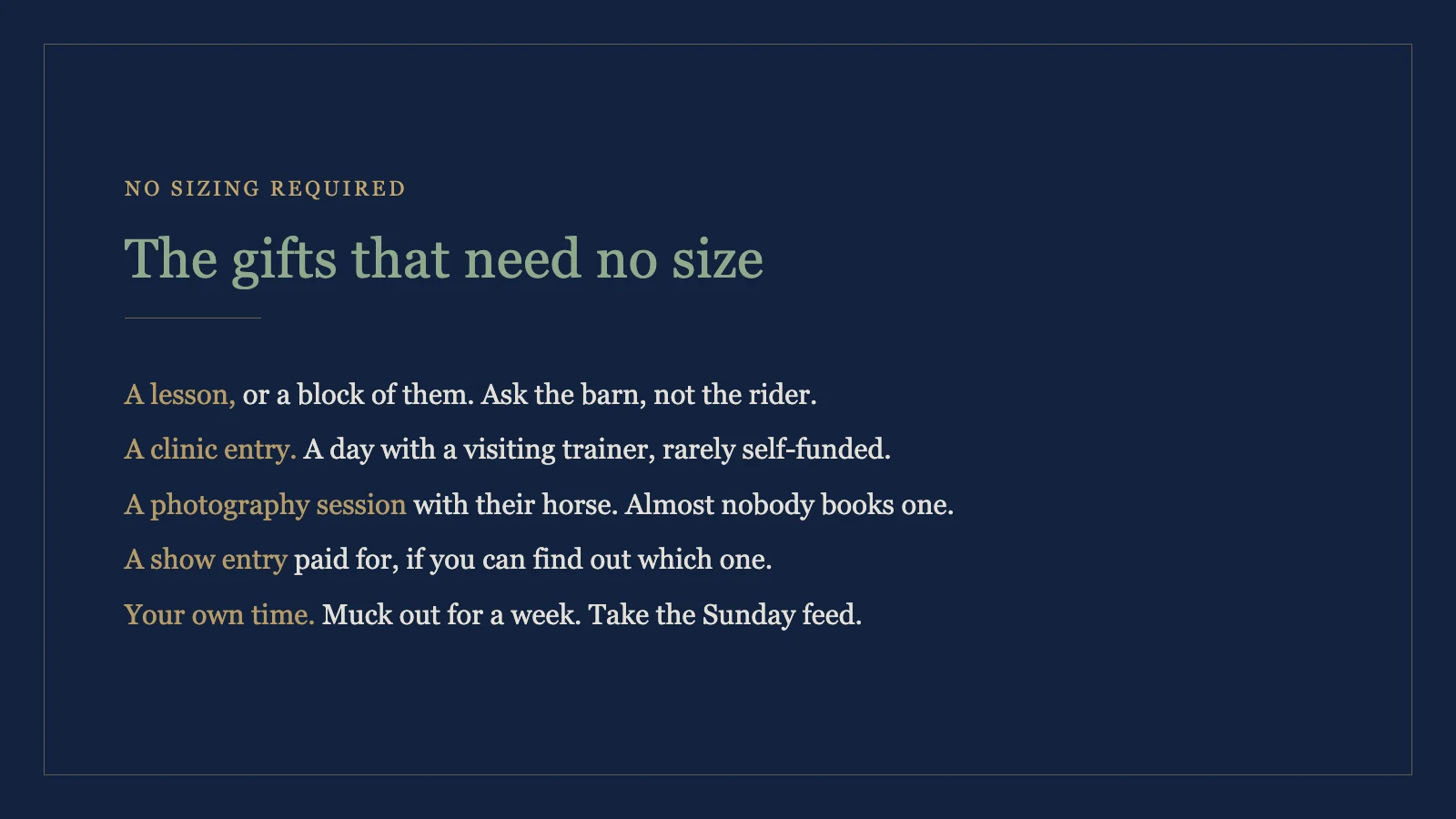
Then you’ve found the best category on this page, and you need no equestrian knowledge whatsoever to shop it.
Riders spend their money on the horse and their time on the horse, and the thing they most consistently want is more of both. Experiences deliver that directly:
- A lesson, or a block of them, with their own instructor. Ask the barn, not the rider.
- A clinic entry. A day with a visiting trainer is a genuine treat and rarely self-funded.
- A cross-country schooling day or an arena hire, depending on discipline.
- A photography session with their horse. This one has an emotional weight the others don’t. Horses have short careers and shorter lives, and almost every rider will eventually wish they had better photographs. Very few book them.
- A show entry paid for, if you can find out which one.
There’s a companion category that costs nothing at all, and riders rate it higher than most objects: your time. Offering to muck out for a week, drive the trailer, hold a horse for the vet, or take the early feed on a Sunday is a real gift to someone whose hobby has no days off. If you live with a rider, this is very likely the best present on this page.
Which Gifts Should You Leave to the Rider?
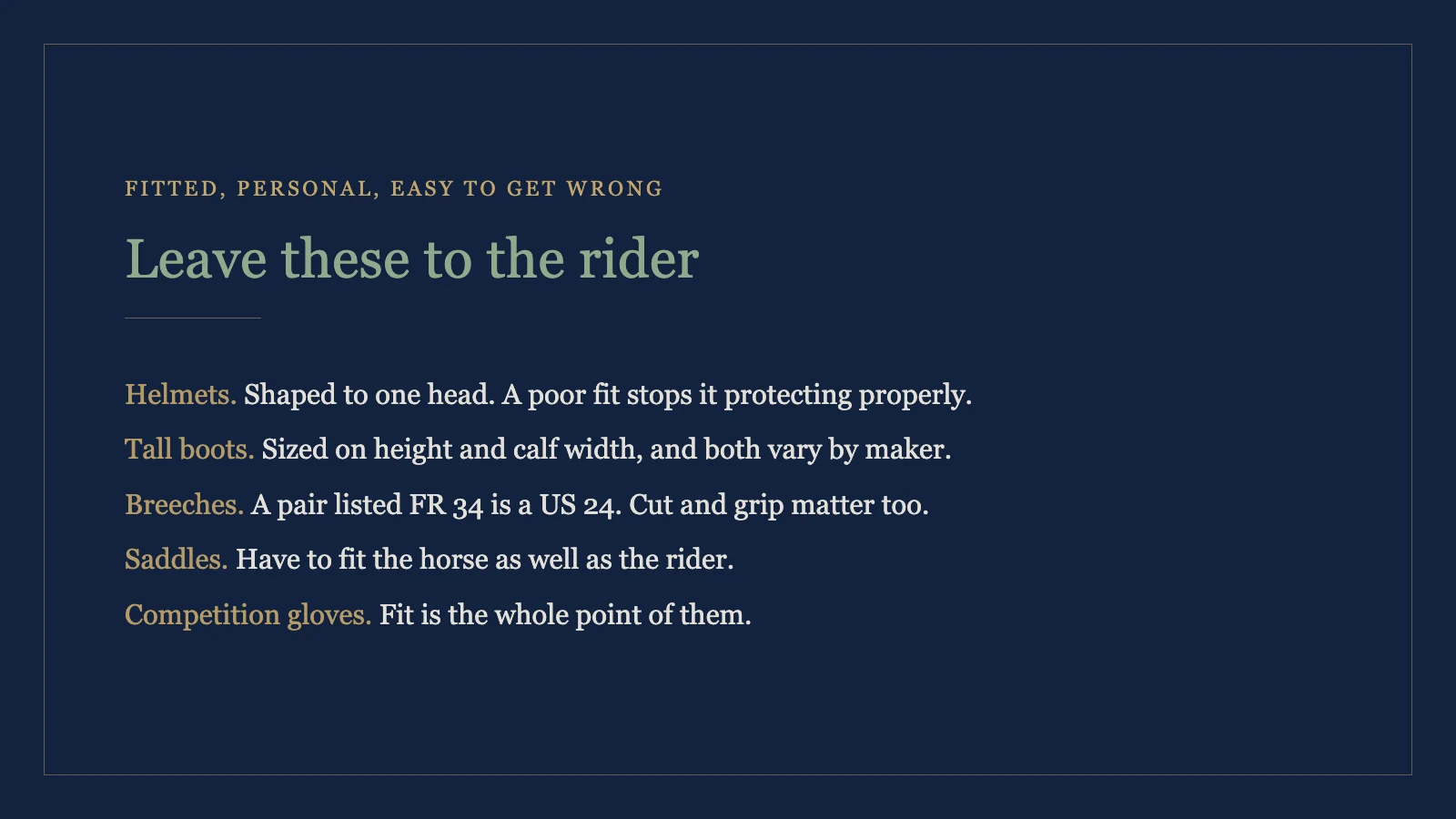
Helmets, boots, breeches, saddles, competition gloves and body protectors. All fitted, and the failure modes run from mildly disappointing to genuinely unsafe.
Helmets deserve singling out, because this is the most consistent advice riders give the people shopping for them. Manufacturers build their shells around different head shapes, so a helmet that sits perfectly on one rider will rock or pinch on the next at the identical nominal size, and a helmet that moves isn’t protecting anything. There’s an age and certification dimension too that a gift-buyer has no way to assess from the outside.
Breeches are the other reliable trap, and the sizing alone explains why. English brands often run on a European scale, so a pair listed as FR 34 is a US 24, a conversion nobody carries around in their head. Then there’s cut and grip: knee patch and full seat suit different disciplines and different riders, and the grip material matters as much as the number on the label.
Saddles are the same problem at ten times the cost, since a saddle has to fit the horse as well as the rider, and horses change shape with work, age and season.
None of this makes them bad presents. It makes them presents the rider has to be there for, and saying so out loud turns a gamble into an afternoon out together, which most riders would prefer anyway.
The whole thing on one page
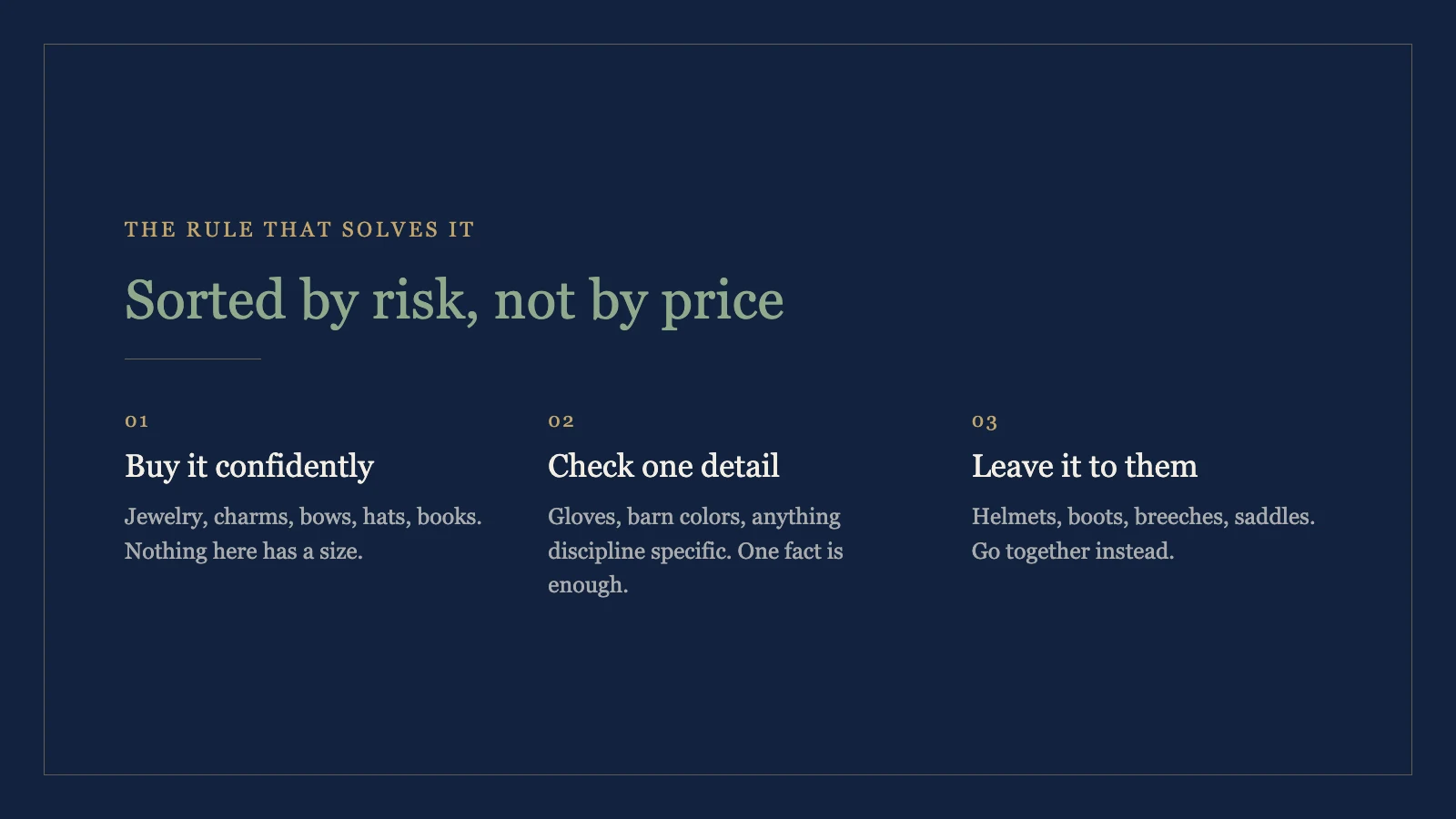
| Risk | What it covers | What you need to know | Where to find it |
|---|---|---|---|
| Buy it confidently | Jewelry, charms, bows, hats, books, stable name plates | Nothing | $16 to $75 in the accessories and jewelry categories |
| Nearly free of risk | Experiences, lessons, clinics, photography, your own time | Which barn they ride at | Ask the barn, not the rider |
| Check one detail | Gloves, barn-color items, anything discipline specific | Hand size, English or Western, their colors | A photo usually answers it |
| Leave it to them | Helmets, boots, breeches, saddles, body protectors | More than you can find out | Go together |
What Do You Buy a Child Who Rides?
Buy pre-owned, and buy the size they are now rather than the size you’re hoping for by spring.
Children outgrow riding kit long before they wear it out, which is the single clearest case in the whole sport for buying second season. The economics are simply different: a pair of breeches with two seasons of use left in them is hard to justify at full price and easy to justify at resale. On the breeches and jodhpurs page there are pull-on jodhpurs at $10 and kids’ breeches at $20, against adult pairs from Equiline and Dada Sport at $180 to $200.
You still need a current size, so this isn’t a gift you can pull off entirely alone. Ask the parent. Parents of riding children are invariably pleased to be asked, because the alternative they’re steeling themselves for is another full-price pair outgrown before the spring shows.
How Do You Ask Without Ruining the Surprise?
You ask someone else, or you ask a question one level away from the gift.
This is the part nobody writes down, and it’s the reason so many people give up and buy a gift card. There are three reliable routes:
- Ask their instructor or barn manager. They know exactly what’s worn out, what’s on the wish list and what the rider has been complaining about for six months. They’re also used to the question and won’t mention it.
- Ask a barn friend. Riders talk to each other about gear constantly. Someone at that yard knows.
- Ask the rider a sideways question. “What’s the thing you keep meaning to replace?” or “What would you buy if someone gave you a hundred dollars for the horse?” gets you an honest answer without signalling anything, because riders answer that question happily at any time of year.
And if all three fail, ask them directly. It’s worth saying plainly: riders would rather receive the right thing than be surprised by the wrong one, and most will tell you so. A present they actually wanted, bought openly, beats a beautifully wrapped mistake.
When Are You Buying, and Does It Change the Answer?
Yes, more than you’d expect, because the equestrian year has a shape.
Before show season is when practical gifts land best. Entries, a clinic, a body clip, anything in barn colors. The rider is spending heavily and any of it lifts the load.
Deep winter is when comfort wins. Cold hands, dark yards, frozen buckets. Warmth and light are worth more in January than anything decorative.
End of season suits the reflective gifts. Photography, a framed print, something that marks the year.
After a bad fall, or after losing a horse, step away from equipment entirely. A rider who’s just had a serious fall doesn’t want new kit, and someone who’s lost a horse doesn’t want anything that assumes a next one. Something quiet and personal, or simply your time, is the right answer. Getting this wrong is far worse than getting a size wrong, and no gift guide ever mentions it.
What Can You Spend, and What Does It Get You?
Because people do still shop by budget, here’s the same advice sorted that way.
| Budget | What it buys |
|---|---|
| Under $25 | Any piece of equestrian jewelry currently listed. Charms at $16, bag charm or hoop earrings at $18, bracelets and chain necklaces at $20, drop necklace at $25. Also treats, a stable name plate, a book |
| $25 to $75 | A $40 hair bow, or two for around $80. The $75 signature logo hat. A single lesson. A grooming session |
| $75 to $200 | A block of lessons, a clinic entry, a photography session, or a genuinely good pre-owned item in a category you’re confident about |
| Over $200 | Fitted equipment, which means the rider comes with you. Or several of the above, which is usually the better gift |
Two smaller things that are right beat one larger thing that’s nearly right. That holds at every level.
Why Does Pre-Owned Buy a Better Gift?
Because riding kit outlasts the rider’s need for it, so a fixed budget reaches a better brand second season than it does new.
The gear is built to survive years of daily work in a barn, and yet it routinely leaves its first owner after a season or two when they change size, change discipline or stop competing. That gap between how long something lasts and how long one person uses it is the entire reason a resale market exists. In gift terms it moves the ceiling: money that would buy an entry-level item new instead buys something considerably better that’s barely been ridden in.
Two things stop this being a compromise rather than an upgrade. Listings carry condition ratings running from New With Tags through Excellent, Good and Well-Loved, so you can filter to the top of the scale and give something indistinguishable from new. And in children’s categories, where things are outgrown rather than worn out, second season isn’t the thrifty option so much as the obvious one.
If giving something pre-owned still feels awkward, filter to New With Tags and the discomfort disappears along with the price.
Frequently Asked Questions
Something without a size. Jewelry, charms, hair bows and accessories all work, because they can’t fit wrongly and they belong to the part of the wardrobe riders neglect on their own behalf. Experiences are just as strong: a lesson, a clinic or a photography session with their horse needs no product knowledge from you at all.
Lean decorative and sentimental rather than practical. Someone who loves horses without currently riding has no use for equipment, so jewelry, art, books and anything horse-shaped and beautiful lands far better than gear for a life they aren’t living.
It’s the one item most riders will tell you to avoid. Helmets are fitted to an individual head, brands are shaped differently, and a helmet at the correct nominal size can still sit badly, which undermines the protection it exists to provide. If you want to give one, go together so it can be fitted properly.
Give time or an experience, because those are the two things no amount of buying accumulates. Mucking out for a week, driving to a show, a clinic entry or a photography session all land with someone whose tack room is already full.
There’s no rule, but the bands are useful. Under $25 covers charms, earrings and bracelets. Between $25 and $75 covers hair bows, hats and a single lesson. Above $75 you’re into lesson blocks, clinics and experiences. Anything fitted needs the rider present regardless of budget.
Yes, and riders often prefer them, because the same money reaches a better brand. Riding kit outlasts its first owner’s need for it, so much of what returns to the market has barely been worn. Filter to New With Tags or Excellent condition for something indistinguishable from new.
Anything fitted they haven’t chosen, which means helmets, boots, breeches, competition gloves and saddles. Skip consumables too, since hoof picks, brushes and fly spray are exactly what riders restock themselves and already own several of. And avoid equipment entirely if they’ve recently had a bad fall or lost a horse.
The Takeaway
The awkward thing about gifts for horse lovers is that the obvious presents are the risky ones and the safe ones don’t look like presents at first glance. Work backwards from fit and it resolves quickly. Anything decorative can’t be wrong. Anything experiential can’t be wrong. Anything for the barn or for the horse can’t be wrong. That leaves a very large field, and almost all of it is territory the rider never shops for themselves.
If the budget stretches, spend it on something better rather than something bigger. Riding kit is made to last far longer than one rider needs it, which is exactly why so much of it goes round to a second and third owner still in excellent condition, and why a gift budget goes further here than it does at full retail.
Reequestrian is the US peer-to-peer marketplace where riders buy and sell English apparel and accessories directly. Have a look at what’s listed now, or if there’s a wardrobe of outgrown kit at home, list it with us and let it find its next rider.


