


Most lists of exercises for equestrians are a gym routine with a horse photo on top, and most rider fitness advice never says what a given exercise is for. This one starts from the two questions that decide whether off-horse training is worth a rider’s time: what does riding actually ask of the body, and is there evidence that training it off the horse changes anything in the saddle? The answer to the second is yes, and the study that shows it also tells you how much work it takes, which is where the plan at the end comes from.
Why equestrians should exercise off the horse: what the studies found
Core training changed how riders sat, and the horse felt it. In a study by Hampson and Randle, ten dressage horse-and-rider pairs were measured with an electronic saddle pressure mat at sitting trot, then the riders did an unmounted, sport-specific core program for eight weeks, 20 minutes a session, three sessions a week, and were measured again. After the program the left-to-right difference in pressure on the horse’s back fell significantly (the riders sat more symmetrically) and the horses’ mean stride length increased by 8.4 percent. The authors concluded that a rider core program “can have a significant effect on rider symmetry” and reduce asymmetrical loading on the horse (Hampson and Randle, International Journal of Performance Analysis in Sport, 2015).
That is the study to remember. Twenty minutes, three times a week, eight weeks, and a measurable change under the saddle.
Better riders are more stable, not stronger in the arms. A 2023 study in the Journal of Equine Veterinary Science put ten expert and twelve novice competitive dressage riders through a physiotherapy screening and a riding simulator test. The experts showed less variability in left and right rein force and a trend toward “a more stable posture on the simulator as indicated by the reduced trunk variability.” The conclusion: the ability to hold a constant rein contact and a “dynamically stable hand position” are markers of good riding, and both come from the trunk, not the hands (Heidbuchel et al., JEVS, 2023).
Fitness predicts riding performance. Penn State Extension’s equine specialists summarise a further study this way: “endurance, reaction, and strength were all positively associated with riding performance; in other words, the riders who had more endurance and strength performed better in a riding test.” Their own recommendation is five exercises at three sets of eight to twelve (Penn State Extension, updated August 2026).
So the case for workouts for equestrian riders is not “fit riders look better.” It is that a rider’s asymmetry loads the horse’s back unevenly, that off-horse core work reduces it in eight weeks, and that trunk stability is what separates expert hands from novice ones.
What riding actually asks of the body
Before the exercises, the demands, because the exercises are chosen to match them.
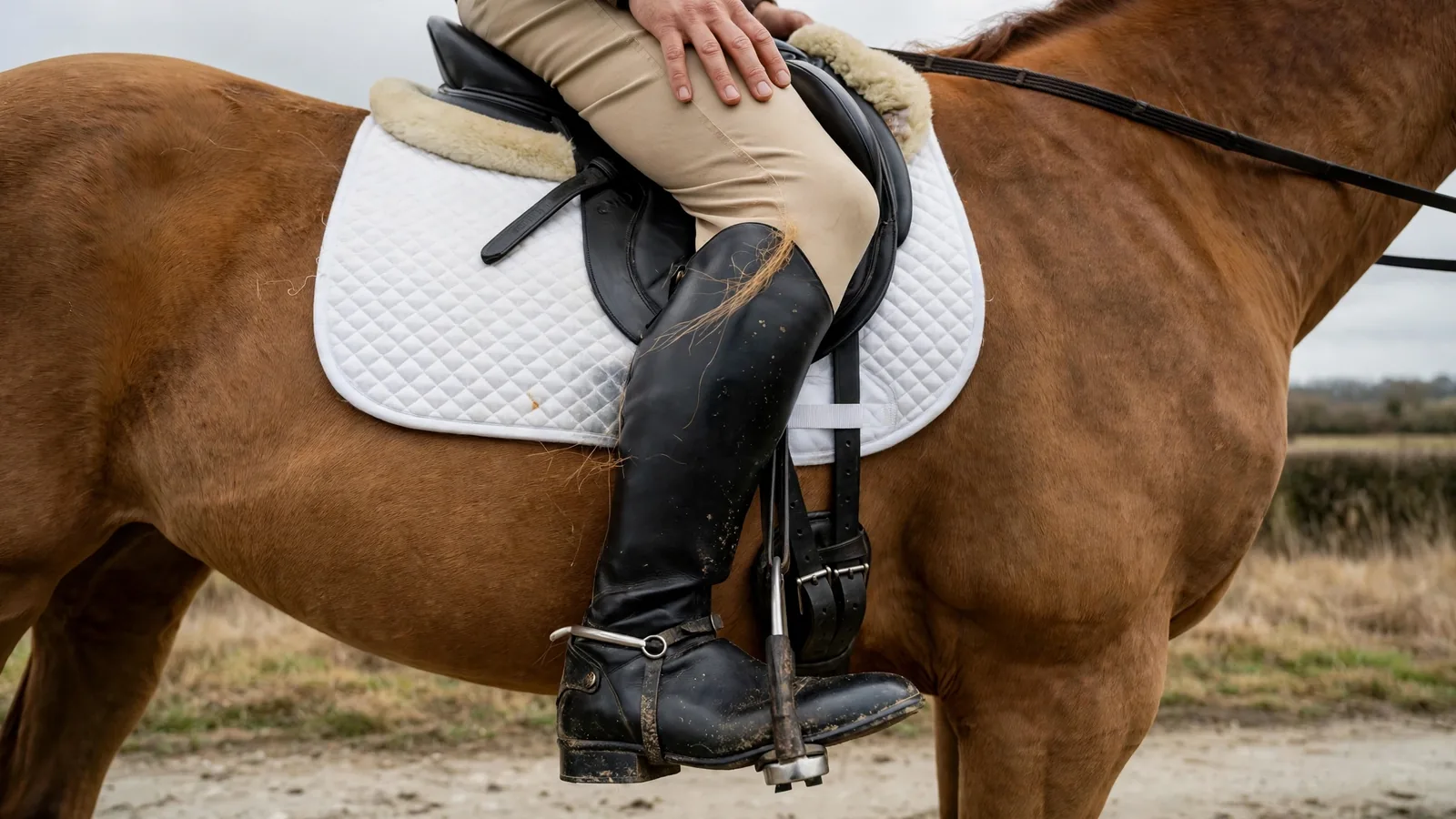
| Riding demand | What it needs | Where riders feel the gap |
|---|---|---|
| Sitting still at trot and canter | Anti-rotation and anti-extension core strength: the ability to stop the pelvis being thrown by the horse | Bouncing at sitting trot, hollowing the back, hands that move with the body |
| Heels down, leg still | Calf and hamstring length, glute strength to keep the leg under the hip | Heels that creep up, lower leg swinging, gripping with the knee |
| Independent hands | Upper back (rhomboids, lower traps) and shoulder stability so the arm can absorb the horse’s motion | Rein contact that jerks, elbows locked, shoulders rounded |
| Half-halts and transitions | Hip adductors and abductors, and the ability to close the leg without gripping | Leaning to one side, one stirrup always feeling longer |
| Two-point and jumping | Quad and glute endurance, ankle mobility | Collapsing on landing, standing in the stirrups, tipping forward |
| Symmetry | Equal strength left and right in hips and trunk | The horse drifting one way, one diagonal always harder, a crooked halt |
Most riders are strong on one side and do not know it. The single-leg tests below find out which.
Two tests to do before you start
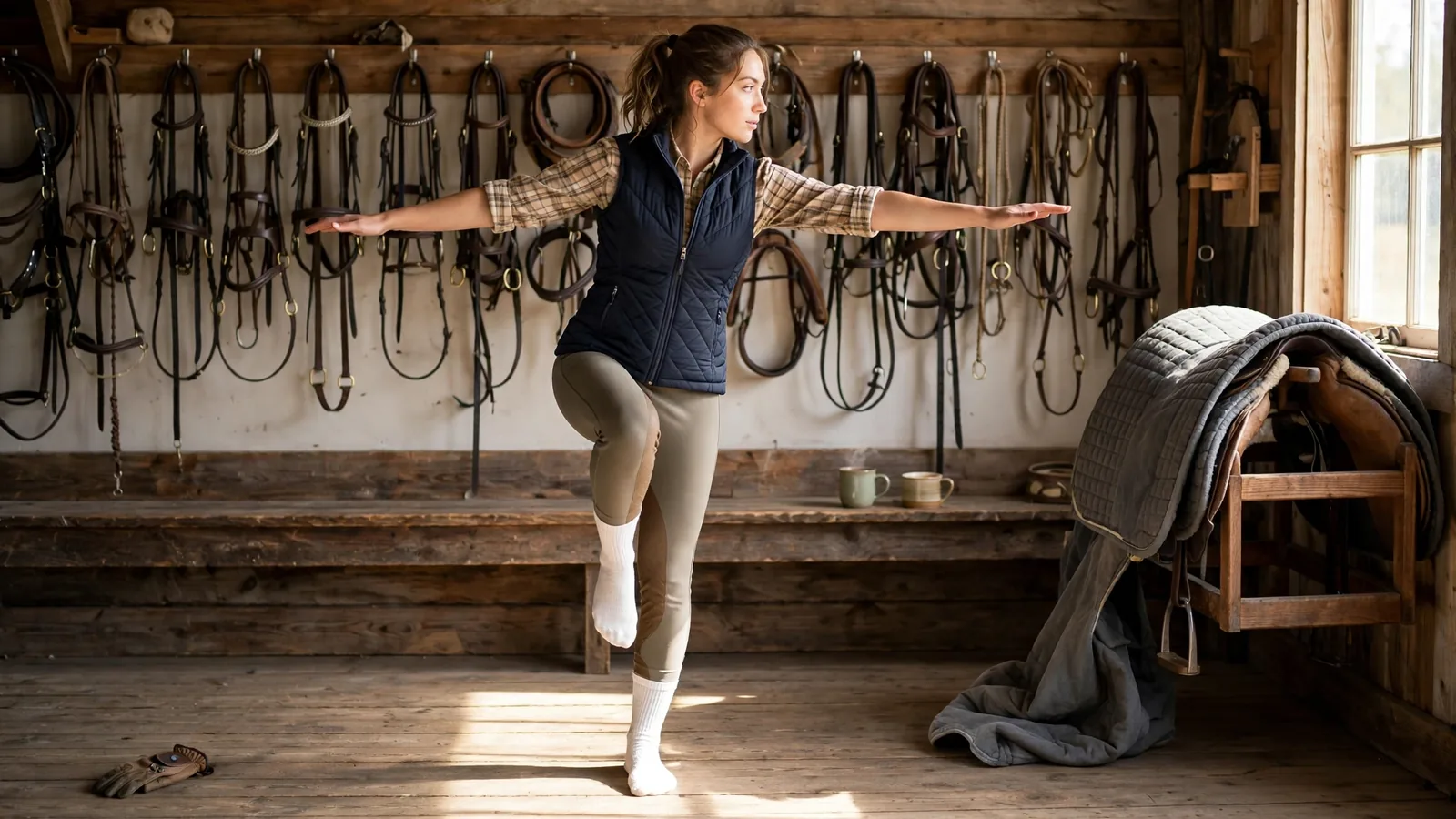
Single-leg balance. Stand on one leg, eyes open, arms at your sides, for 30 seconds. Then the other. If one side wobbles, drifts or fails early, that is the weak hip, and it is almost always the side the horse drifts toward.
Side plank hold. On the forearm, feet stacked, hips lifted, hold as long as form lasts. Time each side. A difference of more than 15 percent between sides is the asymmetry Hampson and Randle’s riders trained away.
Write the numbers down. Repeat both tests at week four and week eight.
The 12 exercises for equestrian riders
These exercises for equestrians each name the riding fault they address, because that is the only reason to do one. Sets and reps are for a rider training three times a week; beginners do the lower number.
Core: sitting still
1. Dead bug. Lie on your back, arms up, knees over hips. Lower opposite arm and leg slowly, keeping the lower back pressed into the floor, and return. 3 sets of 8 to 12 each side.
Riding fault it fixes: the hollow back and tipped pelvis at sitting trot. This is anti-extension, the exact muscle job of absorbing the trot without bouncing.
2. Bird dog. On hands and knees, extend opposite arm and leg, hold two seconds, return without letting the hips rotate. 3 sets of 8 to 10 each side.
Fixes: the twist through the trunk on a circle, and the shoulder that drops on one rein.
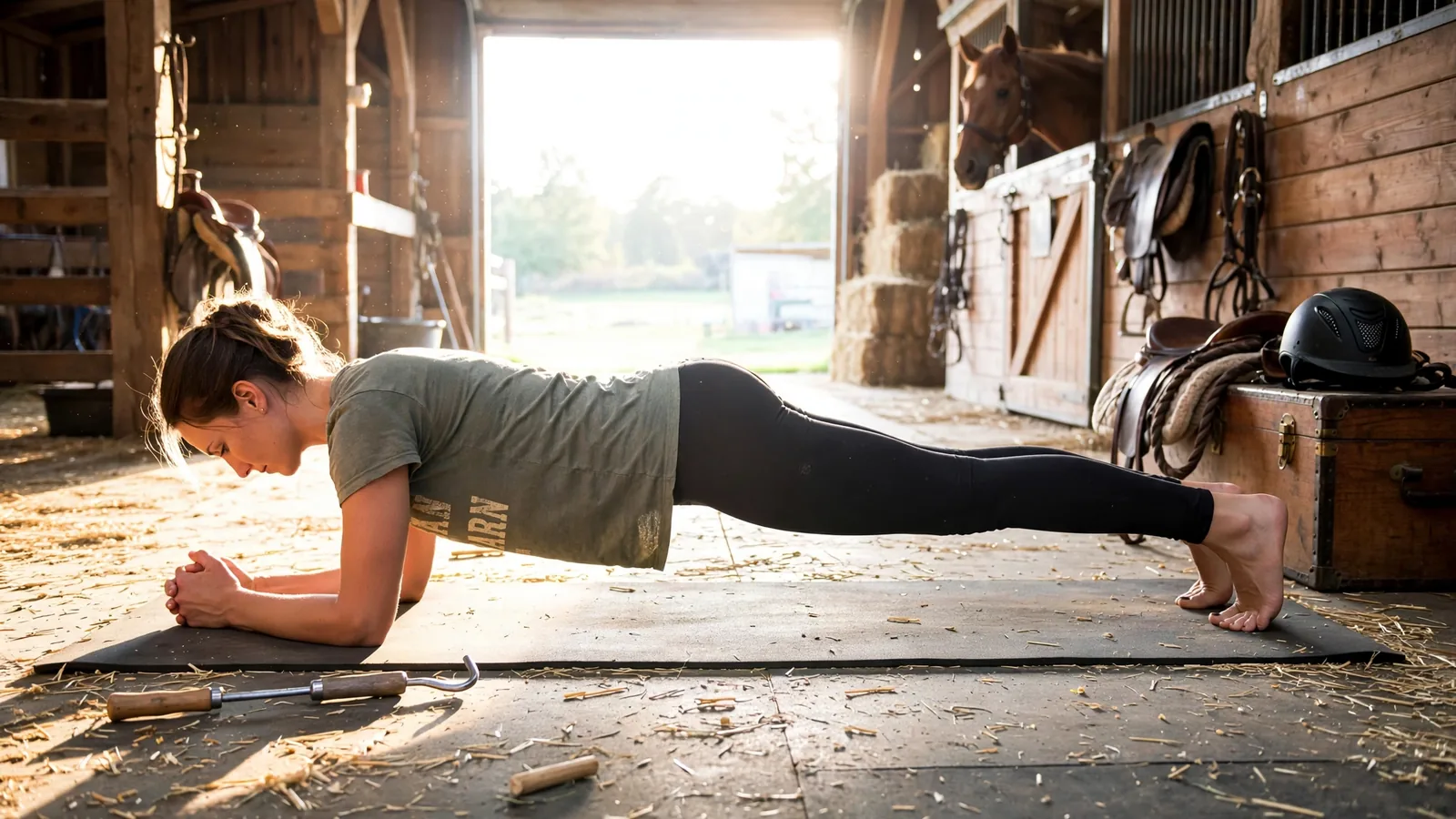
3. Side plank. Forearm and feet, hips lifted, body in one line. Hold 20 to 45 seconds each side; work the weaker side first and match it.
Fixes: leaning, collapsing a hip, one stirrup “longer” than the other. This is the direct training for the asymmetry the pressure-mat study measured.
4. Pallof press. Stand side-on to a band anchored at chest height, press the band straight out and hold three seconds against the pull, return. 3 sets of 10 each side.
Fixes: being pulled off the center line by a strong horse; the core job of a half-halt.
Hips and legs: heels down, leg still
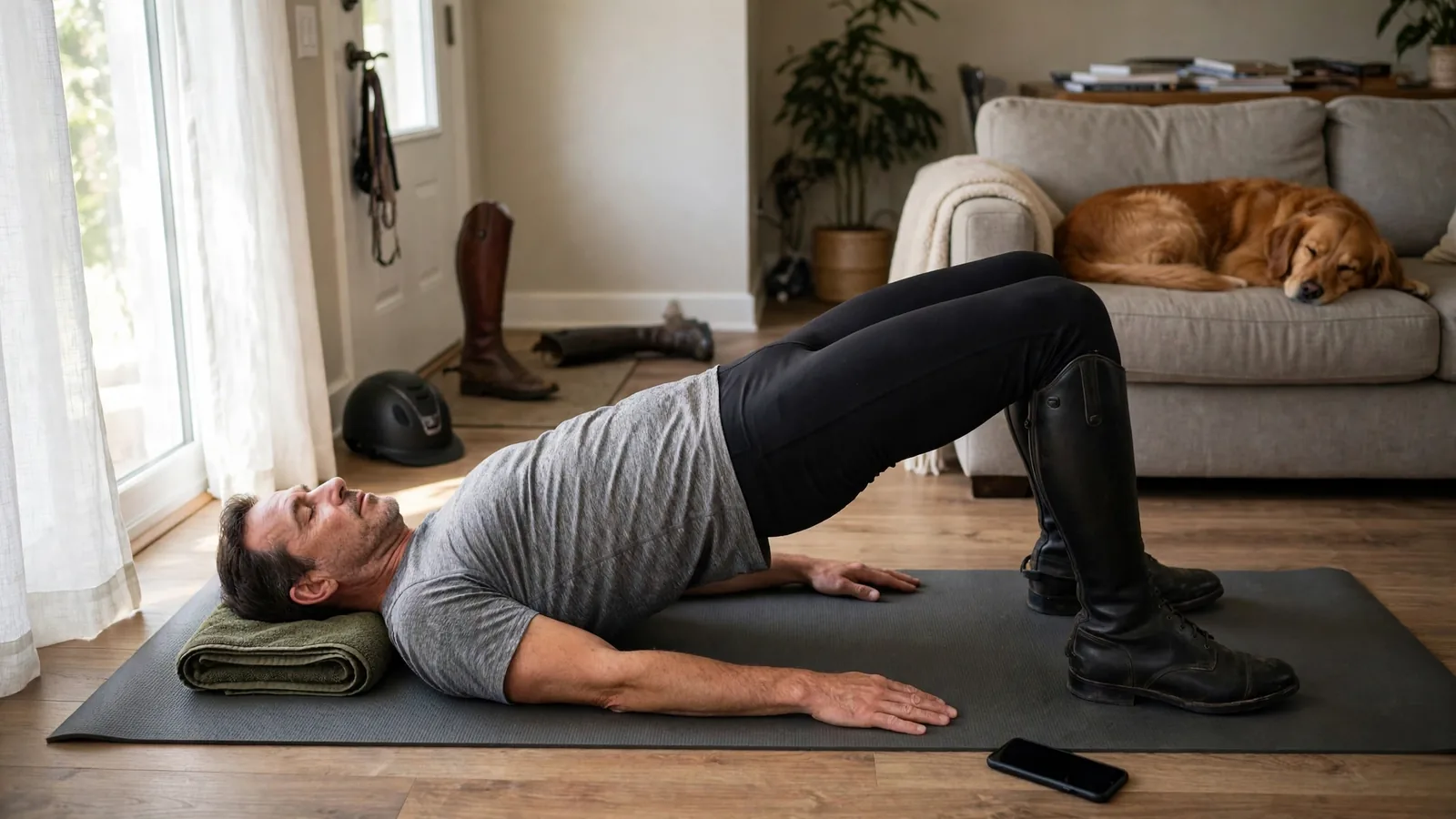
5. Glute bridge, then single-leg bridge. Lie on your back, feet flat, drive the hips up, squeeze at the top. 3 sets of 12; progress to one leg, 3 sets of 8 each.
Fixes: the leg that swings back, the seat that cannot sit into a downward transition.
6. Single-leg Romanian deadlift. Stand on one leg, hinge forward from the hip with a flat back until the trunk is near parallel, return. Bodyweight, then a light dumbbell. 3 sets of 8 each side.
Fixes: hamstring length for heels down, hip stability for a still lower leg, and it exposes the weak side within a rep.
7. Cossack squat. Feet wide, sit down toward one heel with the other leg straight, return through the middle, other side. 3 sets of 6 to 8 each side.
Fixes: the adductor length and strength that lets the leg drape around the horse instead of gripping. Riders who cannot get low in this are the riders whose knees pinch.
8. Split squat. One foot forward, one back, lower the back knee toward the floor, drive up. 3 sets of 8 to 10 each side.
Fixes: two-point endurance and the collapse on landing after a fence.
9. Calf raise with a slow lower. On a step, rise on both feet, lower on one over four seconds, heel below the step. 3 sets of 10 each side.
Fixes: heels that come up. Strength through the full range is what holds the heel down under a horse that pulls, and the slow lower is the part that matters.
Upper back and shoulders: independent hands
10. Band pull-apart. Hold a light band at shoulder height, arms straight, pull it apart until it touches the chest, control it back. 3 sets of 15.
Fixes: rounded shoulders and hands that cannot follow the horse’s neck because the upper back is doing nothing.
11. Bent-over row (dumbbell or band). Hinge at the hip, flat back, row to the ribs with the elbow close. 3 sets of 10.
Fixes: the ability to hold a contact from the back rather than the fingers, which is the difference the simulator study measured in rein-force variability.
12. Farmer’s carry. Pick up two heavy objects, walk 30 to 40 meters tall and level, put them down. 3 carries.
Fixes: grip endurance for the last five minutes of a lesson, and it is the best symmetry teacher on the list: a heavy carry will not let you lean.
The 8-week workout plan for equestrian riders
The plan copies the dose that produced a measurable result: three sessions a week, about 20 minutes each, for eight weeks. Do it on non-riding days or after riding, not before a lesson.
| Session A (core and hips) | Session B (legs and back) | Session C (symmetry) | |
|---|---|---|---|
| Weeks 1 to 2 | Dead bug, bird dog, glute bridge, band pull-apart | Split squat, calf raise, bent-over row, side plank | Single-leg RDL, Cossack squat, Pallof press, farmer’s carry |
| Weeks 3 to 5 | Same exercises; add a set, or add load to bridge and row | Progress bridge to single-leg; slow the calf lowers to five seconds | Weak side first on every single-side move; match reps |
| Weeks 6 to 8 | Hold each dead bug and bird dog rep for three seconds | Add a dumbbell to the split squat and RDL | Retest the two symmetry tests in week 8 |
Five minutes of walking and leg swings before each session; the hip flexor and calf stretches below after.
If three sessions is not realistic, two is not nothing, but the study that showed the change used three. Under that, expect to feel stronger and not to see the symmetry shift.
Stretches for horse riders that are actually worth the time
Riders are short in three places and long stretches in the wrong ones waste the time.
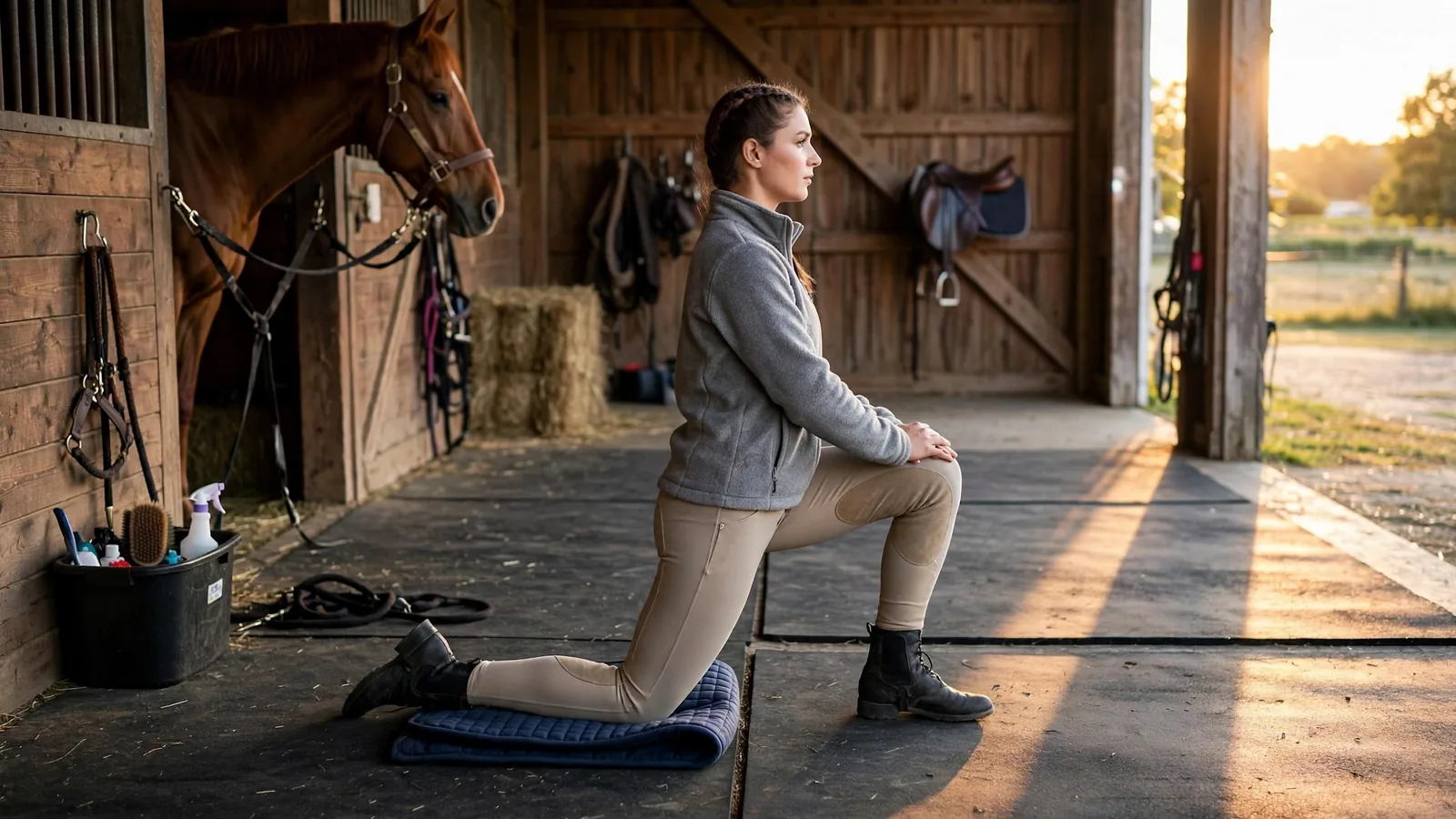
- Hip flexors. Half-kneeling, squeeze the back-leg glute, shift forward until the front of the hip stretches. 45 seconds each side. This is the stretch for the rider who cannot sit deep.
- Calves. Heel off a step, straight knee then bent knee, 45 seconds each. For heels down.
- Adductors. Wide-kneeling, sit back toward the heels with knees wide. 45 seconds. For the leg that grips.
- Thoracic rotation. On all fours, one hand behind the head, rotate the elbow toward the ceiling. 10 slow reps each side. For the shoulder that drops on one rein.
Skip static hamstring stretching before riding; it reduces the stiffness you need for a stable leg. Do it after.
What to leave out
Crunches and sit-ups. They train the trunk to flex, which is the opposite of what sitting trot asks (anti-extension and anti-rotation). Every core exercise above holds a neutral spine against a force, which is the job in the saddle.
Heavy inner-thigh machines. Adductor strength matters, but not the gripping kind. The Cossack squat trains the adductors long, which is the position the leg is in on the horse.
Running as the only fitness. Endurance helps (the Penn State summary says so), but running builds none of the symmetry or anti-rotation work. Add it, do not substitute it.
Adjusting the exercises for horse riders of different ages and levels
Children and teenagers. Bodyweight only, half the sets, and the symmetry tests are more useful than the exercises: a growing rider’s asymmetry changes every few months. Position is judged directly in equitation, and the hunter jumper attire guide explains what the judge is looking at, most of which is the trunk stability this plan builds.
Adults returning to riding. Start at two sessions, and expect the Cossack squat and single-leg RDL to be humbling. They are the two that give the fastest return in the saddle.
Riders who only ride once a week. This plan is worth more to you than to anyone. A once-a-week rider does not get enough saddle time to build the trunk in the saddle; three 20-minute sessions is where it happens.
What to wear. Riding tights or breeches are fine for this and most riders own several pairs; the guide to what breeches are covers the difference between the two. For the first-lesson rider, what to wear to a first horseback riding lesson covers the saddle side.
How to know it is working
Three markers, in the order they appear:
- Week 3 to 4: the weak-side side plank hold closes the gap by a third or more.
- Week 5 to 6: sitting trot stops being a fight. The dead bug and Pallof press are doing this.
- Week 8: the horse is straighter. If Hampson and Randle’s result holds for you, the drift you blamed on the horse gets smaller when your pressure on its back evens out.
Retest, write it down, and start again at the week 3 loads. Exercises for equestrians are not a block of work you finish; they are the thing that keeps the position you have built.
How we researched this
The eight-week program dose, the symmetry result and the stride-length change are from Hampson and Randle (2015), International Journal of Performance Analysis in Sport, volume 15, pages 1145 to 1159. The expert-versus-novice stability findings are from Heidbuchel et al. (2023), Journal of Equine Veterinary Science, volume 121. The fitness-and-performance summary and the sets-and-reps convention are from Penn State Extension’s equine specialists (updated August 2026). The exercise selection and the riding faults each addresses reflect standard strength-and-conditioning practice applied to the demands in the table above; where a claim is an inference from the research rather than a direct finding, the text says so. No fitness product or program was consulted or is recommended.
Disclaimer: This article is general fitness information for healthy adults and supervised young riders, not medical advice. Check with a doctor before starting a new exercise program, especially after an injury or a fall, and stop any exercise that causes pain. Results from the studies cited are group averages and will vary between individuals.


