


The fall indoor finals open on October 8 with the Pennsylvania National Horse Show, and for the next four weeks the hunter, jumper and equitation rings are where the season is decided. They are also three rings with three different sets of clothing rules, and most of the guides you will find online are quoting rule numbers that now point to a different section of the rulebook.
This guide covers hunter jumper attire ring by ring as part of the wider English riding apparel a competing rider needs, with the actual wording from the 2026 USEF Rulebook, the conventions that are not written down but are still expected, what changes for the indoor finals, what younger riders wear, and which pieces of a show outfit are safe to buy pre-owned.
Hunter jumper attire at a glance
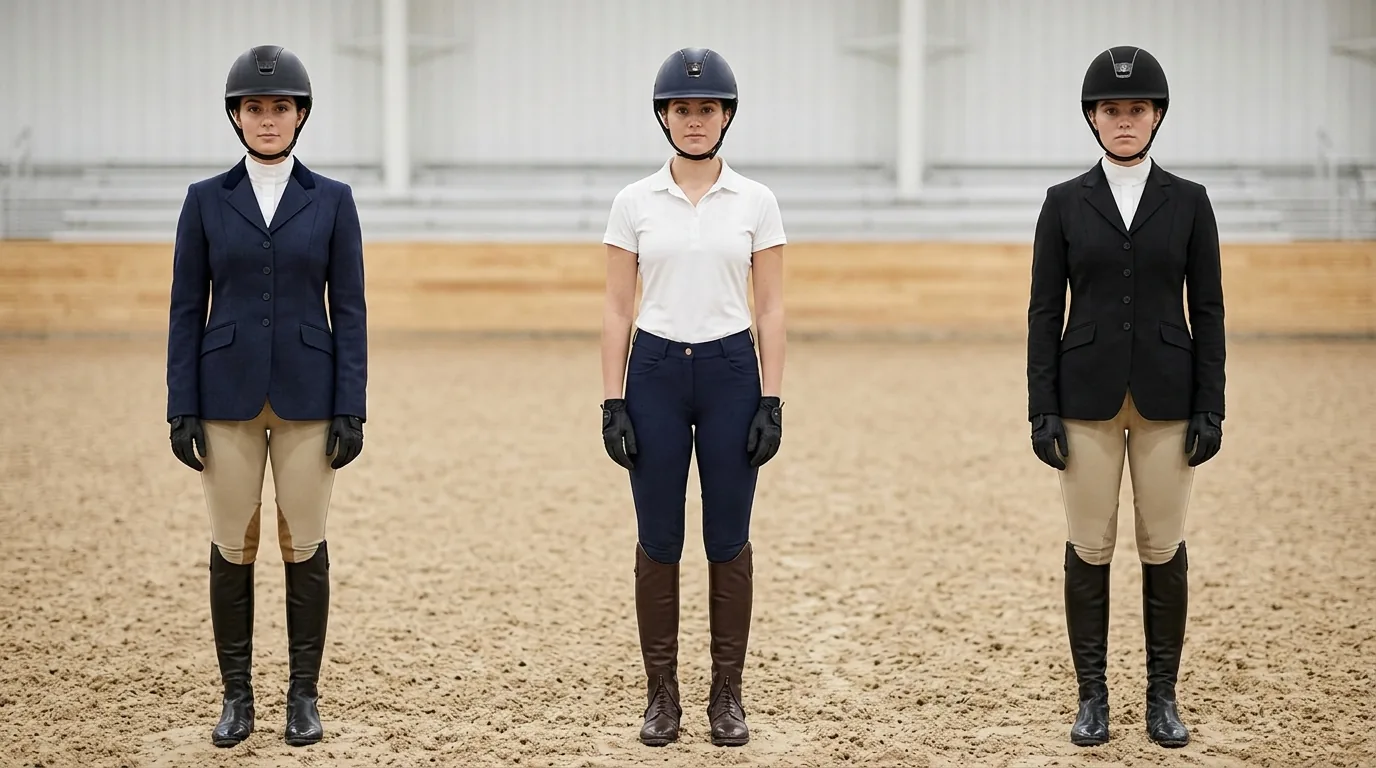
| Hunter ring | Jumper ring | Equitation ring | |
|---|---|---|---|
| Coat | Black, blue, green, grey or brown, by rule | Depends on the tier: dark or scarlet (Formal), any color (Proper), none required (Standard) | Not specified by rule; navy or black by convention |
| Shirt | Choker, similar collar or tie required | White collar and cuffs (Formal), light color with tie or choker (Proper), collared polo allowed (Standard) | Choker, similar collar or tie required |
| Breeches | Buff, canary, tan, rust or white | White or fawn (Formal), white, fawn or canary (Proper), any color (Standard) | Buff, canary, tan, rust or white |
| Boots | Boots with a heel; tall black boots by convention | Boots required; half chaps allowed if they match the paddock boot | Boots with a heel; tall black boots by convention |
| Helmet | Certified to an accepted standard, fastened | Same | Same, and free from non-traditional adornment |
| Penalty for wrong attire | Judge or management may eliminate | Warning first, elimination for repeat offenses | Elimination only for safety; the judge still marks you down |
The rest of this article explains where each of those lines comes from.
What the 2026 USEF Rulebook actually says
Nearly every article on this subject cites HU107 for hunter attire and EQ105 for equitation. Those were the right numbers for years. In the 2026 Rulebook, effective December 1, 2025, the hunter chapter was renumbered and HU107 is now the Amateur Owner Hunter section. The attire rule is HU128. The equitation appointments rule moved from EQ105 to EQ106. The jumper attire rule is still JP111, paragraph 9. The helmet rule for every ring is GR801.
| What it governs | 2026 rule | What it says |
|---|---|---|
| Hunter coat, shirt, breeches | HU128.2 | “Riders are required to wear conservatively colored coats (black, blue, green, grey or brown) which are free from adornment which in the judge’s opinion is overly distracting. Shirts must have a choker, similar collar or tie. Breeches may be buff, canary, tan, rust or white.” |
| Hunter formal classes | HU128.3 | “Riders are required to wear scarlet or dark coats; white shirts with white stock; white, buff or canary breeches.” |
| Hunter and equitation when jackets are waived | HU128.4 and EQ106.4 | Riders must wear “traditional, short, or long-sleeved riding shirts with chokers or ties. Polo shirts and full chaps are not permitted except in unjudged warm-up classes.” |
| Jumper attire, three tiers | JP111.9 | Formal, Proper and Standard, quoted in the jumper section below |
| Equitation attire | EQ106.2 | “Conventional attire following the tradition of fox hunting is encouraged and preferred… Judges shall not eliminate a rider for inappropriate attire except for safety.” |
| Helmets, all rings | GR801.1 | Compulsory “when mounted anywhere on the competition grounds,” must “carry the applicable quality testing tag and/or label” and be “properly fitted with harness secured” |
| Boots, all rings | GR801.4 | “Boots/shoes worn while riding anywhere on the competition grounds must have a distinguishable heel” |
Two things follow from reading the rules rather than the summaries. First, for the hunter, jumper and hunter seat equitation rings the rulebook says nothing about gloves, hairnets, boot color or belt color. (Side saddle has its own appointments rule, HU130, which does cover gloves and hair.) Those are conventions, and strong ones, but a judge cannot point to a rule on them. Second, the three rings treat a wrong outfit very differently, which is the part most guides skip.
Horse show attire for the hunter ring
The hunter ring judges the horse, but the rider’s turnout is part of the picture the judge sees, and HU128 is the strictest of the three rules on coat color, with a fixed list.
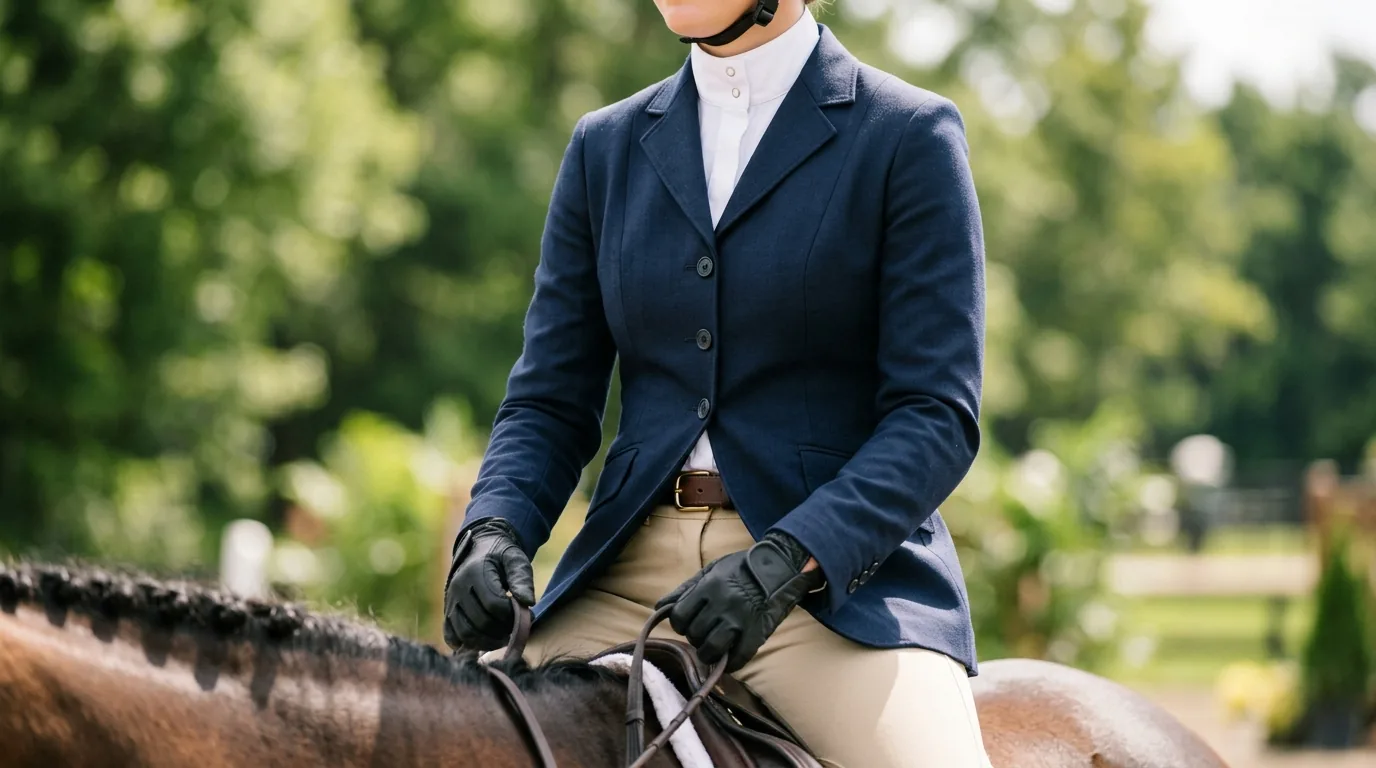
Coat. Black, blue, green, grey or brown. Navy is the default at every level because it flatters most horses and never looks wrong. Burgundy, plum and other fashion colors are not on the list. The coat must be “free from adornment which in the judge’s opinion is overly distracting,” which in practice means plain buttons and no contrast piping loud enough to catch the eye from the judge’s box.
Shirt. The rule says choker, similar collar or tie. White is the convention, and a white shirt with a built-in stand collar is what almost every rider wears. Any collar color other than white is technically permitted and almost never seen.
Breeches. Buff, canary, tan, rust or white. Tan is the standard. Rust is rarely worn but still legal.
Boots. GR801.4 requires a heel and HU128 says nothing else. Tall black boots, either field boots with laces at the ankle or plain dress boots, are the convention for anyone out of the pony divisions. The one written restriction is in HU129: a junior who is not wearing scarlet may not wear brown boot tops.
Helmet. Must meet one of the testing standards USEF publishes: ASTM F1163 certified by SEI, British PAS 015, European VG1, or Snell 2016 or later. Black is the convention, and the helmet buying tips post covers fit and replacement. If the chin strap comes undone during a round, HU128.1 lets you stop, refasten it and carry on without penalty.
Gloves and hair. Neither is in the rule. Black gloves and hair contained in a hairnet under the helmet are expected at rated shows (the hairstyles for horseback riding guide covers the show bun, the knotted net and the junior braids step by step), and a judge who sees loose hair will notice it before anything else about the ride.
Formal attire. When a class calls for formal attire, most often the handy round of a hunter derby or a classic, HU128.3 applies: scarlet or dark coats, white shirt with a white stock tie, and white, buff or canary breeches. The “dark coat” almost everyone wears for this is a shadbelly, the cutaway tailcoat, although the rule does not name it. Scarlet is reserved by convention for riders who have been awarded hunt colors.
Jumper ring outfit: the three tiers
The jumper ring judges faults and time, so the rulebook cares less about how the rider looks and more about the class being appropriately dressed for its level. JP111.9 sets three tiers. Which tier applies to a class is set by competition management and published in the prize list, and the rulebook ties a class’s attire requirements to its prize money level, so the bigger the class, the stricter the tier.
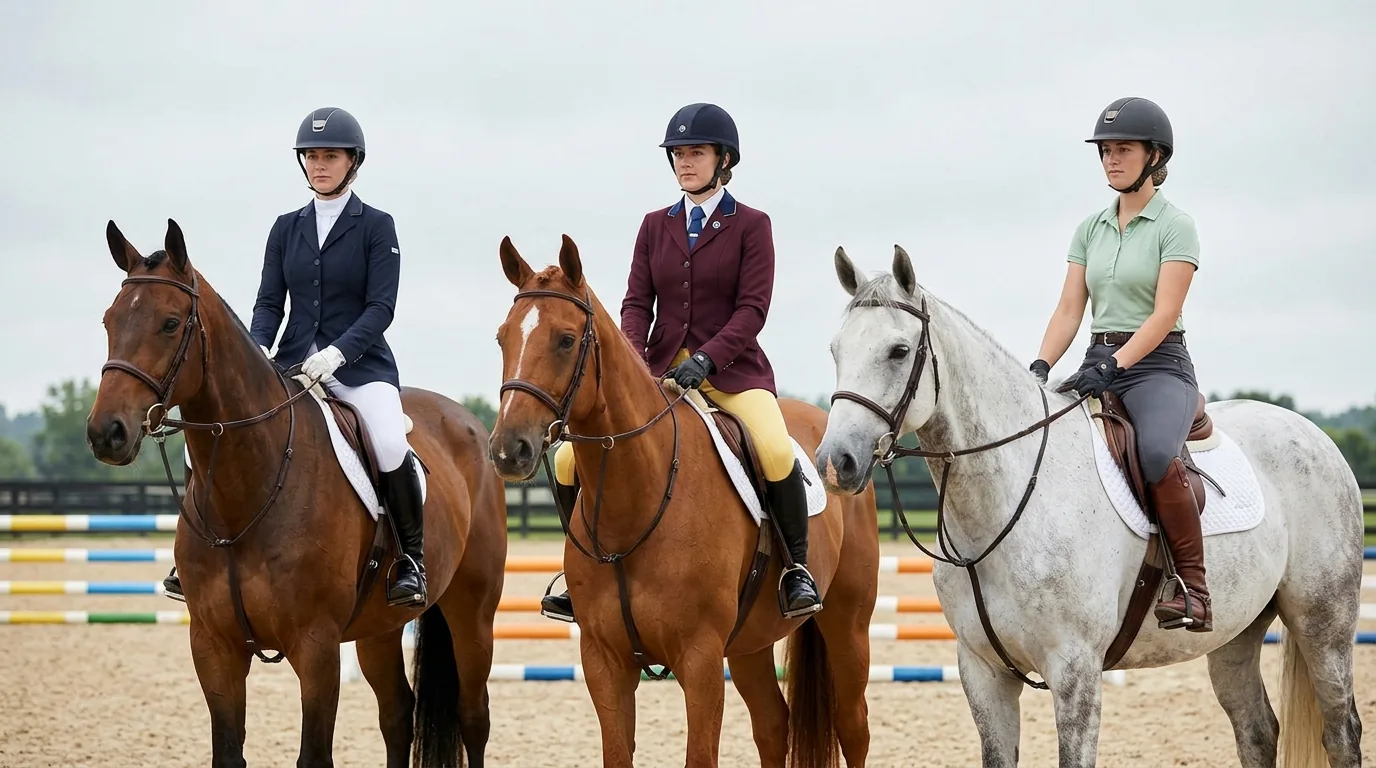
| Tier | Coat | Breeches | Shirt | Boots |
|---|---|---|---|---|
| Formal | “Dark, muted or similar colored, or red (scarlet) coats are required; team or sponsored coats of different colors are also permitted” | White or fawn | White or lightly colored with “a white collar and white cuffs,” plus a white tie, choker or hunting stock | Required; half chaps permitted if they match the paddock boots |
| Proper | “Coats of any color are required” | “White, fawn or canary. Pastel and dark colored breeches are not allowed” | Light in color, tucked in, fastened at the neck, with a tie or choker of any color | Same |
| Standard | Not required | Any color | Collared with sleeves; polo shirts permitted; “sleeveless shirts and shirts with exposed hoods are prohibited” | Same |
Three details in that rule catch people out. Under Proper attire, a pastel breech is a violation even though the coat can be any color. Under Standard attire, a polo is fine but a sleeveless top or a hooded sun shirt is not. And in all three tiers, half chaps are legal only if they match the color of the paddock boots.
The penalty structure is written into the rule as well. JP111.9.e: “the penalty for a first or minor offense will be a warning and for repeated violations by the same exhibitor at the same event, the penalty may be elimination.” That is more forgiving than the hunter ring, where HU128.4 lets management or the judge eliminate an inappropriately dressed rider outright. In bad weather, JP111.9.d allows jackets, sweaters or raincoats with permission granted before you enter the ring.
Equitation attire: the same clothes, a different judge
Equitation riders wear what hunter riders wear. The difference is who is being judged. In the hunter ring the horse is the subject and the rider is background. In equitation the rider is the subject, so fit matters more than in either of the other rings.
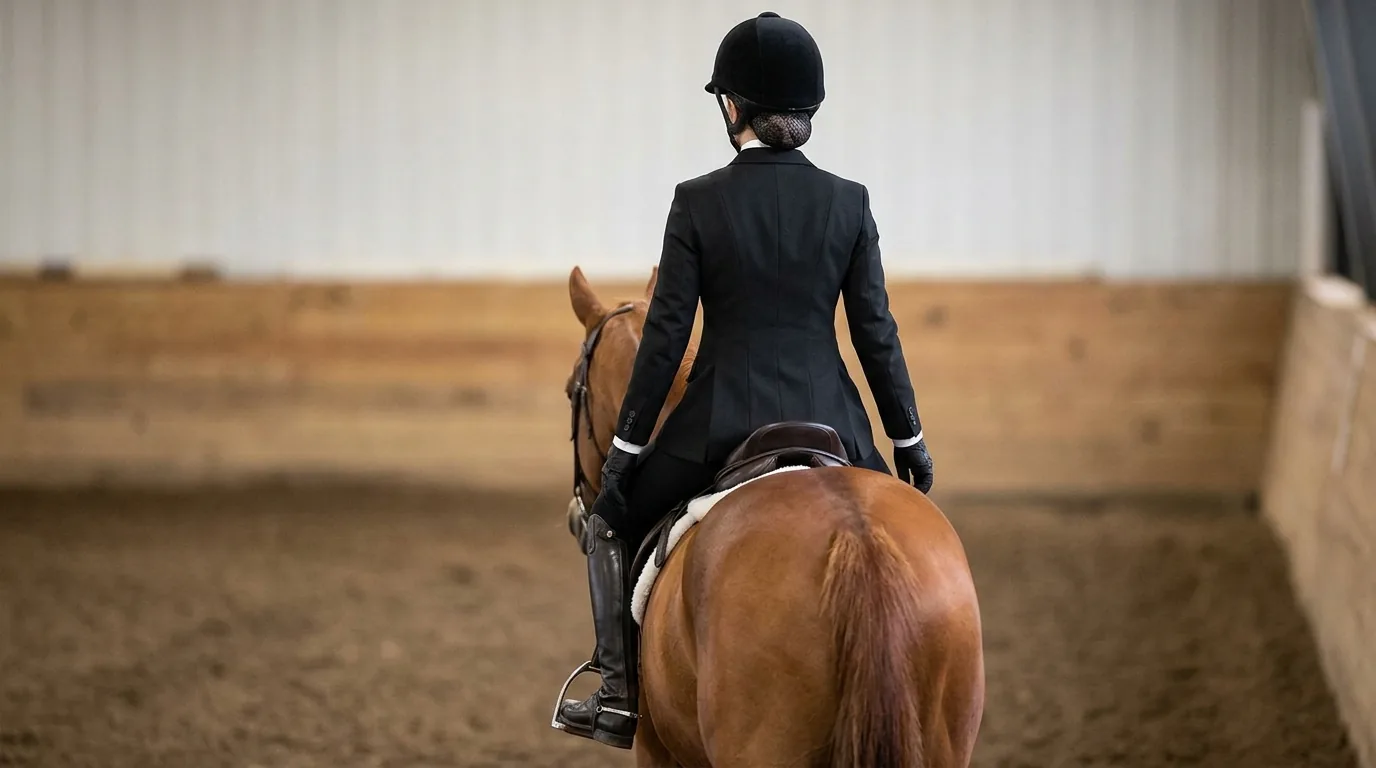
EQ106.2 is worth quoting in full because it is the line every other guide gets backwards:
“Conventional attire following the tradition of fox hunting is encouraged and preferred. It is further recommended that the rider’s attire does not distract from the performance of the horse and rider. Judges shall not eliminate a rider for inappropriate attire except for safety (see GR801). Shirts must have a choker, similar collar or tie. Breeches may be buff, canary, tan, rust or white.”
So an equitation judge cannot eliminate you for a burgundy coat. What the judge can do is place you below the rider in navy, because the rider is the thing being scored and “does not distract” is the standard. The exception is EQ106.4, the same waived-jackets clause as the hunter rule: if jackets are excused and a rider turns up in a polo shirt or full chaps, elimination is back on the table.
Two more lines from EQ106 that matter for equitation and nowhere else. Headgear “must be free from non-traditional adornment,” which rules out the crystal-trimmed helmets that are legal in the jumper ring. And the rule recommends “traditional stainless steel stirrup irons that promote proper position of the foot in the iron” so the judge has “a clear and unobstructed view” of the leg. The same paragraph says judges may not eliminate a rider for a particular style of iron, so composite irons are not banned, but they hide the thing you are being judged on.
On fit: a coat should close comfortably across the chest with the horse’s neck in front of you, the sleeve should end at the wrist bone with a sliver of white cuff showing, and the hem should sit just below the seat when you are in the saddle. A coat that pulls across the back or rides up on the jump is visible from the judge’s box and reads as a position fault even when it is a tailoring fault.
What changes for the indoor finals
The three national equitation finals all fall in the next month (the full 2026 US equestrian events calendar lists the rest of the season):
- USEF Hunter Seat Medal Final, at the Pennsylvania National Horse Show, Harrisburg, October 8 to 18
- WIHS Equitation Finals, at the Washington International Horse Show, Upper Marlboro, Maryland, October 19 to 25
- ASPCA Maclay National Championship, at the National Horse Show, Tryon International, October 21 to November 1, with the Maclay held on the first Sunday in November
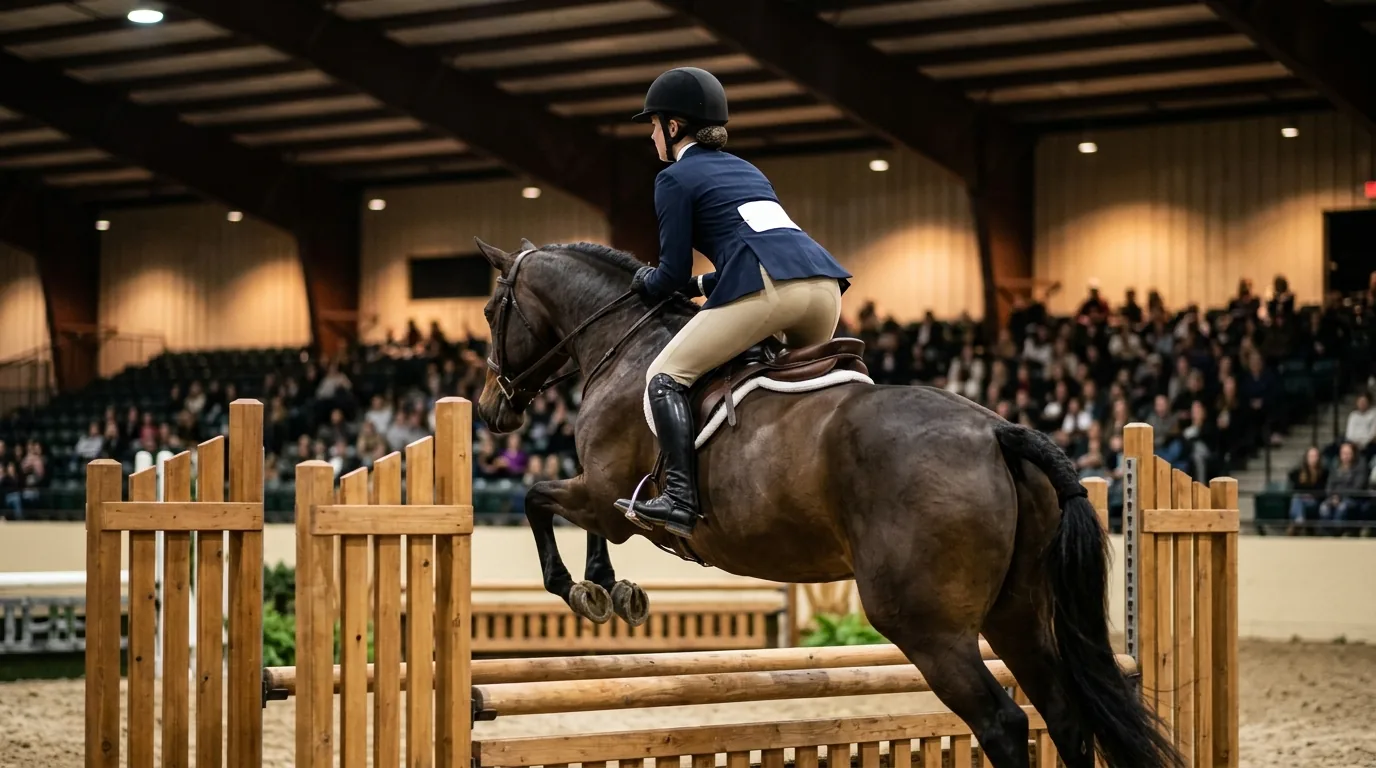
All three are equitation classes, so EQ106 governs and the lenient elimination clause applies. Nobody at a final is relying on that clause. The turnout expected in an indoor equitation final is the most conservative version of the hunter standard: navy or black coat, white shirt, tan breeches, black tall boots, black gloves, matte black helmet, hair in a net. Finals riders are photographed and streamed under arena lights, and anything shiny, patterned or loose shows up on camera in a way it does not outdoors.
Three practical points for anyone heading indoors for the first time. Pack two show shirts, because the second day is not the day to discover a stain. Pack a spare pair of gloves and a spare hairnet, because both go missing at exactly the wrong moment. And check the prize list for each class, because a show can run an equitation final, a hunter classic in formal attire and a Standard-tier jumper class on the same day, and the correct outfit changes from ring to ring.
What younger riders wear
The rulebook does not set a separate dress code by age. What it does is leave boots and coat fit unspecified, and convention fills the gap.
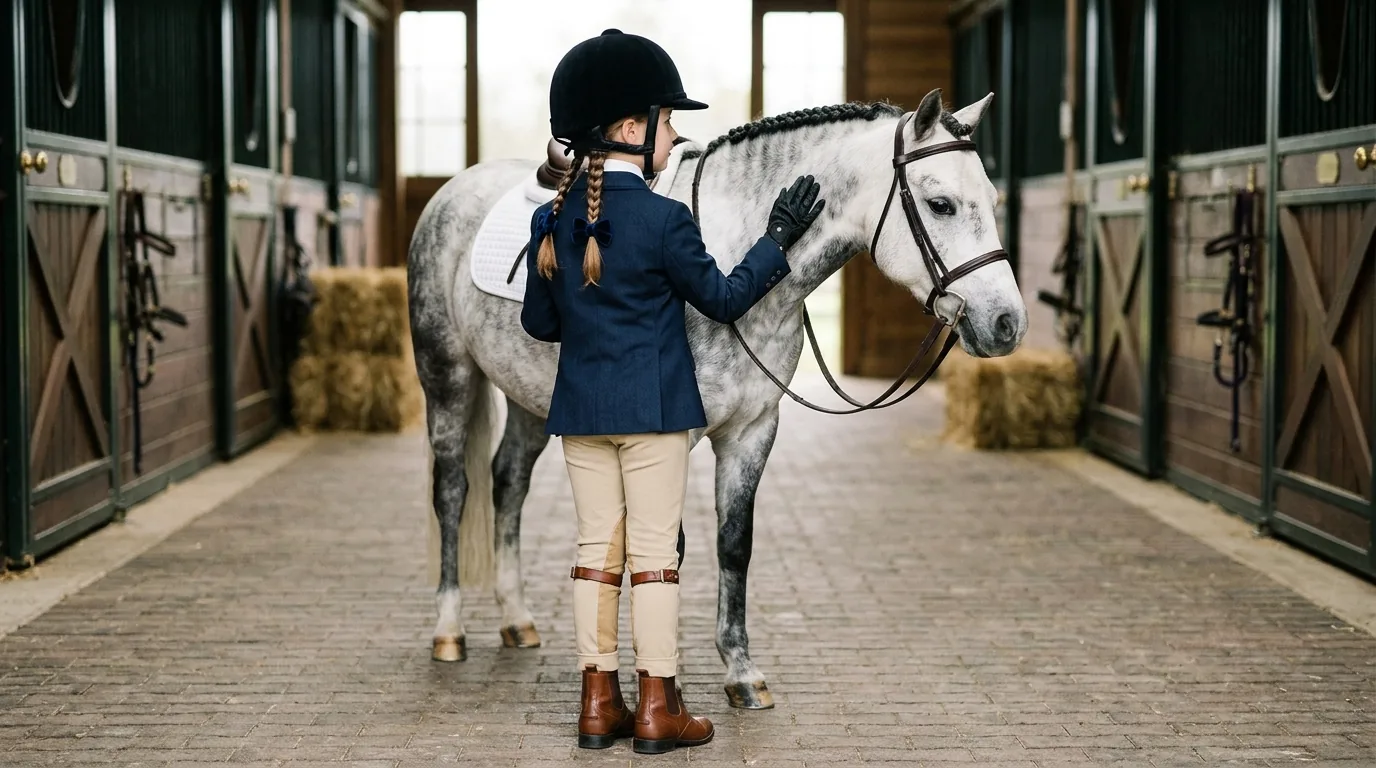
In the short stirrup and pony divisions, riders typically wear jodhpurs, which run to the ankle, with paddock boots and leather garter straps just below the knee, brown with brown and black with black. Hair is in two braids finished with matching bows. The coat is a scaled-down navy hunt coat, the shirt is white, and the helmet rules are identical to an adult’s. A child who is still at the lesson stage does not need any of this yet; see what to wear to a first horseback riding lesson.
The switch to breeches and tall boots happens when the rider moves out of the pony and short stirrup divisions, usually in the early teens. Tall boots are the single most expensive item in the change, which is why so many of them are bought and sold pre-owned.
What to buy new and what to buy pre-owned
A complete horse show outfit for the hunter jumper rings, bought new from mainstream brands, comes to roughly $800 to $1,600 depending on the brand, using the ranges in the table below. The figures below are current retail prices from US tack retailers in September 2026, alongside what the same categories list for on Reequestrian as of the same month.
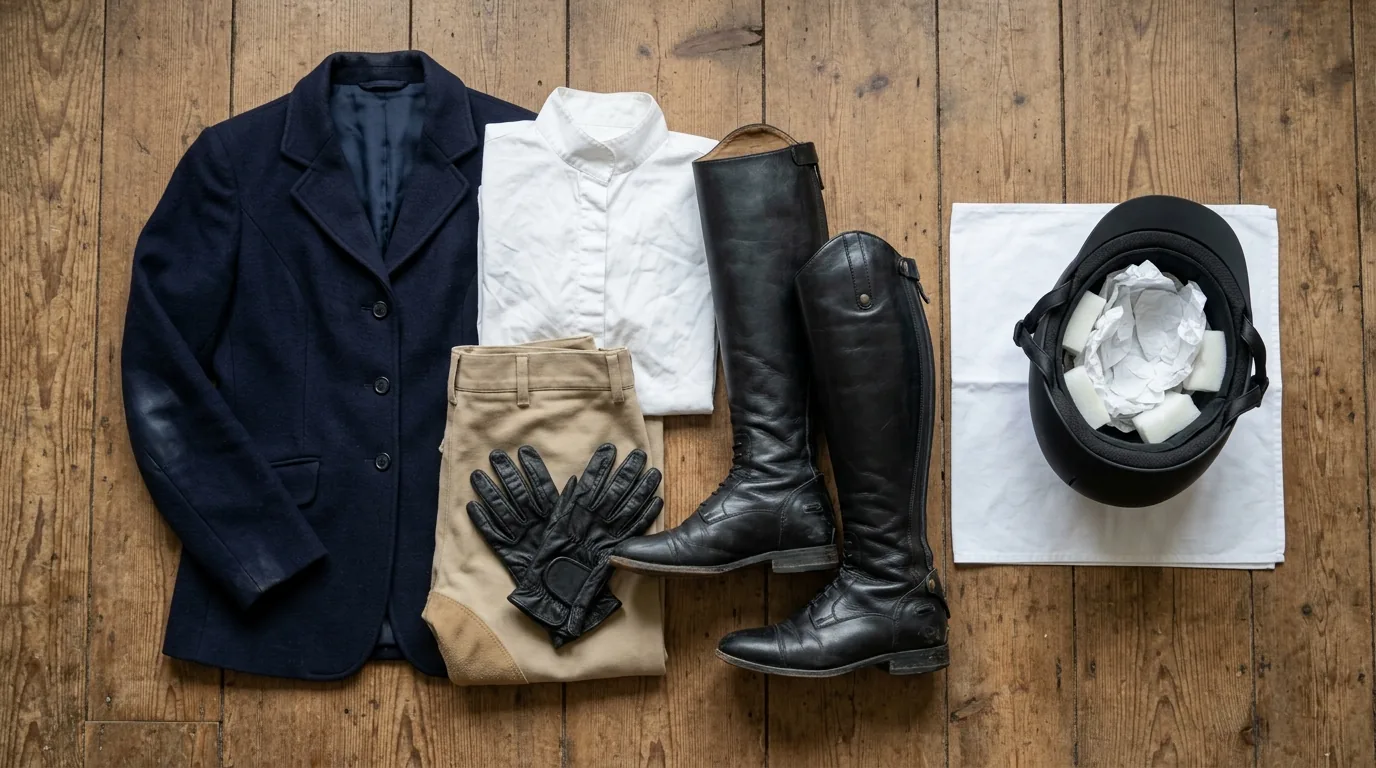
| Item | New, mainstream brands | Pre-owned listings on Reequestrian | Buy used? |
|---|---|---|---|
| Show coat | $99 to $290 (junior and adult, RJ Classics, Ariat, Kerrits); more for Italian tailoring | From $420 for Equiline and Charles Ancona | Yes. Wool and technical fabric coats outlast their first rider |
| Show shirt | $55 to $115 (Ariat, Kerrits, RJ Classics) | From $20 (Ariat Pro Series, Horseware) | Yes |
| Breeches | $180 to $210 for Tailored Sportsman knee patch | $10 to $200, from kids’ jodhpurs to Equiline and Dada Sport | Yes, if the patches and waistband are sound |
| Tall boots | $360 to $450 for Ariat and Tredstep; $600 to $1,190 for Parlanti, DeNiro and EGO7 | None listed at the time of writing; the category is open for sellers | Yes, once the calf and height measurements are confirmed |
| Helmet | $99 to $550 (Ovation, One K, KEP, Kask) | Not listed | No. Buy new and have it fitted |
The helmet is the one exception, and USEF’s own guidance is the reason. The federation’s headgear standards document says: “Always try on the product and have it fitted by someone that is qualified to do so. Avoid buying online, even if you bought the same model before, as individual differences may exist.” A helmet that has been dropped or crashed can be damaged without any visible mark, and a used one carries a history you cannot check.
Everything else is a fabric or leather item that either fits or does not, and the things to check are the same ones a judge would notice:
- Coat: seams at the shoulder and centre back, lining intact, buttons original, no shine on the elbows, no pull across the chest when buttoned
- Shirt: collar not yellowed, snaps or zip at the neck working, no pilling where the coat sleeve rubs
- Breeches: knee patches or full seat flat and unbroken, waistband holding shape, zipper running clean, leg closures at the ankle sitting flat under a boot
- Tall boots: zips running the full length without catching, no cracking at the ankle crease, the calf measurement and height measurement taken by the seller rather than guessed from a size label
Listings on Reequestrian are written by the rider or parent who owned the item, with the brand, the label size and the condition, which is the information a general resale app leaves out (see where to buy used equestrian gear online for how the options compare). If the outgrown coat and boots are yours, how to sell equestrian gear walks through photographing and pricing them. Browse show jackets, riding shirts, breeches and jodhpurs, tall boots and hair bows, and if you are new to the sizing, start with the guide to what breeches are and how they fit.
Mistakes that cost ribbons
Every one of these is either a rule violation or a convention strong enough to act like one.
- A burgundy or plum coat in the hunter ring. Not on the HU128 list. It is legal in Proper jumper attire and merely unwise in equitation.
- Pastel breeches in a Proper-tier jumper class. Named in JP111.9.b as not allowed, even though any coat color is.
- A polo shirt when jackets have been waived in hunters or equitation. HU128.4 and EQ106.4 both prohibit it outside unjudged warm-ups, and both allow elimination.
- A sleeveless top or a hooded sun shirt in the jumper ring. Prohibited even under Standard attire.
- Paddock boots with half chaps of a different color. Legal only when the colors match, in all three jumper tiers.
- Riding boots without a heel anywhere on the grounds. GR801.4 applies from the moment you are mounted, not from the in-gate.
- Brown boot tops on a junior in the hunter ring. HU129 prohibits them unless the rider is in scarlet.
- An unfastened chin strap. Not a mistake, as long as you stop and refasten it. Both HU128.1 and EQ106.1 say there is no penalty for doing so.
- Loose hair. No rule, but no judge in any of the three rings will overlook it.
The rule numbers changed this season. The hunter jumper attire itself did not. A navy coat, a white shirt, tan breeches, black tall boots and a certified helmet is correct in all three rings on every day of the indoor season, and every piece of it except the helmet can be bought from a rider who has outgrown it.


