


Every guide to how to groom a horse gives you the same eight steps in the same order, and they are right. What they leave out is why the order matters, what a groom is actually checking while brushing, why hoof picking is the one step you cannot skip, and the uncomfortable finding from a 2019 field study: most horses do not enjoy the way most people groom them, and most people put themselves in a risky position while doing it. This guide has the steps, the health check, the research, and the fix for both problems.
Why grooming matters more than a clean coat
A horse is groomed before every ride for three reasons, in this order of importance.
Safety. Grit under a saddle or girth rubs a sore in one ride. A stone in a hoof lames a horse in a mile. Grooming is the only time anyone runs their hands over every inch of the horse every day.
Health. Grooming is the daily health check. Heat in a leg, a swelling, a cut, a tick, a patch of rain rot, a foul smell in a hoof, weight loss under a winter coat: every one of these is found by the person grooming, days before it would be found any other way. Penn State Extension’s guidance for wet weather puts it simply: “Keeping the horse’s coat clean and dry will deter rain rot,” and to reduce thrush, “pick out your horse’s hooves regularly” (Penn State Extension, updated August 2026).
The relationship. Horses groom each other, and there is a physiological reason it works. A 1993 study of a Camargue horse herd identified the preferred mutual grooming site on the lower neck and withers and found that imitating grooming there “reduced the heart rate of the recipient,” while grooming a non-preferred area did not, in both adults and foals (Feh and de Mazières, Animal Behaviour, 1993). Scratching the withers calms a horse measurably. That is the part of grooming the horse is in it for.
What the research says the horse actually feels
Here is the finding every grooming guide should open with. In a 2019 field study, researchers observed 69 horses being groomed by their usual riders in riding centres and sport stables in France. Only 5 percent of the horses showed mutual grooming, approach or relaxed behaviour during the session; four times as many showed avoidance or threatening behaviour. Nine incidents were recorded in which a hoof or teeth passed within 10 cm of the rider’s body or head. Every rider (100 percent) did something risky at least once, most often passing behind the horse or under its head without keeping it in view (97 percent), and 88 percent picked out hooves in a posture that risked their back. Experience made no difference: professionals were as exposed and their horses as defensive as beginners’ (Lansade et al., Applied Animal Behaviour Science, 2019).
Two lessons come out of that and they run through every step below: groom the way the horse’s own species does (firm on the neck and body, gentle on the face, belly and legs, and stop when the horse says so), and never leave the horse’s field of view.
What you need
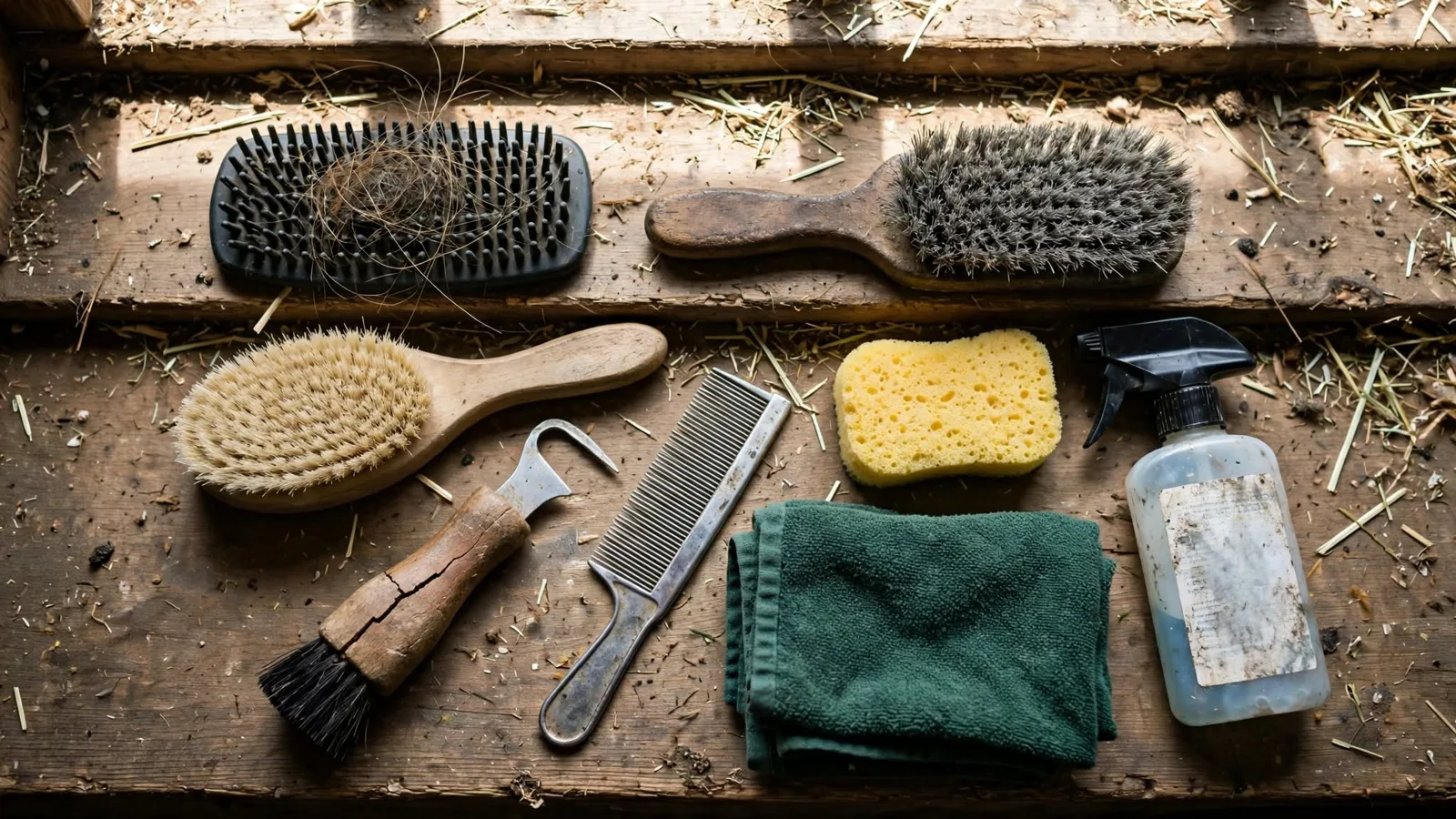
| Tool | What it is for | Buy |
|---|---|---|
| Hoof pick with a brush | Cleaning out the feet | First, before anything else |
| Rubber curry comb | Loosening dirt and hair from the body, in circles | Yes |
| Dandy brush (stiff bristles) | Flicking the loosened dirt off the body | Yes |
| Body brush (soft bristles) | Removing dust and putting shine in the coat; the face and legs | Yes |
| Face brush or grooming mitt | Face, ears, around the eyes | Optional, a soft body brush does it |
| Mane and tail comb or brush, wide-toothed | Manes and tails, with detangler | Yes |
| Two cloths or sponges | One for eyes and nose, one for the dock | Yes, and keep them separate |
| Sweat scraper, shedding blade, hoof oil, fly spray | Seasonal | Later |
A basic kit is $30 to $60 new and is one of the few pieces of equipment that is genuinely fine to buy used, once the brushes have been washed: dirty brushes are how skin conditions such as rain rot move from horse to horse, so one kit per horse and a wash in warm soapy water once a month.
How to groom a horse step by step
The order runs from the dirtiest, most important job (the feet) to the finishing touches, and from coarse tools to fine ones, so that each brush removes what the last one loosened. Twenty minutes for a horse that is groomed daily; forty for one that has lived out.
Step 1: Tie the horse safely and start at the feet
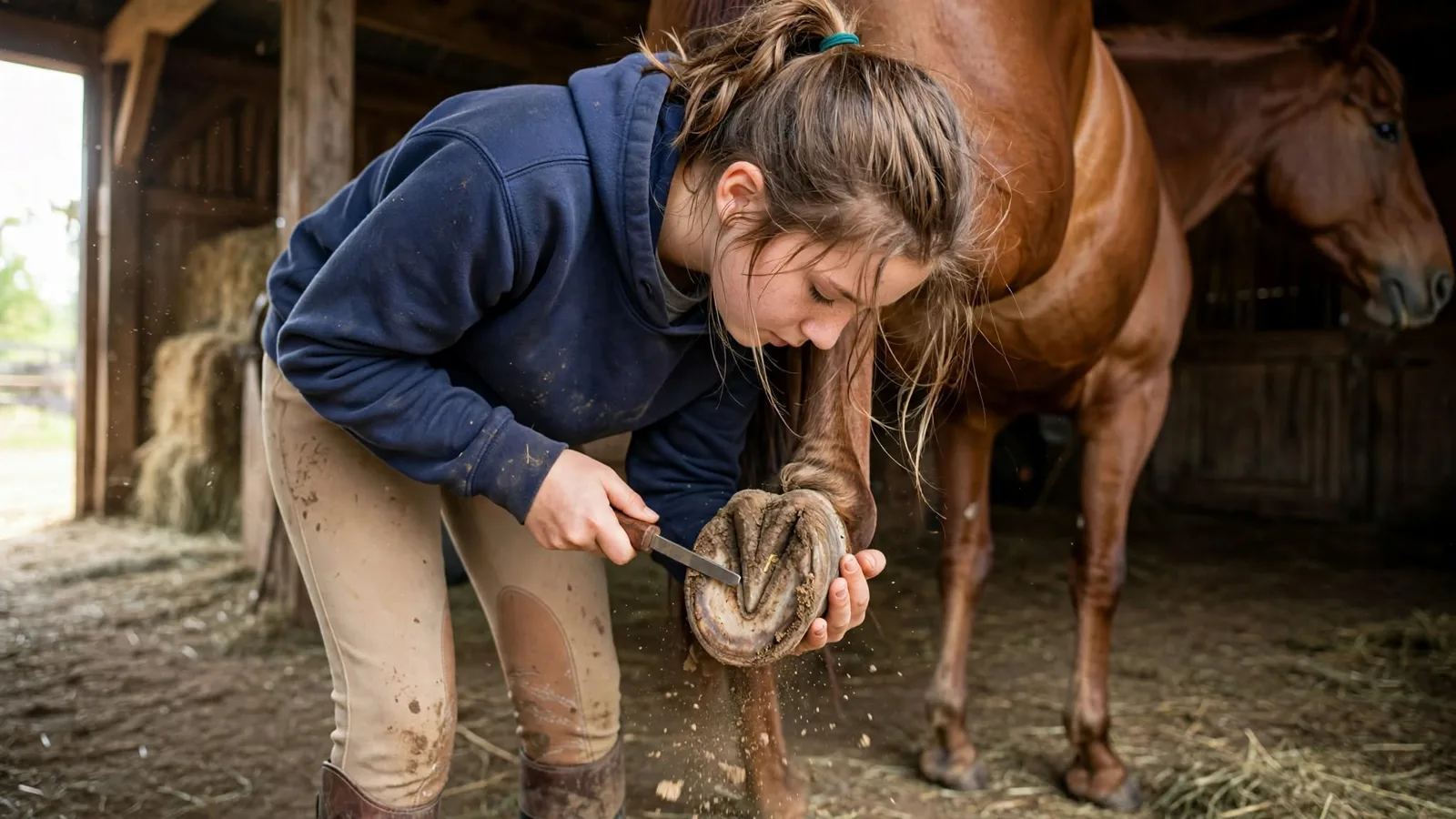
Tie with a quick-release knot, or in cross ties, to something that will not move. Stand at the horse’s shoulder, run a hand down the leg, and say “up” as you squeeze the tendon just above the fetlock. Pick from heel to toe, away from you, clearing the grooves either side of the frog and the cleft in the middle. Look and smell: the University of Minnesota Extension describes thrush as “a foul-smelling black oozy liquid around the frog” that “occurs in wet, soiled conditions” and “invades the sensitive tissues of the hoof and causes lameness” (UMN Extension, Mary Boyce DVM). Check the shoe is tight, if shod, and that nothing is wedged.
Feet first because a stone found now saves a ride, and because a horse that is going to object to being handled tells you here, with three legs on the ground.
Your back: bend at the knees and hold the hoof on your thigh, not at arm’s length. That is the 88 percent finding above.
Step 2: Curry the body
Rubber curry comb in the hand nearest the horse’s tail, working in firm circles from just behind the ears down the neck, over the shoulder, back, barrel and hindquarters, on both sides. This lifts dirt, loose hair and dander to the surface. Firm on the big muscles, where the horse’s own grooming partner would use its teeth; lighter over the bony points of the hip and shoulder; not on the face, and not below the knee or hock with a stiff curry. Watch the ears and tail: a swishing tail or pinned ears means lighter, not harder.
Step 3: Curry the legs and face, gently
A soft rubber curry or a grooming mitt for the legs below the knee and for the face, or skip the curry there entirely and go straight to the soft brush. The bones are close to the skin and the 2019 study’s avoidance behaviours cluster here.
Step 4: Dandy brush
The stiff brush, in short flicking strokes in the direction of the hair, over everywhere you curried, to flick the loosened dirt off the horse rather than back into the coat. Not on the face, and lightly or not at all on clipped horses and thin-skinned Thoroughbreds. This is the brush that does most of the visible cleaning.
Step 5: Body brush
The soft brush, in long strokes with the hair, over the whole horse including the face and lower legs. This picks up the fine dust the dandy brush leaves and lays the coat flat. Wipe the brush against a metal curry every few strokes to clear it. On the face, cup the horse’s nose in your free hand and brush from the forehead down, around the eyes with the brush rather than across them.
Step 6: Eyes, nose and dock
One damp cloth for the corners of the eyes and the nostrils; a separate cloth for under the tail. Never the same cloth, and never the same cloth as another horse’s.
Step 7: Mane and tail
Fingers first, from the bottom up, to separate the tangles. Then a wide-toothed comb or brush from the ends upward, holding the hair above the section you are working so the pull goes into your hand, not the horse’s dock. A detangler spray halves the time and the breakage. Stand to the side of the hindquarters, not behind them, and keep a hand on the horse. To brush the tail from the side, drape it over your forearm.
Step 8: Hooves again, and finish
A last look at each foot, hoof oil or conditioner if the horse’s feet are dry, fly spray in season, and a final check with the flat of the hand down each leg for heat, swelling or a cut you missed under the hair. Then tack up.
The health check you are doing while you brush
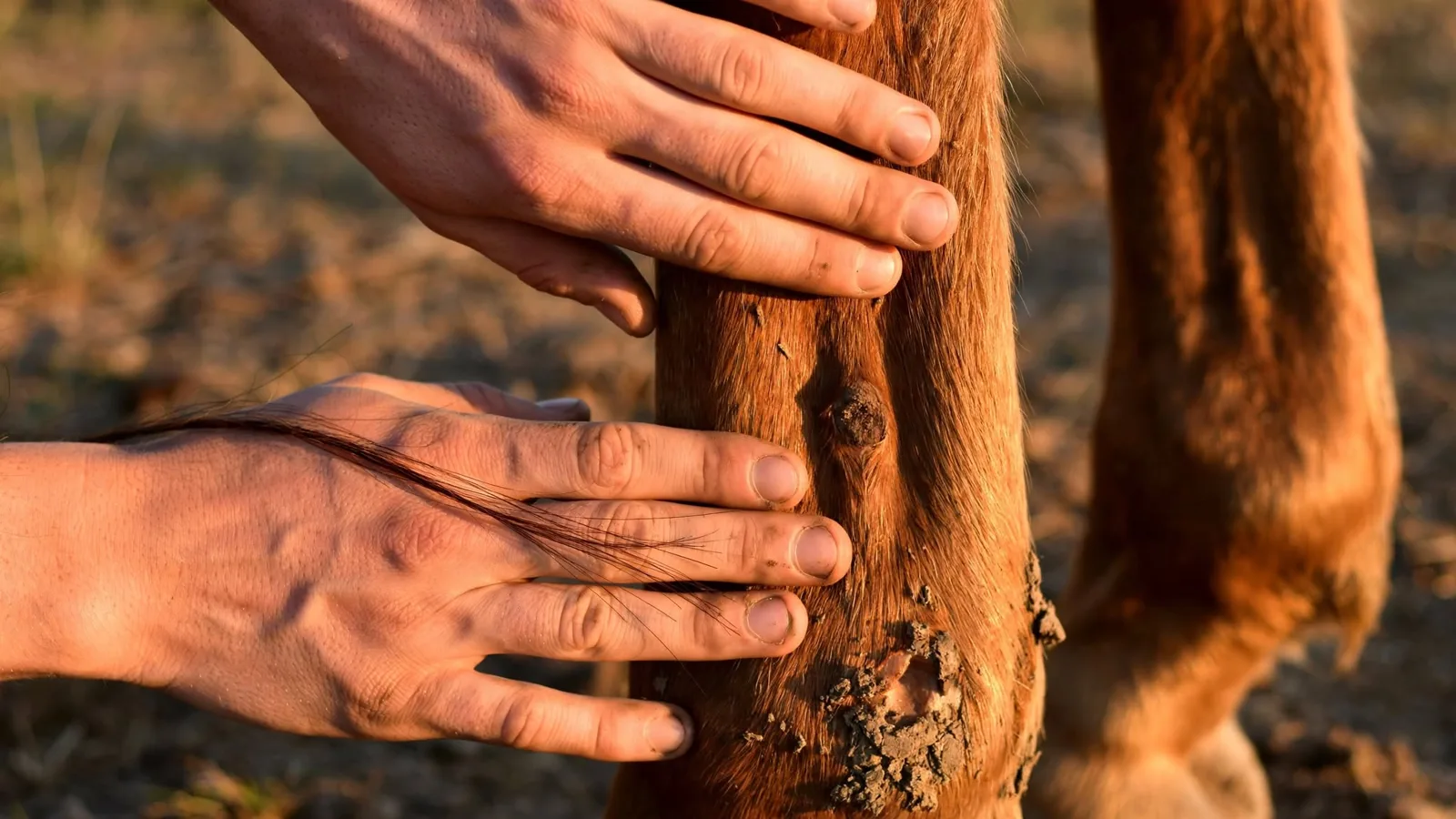
Grooming finds problems. This is what each step is looking for:
| Step | What to notice | What it can mean |
|---|---|---|
| Hoof picking | Black smelly discharge in the frog; a stone; a loose or missing shoe; heat in the foot | Thrush; bruise or abscess brewing; farrier needed |
| Currying the body | Flinching over the back; a lump or hard swelling; a patch of scabs with hair coming away in tufts | Back soreness or saddle fit; a bite or tick; rain rot |
| Legs | Heat, swelling, a cut, or the horse snatching a leg away | Tendon or ligament strain; a wound under the hair |
| Face | Discharge from one nostril; a runny eye; head shyness | Infection; an eye injury needing a vet the same day |
| Mane and tail | Rubbed-out hair at the top of the tail or the mane | Itching from lice, mites or sweet itch; pinworms |
| Overall | Weight change under the coat, a dull coat, a horse that suddenly resents grooming | Nutrition, teeth, pain; the earliest sign is often here |
Anything found here goes to the barn manager or the vet. A horse that is groomed daily by the same person gets noticed on the day something changes.
How often, and what changes with the season
Daily if the horse is ridden, before and after work. Before, for the safety check and to clear the saddle area; after, to remove sweat before it dries and to check for rubs. A horse that is not ridden still needs its feet picked out daily and a full groom several times a week.
Spring: the shedding coat comes out in handfuls; a shedding blade or a rubber curry does the heavy work, and it is the season to look for the skin problems a winter coat hid.
Summer: sweat and flies. Rinse or sponge sweat off after work, scrape, and check for rubs where tack sits. Fly spray after grooming, not before.
Autumn and winter: the coat thickens and hides everything, so hands matter more than brushes. A horse with a thick coat is groomed to lift the dirt, not to shine. Do not bathe in cold weather; a hot-towel wipe over the saddle area does the job. Pick feet daily; mud is the thrush season. The University of Minnesota’s guidance on hoof care is that horses need trimming or shoeing “at least every 6 to 8 weeks in the summer” and “every 6 to 12 weeks” in winter, when the hoof grows more slowly, and the person picking the feet every day is the one who notices when the six weeks are up.
Show grooming, briefly
For a show, the daily routine is the base and the extras are: a bath the day before with a horse shampoo, a whitening shampoo on white legs, the mane pulled or trimmed to braiding length and braided on the morning, the tail braided or brushed out, muzzle and ears trimmed, hooves picked, oiled or blacked, and a final body brush at the trailer. Braiding for hunter and equitation classes is normally done by a professional braider on the show morning; what that and the rest of a show day costs is in the parent’s guide to a first horse show, and what the rider wears while the horse is being made presentable is in the hunter jumper attire guide.
Safety while grooming
The 2019 study found professionals took the same risks as beginners, so these are for everyone:
- Stay in the horse’s field of view. Do not walk behind the hindquarters; go around the front or, if you must pass behind, keep a hand on the horse and stay close, where a kick has no room to build.
- Never duck under the tie rope or the horse’s neck. That was the 97 percent.
- Hold hooves on your thigh with your knees bent, not stretched out at arm’s length.
- Wear boots with a heel and closed toes. A horse standing on a trainer is the most common grooming injury.
- Keep the tools in a bucket or tote, not on the floor around the horse’s feet.
- Watch the ears and the tail. Pinned ears, a swishing tail or a lifted hind leg are the horse saying the pressure is wrong, and the study’s avoidance behaviours are the horse saying it before the threatening ones.
- Tie so it can be released instantly, and never tie to anything that will follow the horse if it pulls back.
Grooming gloves, which many riders keep separate from their riding gloves so the riding pair lasts, are covered in the riding gloves guide; everything else a beginner wears to the barn is in what to wear to a first horseback riding lesson.
Grooming a horse that hates it
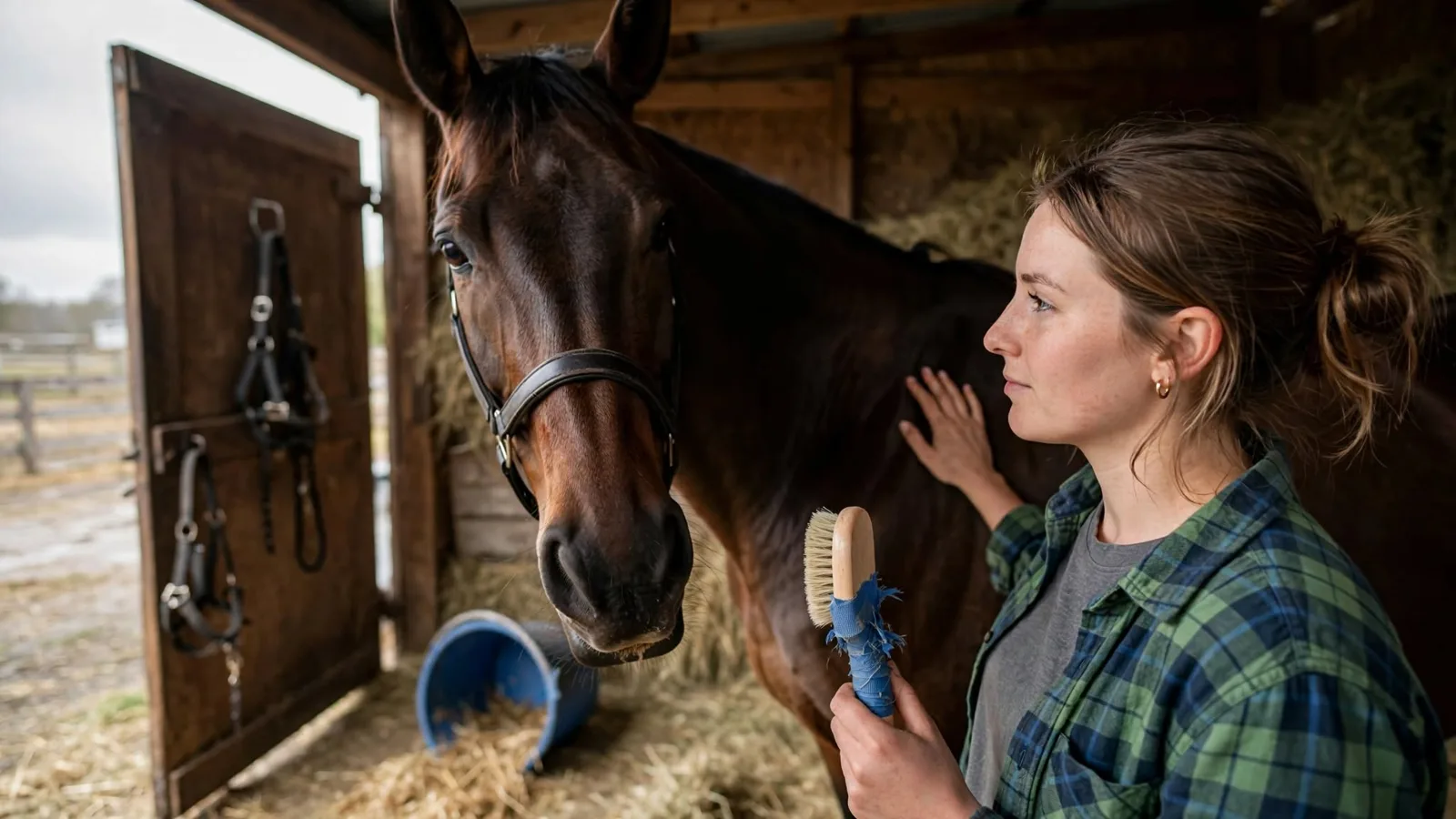
Some do, and the 2019 numbers say more do than owners think. Start where the horse’s own species starts, scratching the withers and lower neck with the fingertips, and watch for the upper lip to twitch and the head to lower, which is the horse grooming back. Move outward from there over several sessions. Use less pressure than feels necessary on the belly, flanks and legs. Keep sessions short and stop before the horse asks you to. A horse that has learned that grooming ends when it fidgets has been taught to fidget; a horse that has learned grooming feels like a friend’s teeth on its withers stands still for it.
How we researched this
Hoof care and thrush guidance is quoted from the University of Minnesota Extension (Mary Boyce, DVM, reviewed 2021) and Penn State Extension (updated August 2026). The heart rate finding is from Feh and de Mazières, Animal Behaviour 1993, volume 46, pages 1191 to 1194. The field study of grooming behaviour and rider safety is Lansade et al., Applied Animal Behaviour Science 2019, volume 217, pages 43 to 47. The grooming sequence and tool descriptions reflect standard practice as taught in US Pony Club and riding-school curricula; the health-check table reflects general equine husbandry and is not veterinary advice.
Disclaimer: This article is general information about routine horse care. Anything found during grooming that looks like injury, infection or lameness should be referred to a veterinarian. Always groom in a safe environment with appropriate footwear, and follow the barn’s rules on tying and handling.


