


Blanket a horse when it can no longer keep itself warm. Deciding when to blanket a horse comes down to three conditions rather than one temperature: whether the coat is dry, whether there is shelter, and whether the coat is intact. Penn State Extension’s plainest trigger is no shelter during turnout with air temperature or wind chill below 5 degrees F. A clipped, wet or recently relocated horse crosses that line a long way earlier.
The Short Answer: Three Conditions, Not One Temperature
The thermometer is the least useful of the three readings you take on a winter morning. The coat does the work, and Penn State Extension explains why: “The equine hair coat acts as insulation by trapping air, however, if the hair is wet or full of mud, air is excluded, reducing its insulating value and increasing heat loss.” Dry and fluffy is warm. Flat, wet or caked in mud is not, at any temperature.
That is why a horse with a genuine winter coat, a dry back and a run-in shed is often fine in weather that sends owners reaching for a heavyweight. The University of Minnesota puts the range in context: in the absence of wind and moisture horses tolerate temperatures at or slightly below 0F, and with access to a shelter they can tolerate temperatures as low as -40F University of Minnesota. Rutgers adds the reason shelter counts for so much: horses in a shelter conserve up to 20 percent more body heat than if completely exposed to the elements.
So before you check the forecast, check the horse and the field. Dry coat plus shelter moves the threshold down by a wide margin. Wet coat plus wind moves it up just as fast.
Lower Critical Temperature, and Why Every Blanketing Chart Disagrees
Lower critical temperature is the point below which a horse must burn extra energy to stay warm, and it is not a single number. That is why two reputable guides can give you two different starting temperatures with no explanation attached.
| Coat and acclimatisation | Lower critical temperature |
|---|---|
| Summer or short coat | 40F to 41F |
| Winter coat, milder climate | 18F |
| Winter coat, general estimate | 18F |
| Good body condition, accustomed to cold | about 5F |
Read the top row against the bottom one. University of Georgia Extension puts the same horse at 40F on a summer or short coat and at about 5F once it is in good condition and accustomed to cold conditions. That is a 35 degree spread inside one source, driven by coat and acclimatisation rather than by the weather. Set it against the 10 degree gap SmartPak’s chart puts between a clipped horse and an unclipped one and you can see which variable is doing the work. When one guide tells you 40F and another tells you 5F, they are usually both right and describing different horses.
Coat condition moves the number on its own. The University of Minnesota’s estimate is 41F with a summer coat and 18F with a winter coat, a 23 degree difference on the same animal across one season.
Blanketing Temperatures for Clipped and Unclipped Horses
SmartPak’s blanket guide carries one of the more widely circulated charts. It puts clipped horses in a light blanket at 50 to 40F, medium at 40 to 30F and heavy below 30F, with unclipped horses one band colder at every step.
| Air temperature | Clipped horse | Unclipped horse, full winter coat |
|---|---|---|
| 50 to 40F | Light | Not indicated |
| 40 to 30F | Medium | Light |
| 30 to 20F | Heavy | Medium |
| Below 20F | Heavy | Heavy |
For reference on what those weights mean, Rutgers describes medium weight turnouts in the neighbourhood of 200 grams of fill and heavy weight blankets at around 300 grams.
Treat the chart as a starting position rather than a rule. Rutgers says exactly that about the popular 60F figure for clipped horses: some people recommend starting to put sheets on clipped horses when temperatures drop below 60 degrees Fahrenheit, but you should monitor your horse to decide what is best. And clipping is not the only route to a manageable coat. An artificial light regime lengthening the day to 16 hours helps thin a heavy winter coat without the clippers, which also keeps the horse’s own insulation partly intact.
One more adjustment worth making: a horse shipped in from a warm climate is not yet the horse the chart describes. Utah State Extension says horses fully acclimate to new temperatures in about 21 days, so a new arrival in December needs more cover than the resident in the next stall for roughly three weeks.
What Happens When You Let the Horse Decide
This question has actually been put to horses. Norwegian researchers trained horses to touch symbol boards meaning blanket on, blanket off or no change. All 23 horses learned the task within 14 training days, and their answers were not random: they chose no blanket in pleasant weather and a blanket when the weather was wet, windy and cold.
The follow-up study ran the same method across a full weather range, using 10 horses that usually wore blankets and 13 that usually did not, each kept out in the paddock for two hours before being asked. Looking at air temperature alone, the horses preferred to have the blanket on in 80 percent of tests below -10C among those usually wearing blankets, and in 90 percent among those usually not wearing them. The horses less accustomed to rugs asked for one more often, not less. Above 20C they preferred to remove the blanket in all the tests, and in the statistical model wind speed and precipitation each raised the probability of choosing to have a blanket on, while sunshine reduced it. The horses were, in effect, reading the same three conditions described at the top of this page.
Worth sitting next to that: in a survey of the Swedish and Norwegian equestrian community, almost all respondents owning warmblood riding horses used blankets outdoors, 97 percent in Sweden and 96 percent in Norway, with 91 percent of Swedish and 84 percent of Norwegian respondents using blankets on horses during turnout overall. The same survey found the coat was clipped by 67 percent of respondents in Sweden and 35 percent in Norway, most often by owners of warmblood horses and horses used primarily for dressage and competition. In North America, a survey of 1,450 horse owners found 54 percent blanketed most of their horses, with English riders more likely to blanket. Routine has drifted well ahead of physiology.
Does Rain Change When to Blanket a Horse?
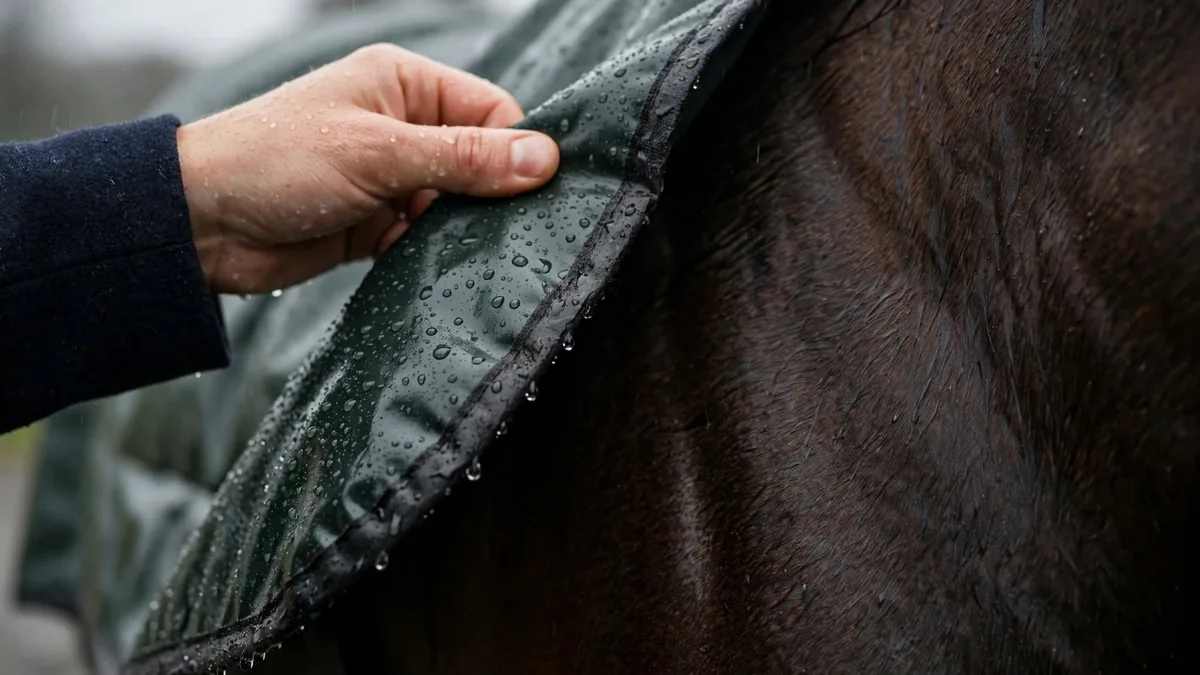
Rain changes the maths faster than cold does, and by a startling margin. The University of Minnesota reports that as little as 0.1 inch of rain can cause cold stress by matting the hair and reducing its insulating value. One tenth of an inch is a passing shower. In the North American owner survey published in the Journal of Equine Veterinary Science, exposure to precipitation was the most frequently selected reason for blanketing at 78 percent, while among the 660 respondents who did not blanket the majority of their horses the primary reason was access to shelter at 50 percent.
Two rules follow from that.
First, the blanket must be the right kind. University of Georgia Extension is blunt about it: stable blankets are only meant to be worn indoors and are not waterproof, and a horse turned out in a stable blanket that gets rained on will likely end up even colder than it would have been with no blanket at all. A soaked stable rug is a cold compress held against the horse all day.
Second, never put a blanket on a wet horse. Penn State is explicit: “Make sure blankets are kept dry and do not put a blanket on a wet horse; wait until the horse is dry before blanketing. Or take a wet blanket off a horse to keep it from becoming chilled.” If you arrive to a wet rug, the correct move is removal, not a top layer. The same logic appears in the winter section of our seasonal horse care checklist, which covers the broader forage and water side of cold weather management.
What a Blanket Is Actually Worth, Measured in Degrees
A heavier blanket is warmer. A North Dakota State University thermographic study measured by how much, using four mature horses in a Latin square design. After an hour outside at a mean of -23C with a -32C wind chill, lumbar surface temperature measured 22.3C unblanketed, 26.8C in a 0g sheet, 30.3C in 200g and 31.5C in 400g.
| Covering | Lumbar surface temperature after 1 hour | Gain over bare coat |
|---|---|---|
| None | 22.3C | baseline |
| Unfilled sheet, 0g | 26.8C | not significant |
| Medium, 200g | 30.3C | 8.0C |
| Heavy, 400g | 31.5C | 9.2C |
Look at where the value sits. The study reported the 200g and 400g blankets as significantly warmer than no blanket, while the unfilled 0g sheet only tended towards a difference and did not reach the study’s significance threshold. Doubling fill from 200g to 400g added 1.2C. For anyone buying, that is an argument for a sheet and a medium turnout rather than the heaviest rug on the shelf, and both are worth looking for second hand first, which is what our pre-owned tack and blanket listings are for.
It also sets a limit on what a blanket can do when the coat is already flat. As Total Equine Veterinary Associates notes, a blanket will make the hair coat lie flat, removing that insulating layer of warm air. If the blanket insulates less than the coat it flattened, the horse ends the day colder than it started. Penn State makes the same point from the other direction: “Woolly horses with a thicker hair coat can retain more heat so sometimes it is better not to blanket.”
The 22 December Rule, and the Coat Myth Measured
Coat growth is governed by day length, not by cold. The University of Minnesota states it as a date you can put in a diary: “A horse will continue to develop a natural winter coat until December 22 (winter solstice), as the days become shorter… Don’t blanket before December 22 or you will decrease your horse’s natural winter coat.” Blanket in November and the coat the horse carries through the rest of the winter will be shorter than the one it would otherwise have grown.
Does blanketing destroy the coat outright? No, and there are measurements rather than opinions on this. In a trial that followed 16 adult horses in Wisconsin from October to March, blanketed horses had shorter neck hair than unblanketed horses in January, at 43mm against 58mm, and in February, at 35mm against 47mm, while hair coat growth over time followed a similar pattern in both groups. Blanketing shortens the coat. It does not switch it off. The practical reading is that a horse blanketed from early winter will carry a shorter coat through the season, which makes the decision closer to a commitment than a day by day choice.
Signs You Have Got It Wrong, in Both Directions
The barn test is simpler than any chart, and it runs in both directions. University of Georgia Extension gives the over-blanketing check first: “Your horse should not be sweating under their blanket without any form of exertion; if they are, they are likely blanketed at too high of a temperature.” Sweat under a rug is worse than a bare back, because the horse is now wet, flat-coated and covered.
Cold shows differently. The same source notes that horses shiver when cold, and that in genuine cold stress they “will often feel cold to the touch under their coats, will stand with a hunched posture, may move more stiffly, and huddle together in the pasture.” Run your hand under the blanket at the shoulder and the loin. Warm and dry is correct. Damp is a problem whichever temperature caused it.
Penn State adds the two maintenance habits that catch the rest: on days the temperature becomes warm, remove the blanket so the horse does not sweat and become wet underneath, then air the blanket out and dry the horse’s hair coat. And on a continuously blanketed horse, take the rug off regularly, because horses can develop rub marks or sores where the straps fit improperly, and the blanket needs inspecting for damage and repositioning due to twisting.
Blanket or Hay: The Feed Side of the Same Decision
Blanketing and feeding are the same thermoregulation decision made with different equipment, and the figures are specific. Rutgers gives the general rule that a 1 percent increase in energy requirement is needed for each degree the temperature falls below the horse’s critical temperature. Utah State Extension scales it: adult horses require about 15 to 20 percent more feed for each 10F the outside temperature falls below lower critical temperature, and for young and growing horses that requirement can be up to 33 percent more.
In hay rather than percentages, Utah State’s table for an 1,100 lb adult horse reads:
| Outside temperature | Alfalfa hay per day |
|---|---|
| 30F | 19 lb |
| 10F | 21.5 lb |
| 0F | 24 lb |
And the two levers trade against each other measurably. In a Wisconsin trial of 16 adult horses split evenly between blanketed and unblanketed groups, daily dry matter intake was 2.31 percent of bodyweight for blanketed horses against 2.51 percent for unblanketed horses, with no difference in body weight or body condition score between the groups. Intake in that trial was measured by pen rather than by individual horse, so read it as a group level difference. The blanket conserved energy and the horses ate less to reach the same condition. So the honest framing is not blanket or nothing. It is blanket, or shelter, or hay, and an unblanketed horse with a full coat, a windbreak and free access to forage is a legitimate answer rather than neglect.
A Decision Sequence for the Morning Check
A temperature chart is hard to use during a morning check in the dark. Run this instead, in order, and stop at the first answer.
- Is the horse wet, or is the rug wet? Take the rug off. Penn State is explicit that you should not put a blanket on a wet horse, and should take a wet blanket off to keep the horse from becoming chilled.
- Is it raining and is the only rug a stable blanket? Leave the horse bare. A stable blanket rained on will hold water and likely leave the horse colder than no blanket at all.
- Is the horse clipped, newly arrived in the last 21 days, very young, very old, or at a body condition score of 3 or less? Treat its threshold as nearer 40F than 18F.
- Is there shelter from wind and wet? If yes, drop the threshold hard. Shelter lets a horse conserve up to 20 percent more body heat than full exposure.
- Only now check the number. No shelter during turnout and a temperature or wind chill below 5F is the clear blanket point for an unclipped horse.
- Put a hand under the rug at midday. Sweating without exertion means too much. Shivering, hunching or cold skin under the coat means too little.
End of season, the blankets you no longer need do not have to sit in a trunk until they mildew. Clearing them out properly is covered in our winter tack room reset, and a clean, repaired turnout in a size you no longer use is one of the easiest things to list for sale to another rider.
Frequently Asked Questions
At what temperature do you put a blanket on a horse? For an unclipped horse with no shelter, Penn State Extension uses below 5F by temperature or wind chill. For a clipped horse the practical starting point is much higher, with SmartPak’s chart putting a light blanket at 50 to 40F.
Are horses okay without blankets? Frequently, yes. In the North American survey, 54 percent of 1,450 owners blanketed the majority of their horses, and among the 660 respondents who did not blanket the majority of theirs, the primary reason was access to shelter, at 50 percent. Penn State notes that for thick-coated horses it is sometimes better not to blanket.
Do horses need blankets in cold weather? Not automatically. With access to a shelter, the University of Minnesota says horses can tolerate temperatures as low as -40F. Blankets become necessary when the coat is clipped, wet or flattened, or when there is no escape from wind.
What temperature is too cold for a horse? There is no single figure. Lower critical temperature ranges from about 5F for a horse in good condition and accustomed to cold, to 18F on a winter coat in a milder climate, to 40F on a summer or short coat. Below it, the horse needs more energy to stay warm, supplied by feed, shelter or a blanket.
Can horses overheat with rugs on? Yes. University of Georgia Extension’s test is sweating without any form of exertion, and it advises familiarity with the signs of heat stress, especially profuse sweating, hot skin, and rapid breathing. Penn State advises removing the blanket on warm days so the horse does not sweat and become wet underneath.
Do you leave horse blankets on in the rain? Only a waterproof turnout. A stable blanket in rain holds water and likely leaves the horse colder than no blanket at all.
Can you blanket a horse if they are wet? No. Penn State is direct on this: wait until the horse is dry before blanketing, or take a wet blanket off to keep the horse from becoming chilled.
Do horses like being rained on? No study answers that question directly, but the preference research points one way. When horses were given the choice themselves, precipitation increased the probability of choosing to have a blanket on, as did wind speed, while sunshine reduced it.
Is it cruel to leave horses out in the rain? Not in itself, provided the horse can get away from it. As little as 0.1 inch of rain can cause cold stress by matting the hair, so the welfare question is whether shelter exists, not whether rain falls.
Kitting Out for the Season Without Buying New
A winter wardrobe for one horse means a sheet, a medium turnout and a spare for when the first one is soaked. Three rugs is a lot to buy new all at once, and a reasonable set to build up second hand. Browse pre-owned turnouts and winter gear from other riders, and when spring arrives, pass on the rugs your horse has outgrown.


