


Your child’s trainer has said the words “I think she’s ready for a show,” and you have said yes without knowing what you agreed to. This guide is for the parent who does not ride: what kind of show it is and why that matters, what it will cost in real numbers, how the day runs, what the classes mean, what to pack, how to behave at the rail, and what to ask the trainer before you write the first check.
Why the type of show matters more than anything else
There are two kinds of horse show and the difference decides your budget, your paperwork and your child’s outfit.
A schooling show is run by a barn or a local association, does not need any national membership, and is where nearly every child’s first show happens. Classes are cheap, the atmosphere is forgiving, and trotting a course instead of cantering it is usually allowed at the lowest levels.
A rated show (also called a licensed or recognized show) is run under US Equestrian rules. It needs memberships, it charges federation fees on top of entries, it awards points toward year-end championships, and the standards for turnout are the ones described in our hunter jumper attire guide.
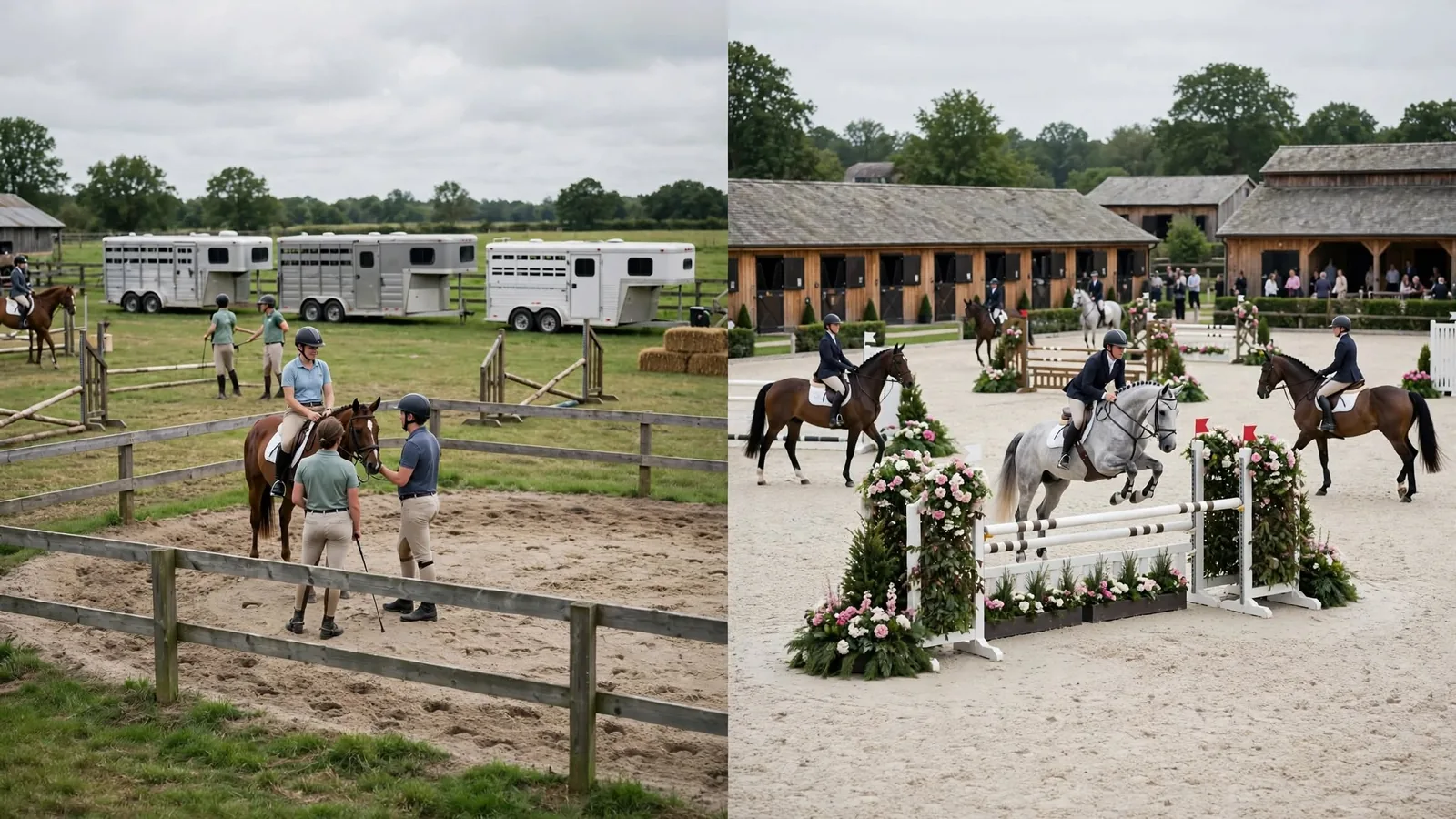
Ask the trainer which one it is before anything else. “A little local show” and “our first rated show” are three hundred dollars apart before the trainer’s own fees.
What a first horse show costs
Every number in this section comes from a published 2026 prize list or fee page. Prices vary by region and by show, so treat these as the shape of the bill rather than your exact bill.
A schooling show: World Equestrian Center summer series, Ohio, 2026
| Item | Fee |
|---|---|
| Each class | $25 |
| Administrative and facility fee (office, online entry, schooling ring, EMT) | $81 per horse |
| Stall (required, no showing from the trailer) | $90 |
| Late entry | $25 |
A child entered in the Beginner Rider Hunter section (four over-fences classes at 2 feet plus one flat class, trotting not penalized) pays $125 in class fees, $81 in administration and $90 for the stall: $296 to the show before the trainer’s bill. Shows that allow showing from the trailer drop the stall line entirely.
A rated show: Germantown Charity Horse Show, Tennessee, June 2026
| Item | Fee |
|---|---|
| Opportunity Short Stirrup Hunter section (18 inches to 2 feet, ages 9 and under) | $120 for the section, or $40 per class |
| Lead line class | $20 |
| Per-entry federation fees: USEF $25 (drugs and medications $15, federation $10), USHJA $10 | $35 |
| Schooling fee | $30 |
| Night watch | $20 |
| Medic fee | $20 |
| Stall, for the show | $210 |
| Post entry (after closing date) | $60 |
Same child, one section: $120 plus $35 plus $30 plus $20 plus $20 plus $210 is $435 to the show. Opportunity classes at this show are exempt from the USHJA horse registration requirement, which is one reason they exist.
Memberships, rated shows only
| Membership | 2026 cost | Notes |
|---|---|---|
| US Equestrian competing membership | $100 per year | Required to earn points. Fan account is free but cannot compete |
| US Equestrian Show Pass (non-member) | $45 per show, one per competition year | No points earned. Reported by the Chronicle of the Horse; the one-per-year limit is in USEF’s own FAQ |
| USHJA active membership | $85 per year | Required for hunter, jumper and equitation classes at rated shows, with exemptions for lead line and opportunity classes at some shows |
So a child’s first rated show, if the family joins both federations, adds $185 in memberships. A single show on a Show Pass costs $45 instead, once.
The trainer’s bill
This is the part no prize list shows you and the part that varies most. Barns publish their rates, and two examples:
- Ocala Hunter Jumpers, Florida: $75 per day coaching and $55 per day day care for the horse
- Bridlewood Farms, Colorado: $100 per day per horse for day care and grooming, or $300 per week all-inclusive at multi-day shows, with entries, braiding, vet and farrier billed separately by the vendors
Add hauling if the horse travels (priced per trip, often split between families), and braiding for hunter and equitation classes at rated shows, which is charged per horse per day by an independent braider. Ask the trainer for the local braiding rate; it is the one line on this list we could not source from a published page.
The whole bill, roughly
| Schooling show, one day | Rated show, one section | |
|---|---|---|
| To the show | $206 to $296 | $435 |
| Coaching | $75 to $100 | $75 to $100 per day |
| Day care or grooming | $55 to $100 | $55 to $100 per day |
| Hauling | varies | varies |
| Memberships | none | $45 to $185 |
| Braiding | usually not needed | ask the trainer |
| Before hauling, braiding and lunch | about $350 to $500 | about $600 to $850 for one day |
None of that includes the outfit, which is covered further down and is the one line a family controls completely.
How the day runs
A schooling show day, from the parent’s chair:
The night before. The trainer confirms the classes entered, the approximate time, and what the child wears. Clothes are laid out, boots polished, the show bag packed from the checklist below.
Arrival, usually two to three hours before the first class. The horse is unloaded, settled and tacked by the barn. The rider picks up a number from the show office (the trainer or the parent signs the entry; at rated shows a parent signs as guardian). The number is pinned to the back of the coat.
Schooling ring. The rider warms up under the trainer’s eye in a busy ring shared with everyone else in the division. This is the most chaotic part of the day and the part where parents should be furthest away.
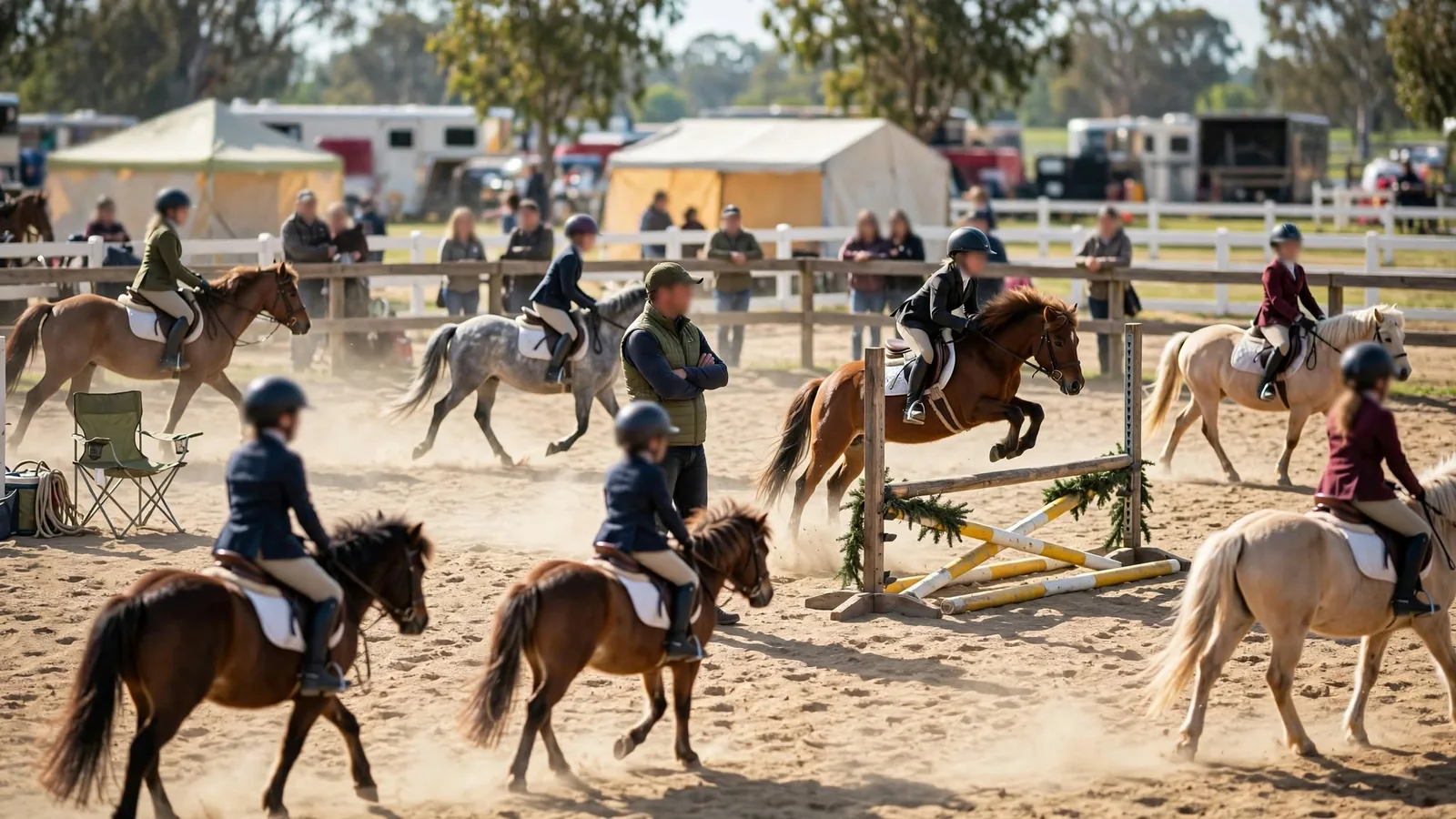
The order of go. Classes run in the order printed in the prize list, but never at the printed time. A class scheduled for 10:00 may run at 9:40 or at noon. The trainer watches the ring and calls the rider up when there are two or three to go. Do not wander off with the child.
The class. An over-fences class is one rider at a time, about ninety seconds each. A flat class (under saddle) is everyone in the ring together at walk, trot and canter, ten to fifteen minutes. Results are announced at the gate, ribbons handed out, and the next class starts.
Between classes. Water for the rider, water for the horse, and the trainer’s notes. This is where the second show shirt on the checklist earns its place.
After the last class. Untack, cool out, load, and the trainer settles up with the show office. Expect to be there five to seven hours for a one-day schooling show and to be tired in a way that surprises you.
What the classes mean in plain English
The prize list will read like a foreign language. The classes a first-time child is likely to enter:
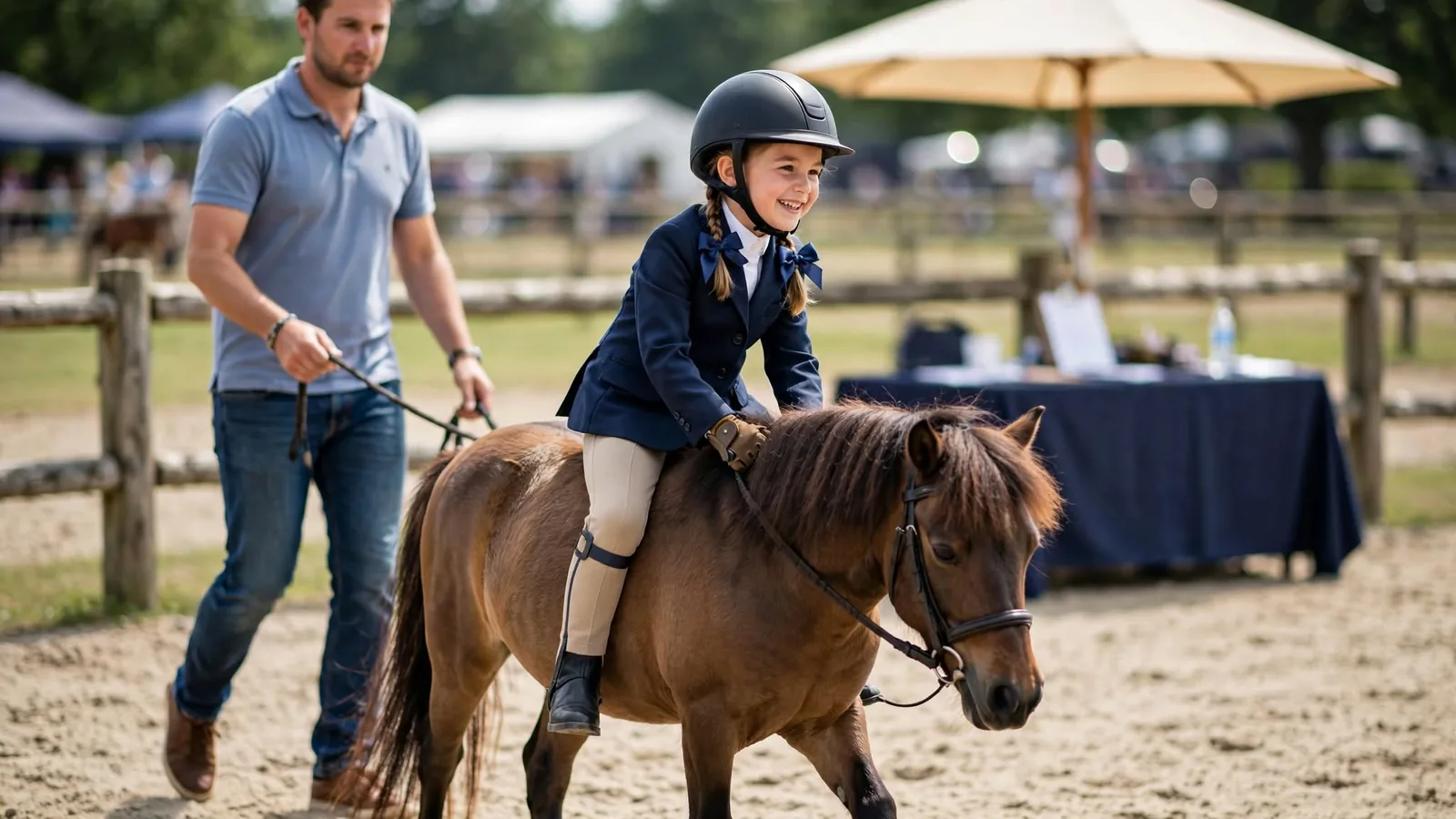
- Lead line. A walking class for the youngest riders, led by an adult on foot. Judged on turnout and smiles. Germantown charges $20 for it and requires only a helmet and boots with a heel.
- Walk-trot. No canter, no fences. Flat only.
- Short stirrup. Small jumps, usually 18 inches to 2 feet, for children under a set age (9 and under at Germantown in 2026). Includes over-fences classes and a flat class.
- Long stirrup. The same heights for older beginners, 10 and up.
- Beginner rider. At WEC’s schooling shows this is defined as riders in their first or second year of showing who have never shown 2 feet 6 inches or higher, with trotting not penalized. That last phrase is the one that matters for a first show.
- Hunter, jumper, equitation. The three rings, and the three sets of clothing rules. In hunters the horse is judged, in jumpers the clock is, in equitation the rider is. The attire guide covers each.
- Over fences and under saddle. Jumping classes and flat classes. A section is usually three or four over-fences classes plus one under saddle, and points across them decide the champion and reserve champion.
- Opportunity classes. At rated shows, lower-level sections run outside the points system so beginners can compete without full memberships. They are the sensible first rated classes.
The horse show checklist
This horse show checklist is three lists: what the rider needs, what the parent needs, and what the barn usually packs for the horse. The third list is there so you can ask, not so you can pack it.
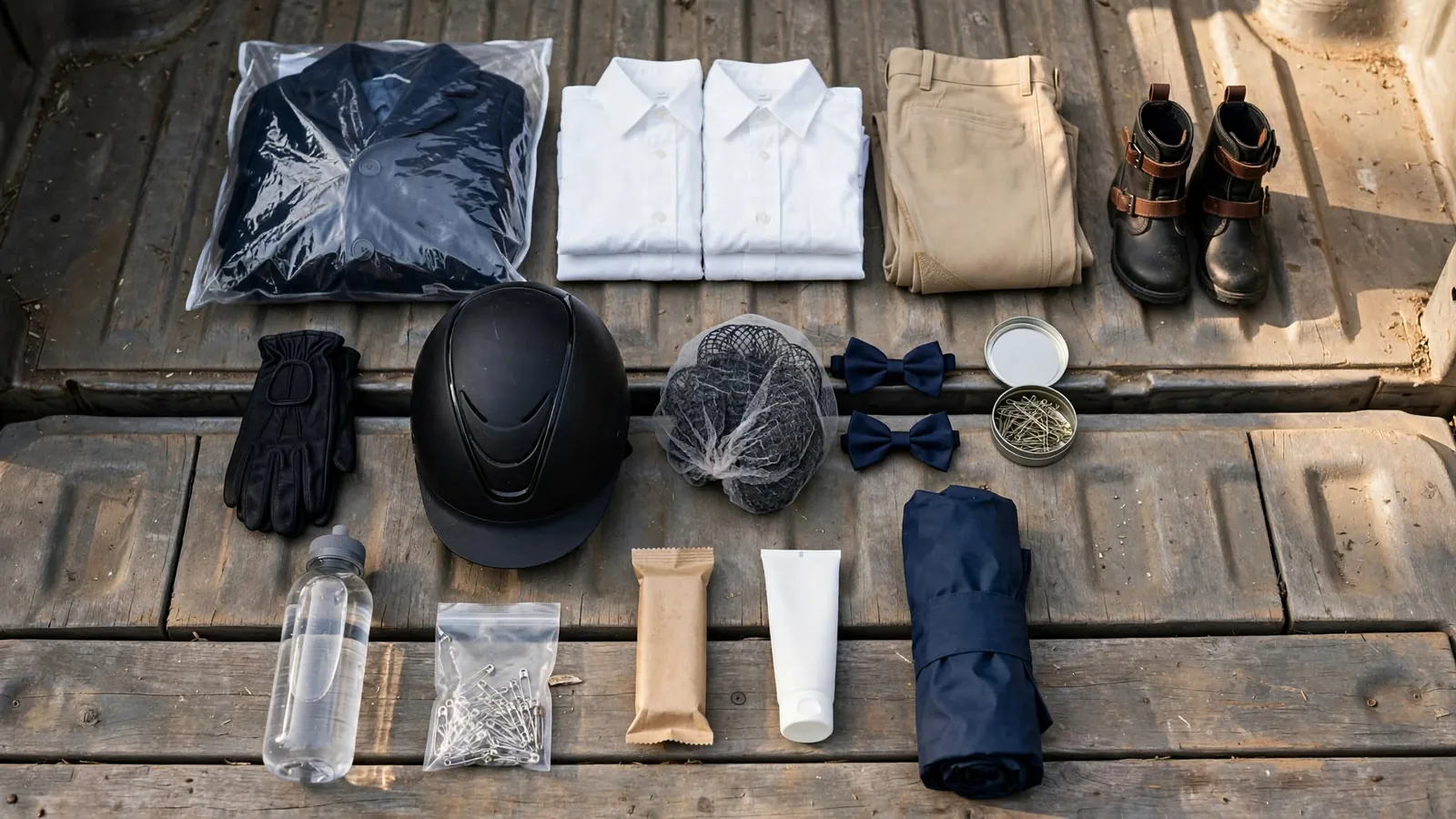
For the rider
- Helmet, certified and fastened (never borrowed, never secondhand)
- Show coat, on a hanger, in a garment bag
- Two show shirts (one spare)
- Breeches or jodhpurs, plus a spare pair
- Belt
- Tall boots or paddock boots with garter straps, polished the night before
- Gloves, plus a spare pair
- Hairnet and spare, or braids and bows for the youngest riders
- Bobby pins, hair elastics, a comb, hairspray
- Warm-up layer to wear over the show shirt until the class is called
- Rain jacket
- Number pins or safety pins
- Entry confirmation, and at rated shows the membership numbers
- Water bottle, snacks that survive a truck, sunscreen
- Change of clothes for the drive home
For the parent
- Folding chairs
- Cash for the show office and for food vendors that do not take cards
- A printed copy of the prize list and the class numbers entered
- The trainer’s phone number and the barn’s emergency contact
- Phone charger and a battery pack
- Baby wipes and a lint roller (boot polish and horse hair end up on everything)
- Cooler with water for two people and for the trainer
- Sunscreen, hat, layers; show grounds are hotter and colder than anywhere else
- A small first-aid kit
- A book. There is a great deal of waiting.
The barn usually packs, but confirm
- Tack, boots for the horse, saddle pad, fly spray
- Hay, water buckets, feed
- Coggins certificate and health papers (WEC requires a negative Coggins within 12 months and flu/rhino vaccination within 6 months)
- Grooming kit, braiding kit if braiding
- Cooler or quarter sheet for the horse
- Muck bucket, fork, shavings
What to wear, and what to buy used
The full rules are in the attire guide. For a first show the short version is: navy coat, white shirt with a stand collar, tan breeches or jodhpurs, black boots, black gloves, hair contained. For the youngest riders, jodhpurs with garter straps, paddock boots and two braids with bows are the convention; the hairstyles for horseback riding guide shows how to do the braids and the show bun, and the riding gloves guide covers sizing.
Buy the helmet new and have it fitted. Everything else in the rider list above is a fabric or leather item that a child will outgrow inside a year, and every one of them is bought and sold pre-owned by families who have been through exactly this. A first show coat that costs $99 to $290 new is the single most expensive thing on the list and the one with the shortest useful life. Our guides to what breeches are and English riding apparel cover sizing, which is the only thing that makes pre-owned buying work.
How to behave at the rail
The parent guides that exist all say the same thing here, and they are right: the trainer coaches, the parent watches. Beyond that:
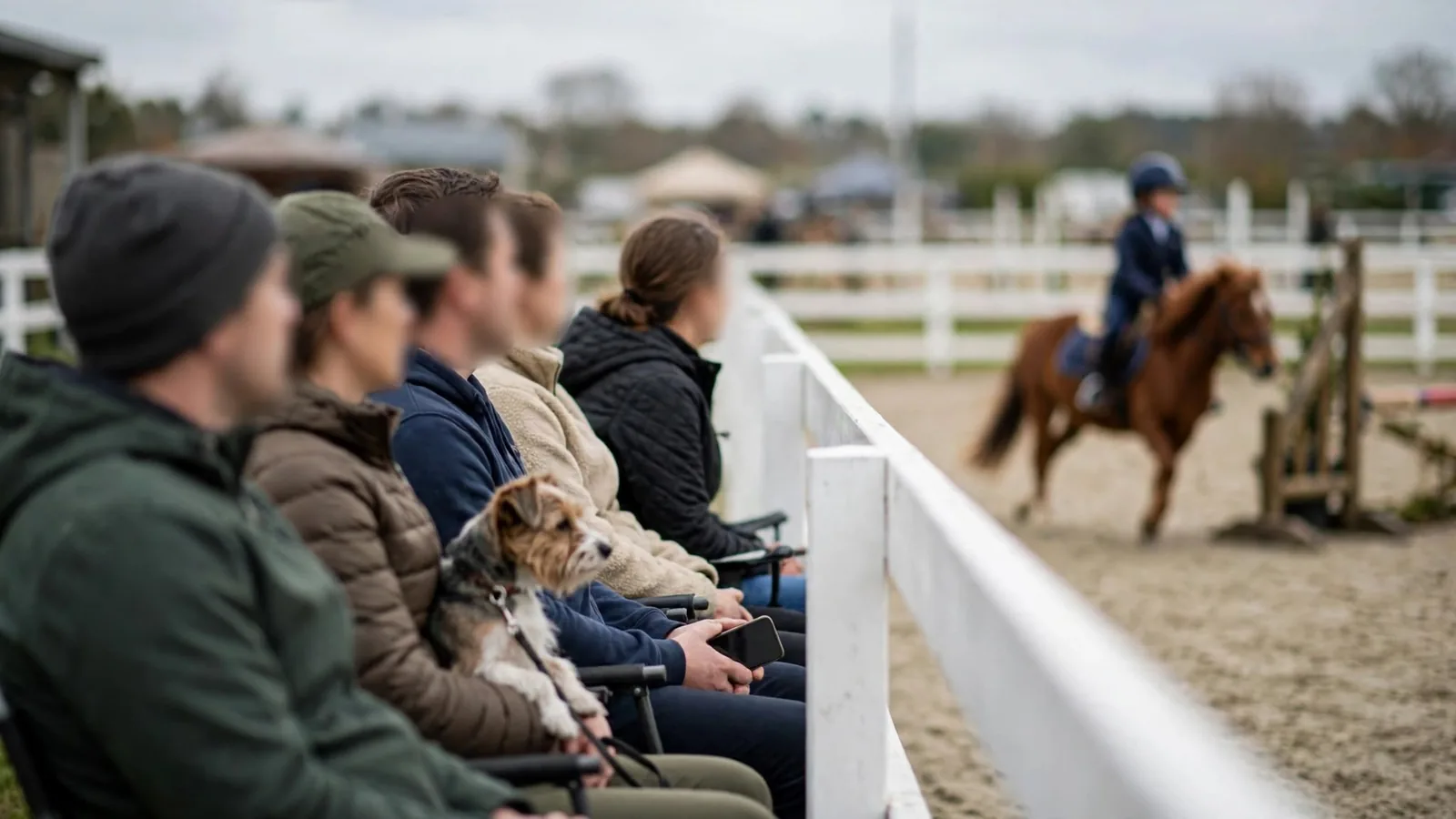
- Do not coach from the rail. One voice in the rider’s head. If you have a concern, it goes to the trainer after the class.
- Do not touch a horse you do not know. A red ribbon in a tail means the horse kicks. A horse standing quietly can still step sideways onto a foot.
- Stay off the schooling ring fence. It is the busiest, most dangerous place on the grounds.
- Clap when the class is pinned, not when your child clears a fence. Horses spook at sudden noise from the rail.
- Keep the phone down during your child’s round or you will film the ground.
- Ribbons are not the point of a first show. The point is that the child leaves wanting to do it again.
One parent, in their first year, described a four-day 4-H fair this way in a July 2026 r/Equestrian thread: “I just loved seeing everyone (~8-15 years, parents, coaches) helping each other with all the thousand things that come up (tack issues, outfits, last second event changes, staying hydrated, bloody noses, teenage emotions).” (u/R4lfJVI) That is what a good first show looks like from the chair.
What to ask the trainer before you enter
The same thread was started by a parent who had left what they called a toxic barn and listed the warning signs they wished they had known. The top-voted addition, from u/cindyana_jones: a red flag is “when the barn owner or trainer asks you to buy something expensive that benefits others equally as much as you.” Most barns are nothing like that, but a first show is the moment money starts moving, so ask, in writing:
- Which show, and is it schooling or rated?
- Which classes, and what are the entry and section fees?
- What is your coaching fee per day, your day care fee, and your hauling charge?
- Is braiding needed, and what does the braider charge?
- What memberships does my child need, if any?
- What exactly does my child need to wear, and what does the barn have that we can borrow for a first show?
- What time do we arrive and what time should we expect to leave?
A trainer who answers all seven without hesitation is a trainer to keep.
How we researched this
Costs come from published sources checked on September 16, 2026: the World Equestrian Center Summer 2026 schooling show prize list (Ohio), the 2026 Germantown Charity Horse Show prize list (Tennessee, June 2 to 6, 2026), US Equestrian’s membership page, USHJA’s membership page, and the published fee pages of Ocala Hunter Jumpers and Bridlewood Farms. The Show Pass fee is as reported by the Chronicle of the Horse. Class definitions are quoted from the two prize lists. Two parents are quoted verbatim from a public r/Equestrian thread of July 27, 2026, attributed by username and linked. We also read the two existing parent guides on this subject, from Tried Equestrian (2019) and Ponytail Bows (2019), neither of which gives prices, a checklist or a timeline, which is why this one does.
The horse show checklist sits in the middle of this guide. Everything before it explains why each item is on it, and everything after it is what to do once the bag is packed.
By the Reequestrian editorial team. Costs are taken from two published 2026 prize lists, US Equestrian and USHJA fee pages, and barns’ published show rates, all linked. Sources and dates are listed above.
Disclaimer: This article is for general information. Show fees, federation fees and barn rates change every season and vary by region; the figures here are as published on the dates given and should be confirmed with the show and your trainer before entering. Parent comments are quoted from public forum posts and reflect those individuals’ experiences, not the views of Reequestrian. If you are quoted here and would like your comment removed, contact us and we will remove it.


