


Horse stirrups are the one piece of tack a rider is attached to, which is why the choice matters more than the price suggests. A stirrup that is the wrong width can trap a foot; a stirrup with a hook on it is now banned by the rulebook; a stirrup that swivels can take the ache out of a knee. This guide covers what the parts are, the six types on the market and who each suits, how to size the width and set the length, what the 2026 rules and Pony Club policy say, what the injury research shows about trapped feet, and what each type costs in September 2026.
What a stirrup is for, and what it is not
A stirrup gives the rider a place to rest the foot, a base to rise from at the trot and to stand in over a fence, and a way to absorb the horse’s movement through the ankle. It is not a footrest to push against and it is not what keeps a rider on: balance does that, and the classic test of whether a rider is using the stirrups correctly is that they can be taken away without the position changing.
The parts have names: the eye is the slot at the top that the stirrup leather passes through; the branches are the two sides; the tread (or footbed) is the bar the foot rests on, usually fitted with a rubber or metal grip pad. Every type below is a variation on those three parts.
The six types of horse stirrups
Fillis irons
The traditional English stirrup: stainless steel, heavy, a plain closed shape with a rubber tread. Named after James Fillis, the 19th-century riding master. Fillis irons are what the show ring expects, what most lesson barns supply, and what the equitation rulebook recommends (below). They hang well, they are the easiest to find with a lost foot because their weight keeps them still, and they are the cheapest type that will last a lifetime: $70 for a stainless pair at a US retailer in September 2026.
Their weakness is the one that led to every other design: a rigid closed loop can trap a foot.
Jointed and flexible stirrups
A Fillis shape with a hinge or a flexible section in each branch so the tread can give a few degrees. Marketed for knee and ankle relief, and riders with joint pain do report it. The trade-off is that a flexible branch moves under the foot, which some riders find less stable over fences and some judges dislike in the equitation ring. $96 to $220.
Composite and wide-track stirrups
Polymer or aluminium stirrups with a wide, grippy tread, weighing far less than steel. The standard in the jumper ring, where a wide tread and an angled footbed help keep the heel down and the light weight matters less than the grip. Many are also inclined: the tread is angled so the heel sits lower without effort. $90 for a basic aluminium pair to $420 for the top models.
Safety stirrups
Any stirrup designed to release the foot in a fall. Four designs are common:
- Peacock (rubber band) stirrups. One branch is replaced by a rubber ring that pulls off under load. Cheap ($56) and long the default for children. Now banned by US Pony Clubs and caught by a new USEF rule (both below) because the hook that holds the band points upward and catches clothing.
- Bent-leg (bow) stirrups. The outside branch curves forward, leaving a gap the foot can slide out of sideways. No moving parts. From about $70.
- Breakaway and hinged-branch stirrups. The outside branch is hinged or magnetically held and opens under sideways force in a fall, then closes again. $144 for a magnetic pair to $390 for the premium hinged designs.
- Open-sided composite stirrups. The outer branch is replaced by a flexible or angled piece that lets the foot out while still supporting it. $220 to $450, and now standard at the top of the jumper sport.
Offset-eye stirrups
The eye is set at an angle so the leather lies flat against the leg and the stirrup hangs perpendicular to the horse, which makes it easier to pick up a lost stirrup and keeps the leather from twisting. A small change that riders with a stirrup they keep losing find worth the money.
Western stirrups
A different object: wood or aluminium covered in leather or rawhide, wide and deep, hung from fenders rather than leathers, in shapes named for their silhouette (bell bottom, oxbow, roper). They are sized by the tread width and the rider’s boot, and the Western safety concern is the same, a boot going through the stirrup, which is why Western boots have a high heel and a smooth sole.
How to size stirrup width
Width is the safety measurement, and the rule is simple. Dover Saddlery’s fitting guidance: “Your irons should be one inch wider than the width of your boot at the ball of the foot. When your foot is in place, you should have ½ inch of space on each side” (Dover Saddlery, About Stirrup Irons).
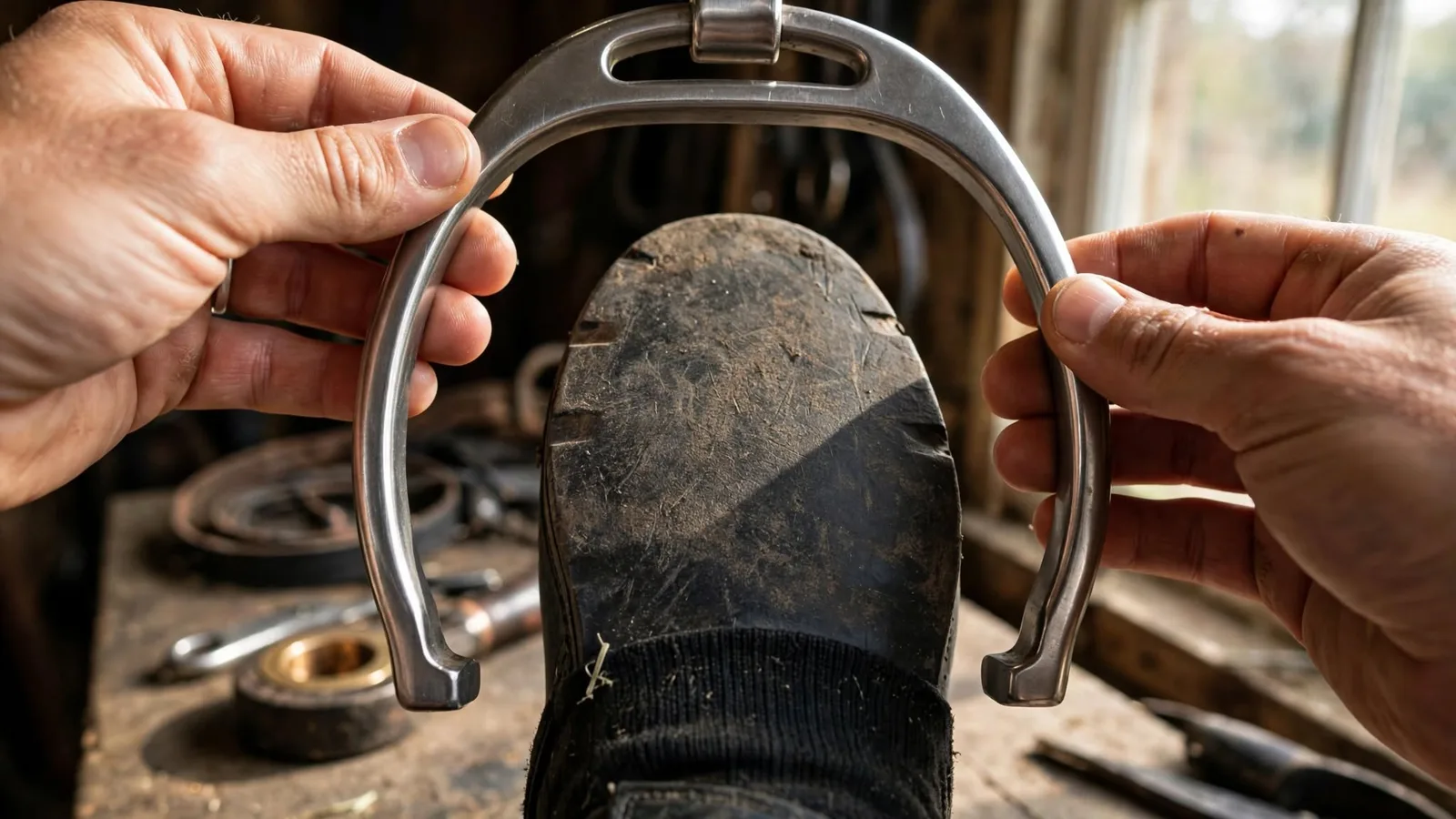
Measure the boot, not the foot, at its widest point across the ball, in the boot you ride in. Then:
| Boot width at the ball | Stirrup width to buy |
|---|---|
| 3 inches | 4 inches (children’s) |
| 3.25 inches | 4.25 inches |
| 3.5 inches | 4.5 inches |
| 3.75 inches | 4.75 inches |
| 4 inches | 5 inches |
Too narrow and the boot can wedge, which is the trapped-foot scenario in the research below. Too wide and the foot can slide through to the heel, which is the other trapped-foot scenario. Half an inch each side is the target on both counts. Composite stirrups are often sold in fewer widths than steel Fillis irons, so check the actual tread measurement rather than the size label.
How to set stirrup length
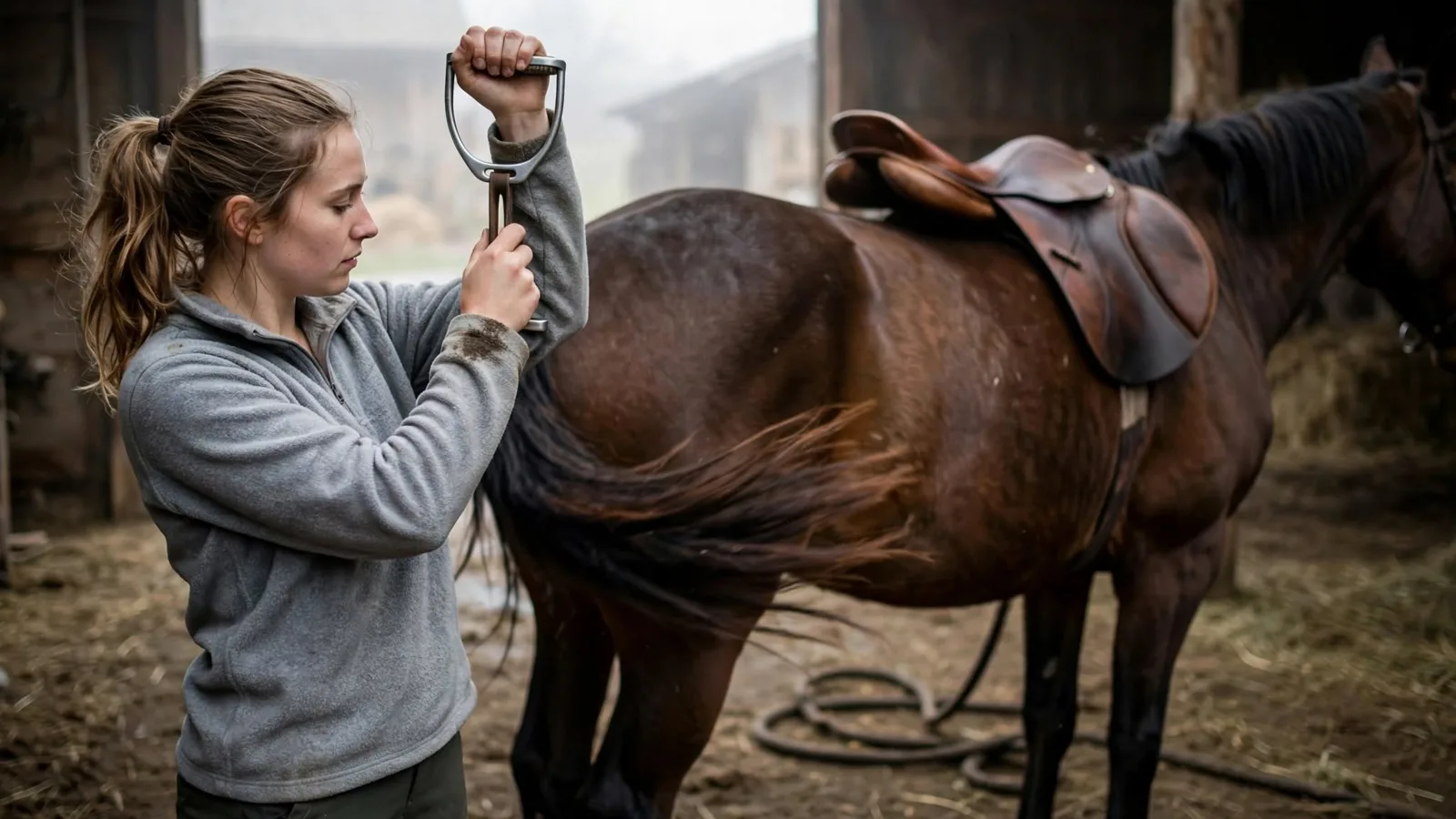
The old rule of thumb is a fair starting point: with the leather hanging from the saddle, put your fingertips on the stirrup bar and the tread should reach your armpit. Then adjust for the job:
| Riding | Where the tread hangs | Why |
|---|---|---|
| Dressage and flatwork | At or just below the ankle bone | A long leg wraps the horse and sits deep |
| Hunter and equitation over fences to 3 feet | Level with the ankle bone | Enough angle in the knee to absorb the jump, enough length to sit |
| Jumpers and higher fences | One to two holes shorter than hunter length | More knee angle for a stronger two-point |
| Cross-country | Two to three holes shorter again | Galloping position, weight off the horse’s back |
| Beginners | Level with the ankle bone | Long enough to sit, short enough to rise at the trot |
A stirrup that is too long shows as a reaching toe and a heel that will not stay down. Too short shows as a knee pushed up in front of the flap and a rider perched rather than sitting. Every barn adjusts a beginner’s length in the first lesson, and a rider who grows an inch needs a hole.
What the rules say
Three rules matter, and two of them are new.
The equitation rulebook prefers plain steel. The 2026 USEF Rulebook, EQ106.6: “it is recommended that riders use traditional stainless steel stirrup irons that promote proper position of the foot in the iron as well as a correct leg position. It is further recommended that riders use stirrup irons that allow judges a clear and unobstructed view of the position of the foot in the stirrup. Judges may not eliminate a rider for using a particular style of stirrup iron.” So composite and safety stirrups are legal in equitation, but a Fillis iron is what the judge would rather see the foot in, and a wide composite stirrup hides the very thing the class is judging.
Upward hooks are banned on saddles. General Rule GR801.6, effective December 1, 2025: “no piece of equipment shall be attached to a saddle that has a rigid upward pointing projection, hook, or similar object capable of catching a rider’s clothing or person when dismounting, including stirrups.” That is the peacock stirrup’s rubber-band hook, described without naming it.
US Pony Clubs banned peacock stirrups from January 1, 2025. Their safety update calls it “the most significant change for riders” and gives the reason: the upward-pointing hook “can catch riders during dismounts, causing torn clothing, skin damage, and in severe cases, permanent injury requiring surgery.” USPC suggests closed-branch, bow-shaped, bent-arm and breakaway designs instead, while noting it “does not endorse or promote any specific products or type of alternative stirrup” (USPC, December 2024).
Between them, those rules retire the stirrup that a generation of children learned in.
What the injury research says
The reason safety stirrups exist is the trapped foot. The clearest study is from the Children’s Hospital of Geneva: over 12 years, 258 children were admitted with horseback riding injuries, and eight had foot injuries serious enough for admission, including four “nutcracker” fractures of the cuboid and two Lisfranc fracture-dislocations. The mechanism in each case was the same: “the horse fell on the patient, and the child’s foot, entrapped in the stirrup, was caught in between the animal and the ground.” The authors’ title says what they concluded: proper footwear and safety stirrups prevent these injuries (Ceroni et al., Journal of Foot and Ankle Surgery, 2007).
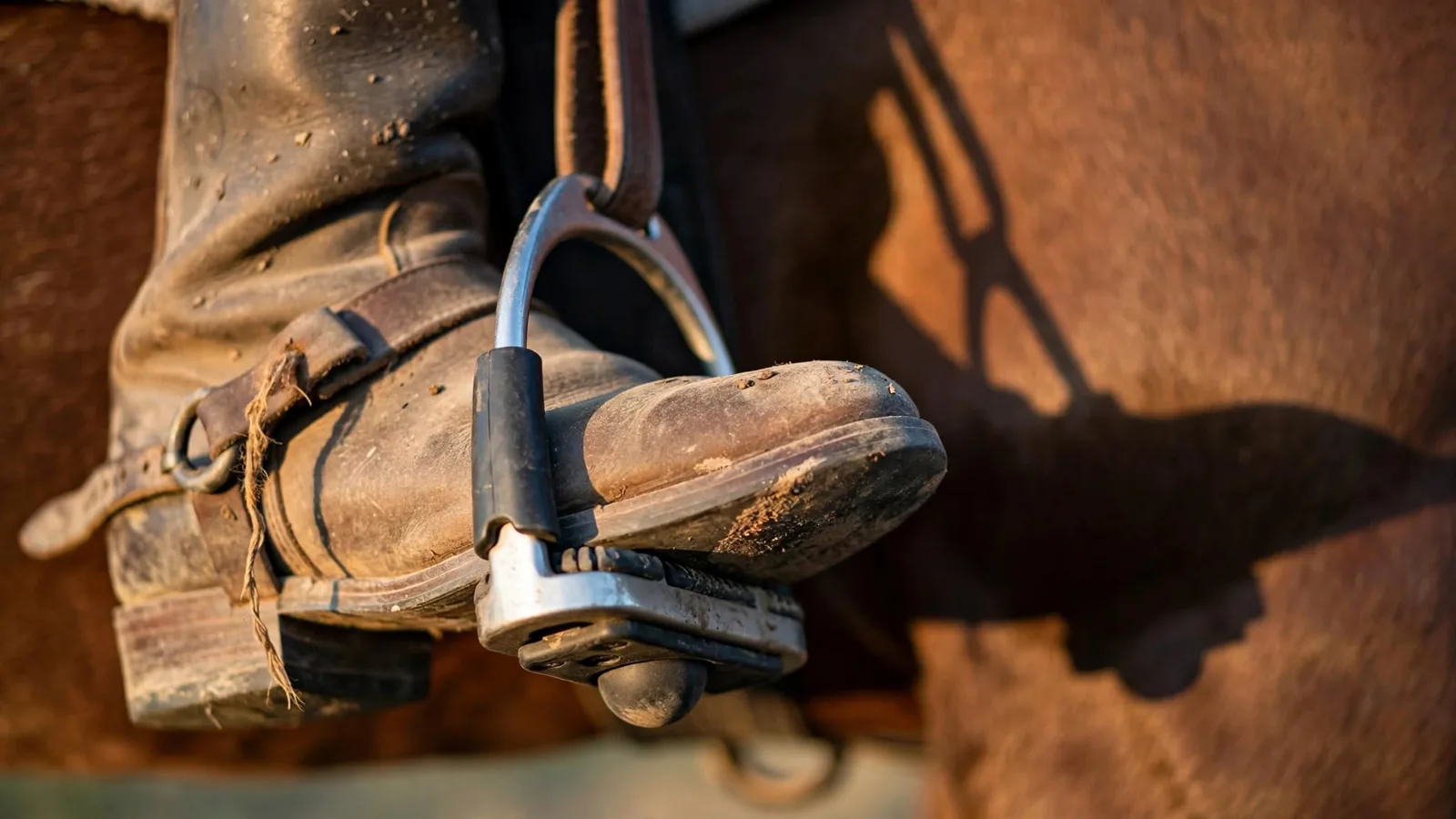
Two practical points follow. First, the boot matters as much as the stirrup: GR801.4 requires “a distinguishable heel” on any boot worn while mounted at a licensed competition, and the heel is what stops the foot going through. Our guide to what to wear to a first horseback riding lesson explains why that is the one non-negotiable item. Second, the width rule above is a safety rule, not a comfort rule, and it is the cheapest safety upgrade on the list.
Materials: steel, aluminium, composite
| Material | Weight (pair, typical) | Pros | Cons |
|---|---|---|---|
| Stainless steel | 1.5 to 2 lb | Lasts decades, hangs still, show-ring correct, cheapest | Heavy on the knee for some riders; can rust if not stainless |
| Aluminium | 0.7 to 1 lb | Light, strong, wide treads available | Scratches; cheap castings can crack |
| Composite (polymer, carbon) | 0.4 to 0.8 lb | Lightest, shock-absorbing, grippy treads | Can wear at the eye; not the equitation judge’s preference |
Weight is not a virtue in itself. A heavy Fillis iron hangs straighter and is easier to find with a swinging foot; a light composite is easier on a long day. Riders who lose stirrups over fences often do better in steel.
What horse stirrups cost
Prices as listed at a US tack retailer on September 21, 2026:
| Stirrup | Type | Price |
|---|---|---|
| Suffolk Peacock Fillis | Safety, rubber band (now banned at Pony Club and caught by GR801.6) | $55.96 |
| Korsteel Stainless Steel Fillis | Fillis | $69.99 |
| Royal Rider Easy | Composite | $69.95 |
| TuffRider Aluminum Nickel | Aluminium | $85.99 |
| Korsteel Aluminum | Aluminium | $89.99 |
| Horse-S Jointed | Jointed | $95.95 |
| Equi Wing Wide Track | Composite, wide tread | $104.95 |
| B Vertigo Aluminum Safety Magnetic | Safety, magnetic release | $143.99 |
| Royal Rider Sport Flex | Flexible composite | $175.96 to $219.95 |
| LeMieux Vector Balance | Safety, open side | $239.96 to $299.95 |
| Flex-On Green Composite Inclined | Composite, inclined tread | $285 |
| Herm Sprenger 4-F Bow Balance | Jointed, four-way pivot | $292.90 to $319.90 |
| Freejump Soft’Up Pro+ | Safety, open side, composite | $359.20 to $449 |
| Acavallo Rel-X 180 | Safety, hinged branch | $390 |
| Flex-On Safe-On Inclined | Safety, inclined tread | $395 |
| Herm Sprenger Aero | Aluminium, lightweight | $436.90 |
The pattern: a lifetime pair of stainless Fillis irons is $70; a safety design with no moving parts is $70 to $150; the open-sided composite stirrups the jumper ring has adopted are $240 to $450. Junior versions of the premium stirrups run $140 to $240.
Which stirrup for which rider
| Rider | Buy | Why |
|---|---|---|
| Child in a lesson program | Bent-leg or closed-branch safety stirrup, sized to the boot | Releases a trapped foot with no hook and no moving parts; replaces the peacock |
| Beginner adult | Stainless Fillis, sized to the boot | Cheap, correct everywhere, easiest to keep |
| Equitation rider | Stainless Fillis | The rulebook’s stated preference; the judge needs to see the foot |
| Hunter rider | Stainless Fillis or a plain safety Fillis | Show-ring convention |
| Jumper rider | Composite, wide inclined tread, open-sided if wanted | Grip and heel position over bigger fences; safety release is the norm at the top |
| Eventer | Safety stirrup with a release, wide tread | Cross-country falls are the trapped-foot scenario |
| Rider with knee or ankle pain | Jointed or four-way pivot | The give in the branch is the point |
| Endurance rider | Wide-tread endurance stirrup, often with a cage | Hours of standing weight, foot protection on trails |
Buying stirrups pre-owned
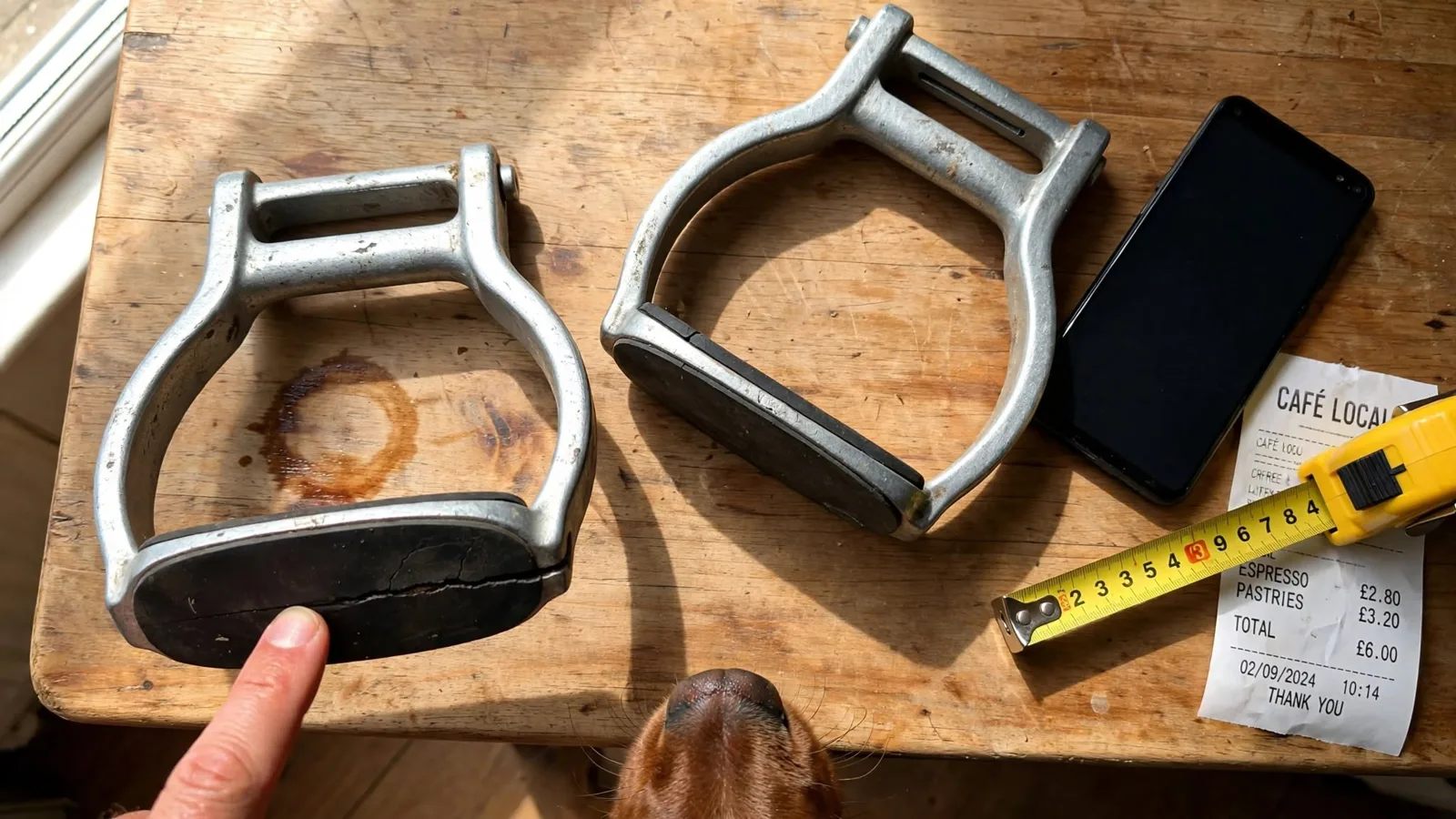
Stirrups are one of the safest pieces of tack to buy used, with three checks. On a steel Fillis, look for a crack at the eye and at the join of branch to tread, and check the tread pad is present and fits. On a composite, check the eye for wear grooves from the leather and the tread for cracked grip. On any safety stirrup with a mechanism, work the release by hand and confirm it resets; on a magnetic one, confirm both magnets are present. Do not buy a peacock stirrup at all now; it cannot be used at Pony Club or, under GR801.6, at a licensed show. Our guide to used horse tack covers the general rules for pre-owned tack, and how to measure a horse girth is the sister sizing guide for the other piece of tack riders get wrong.
Stirrup leathers, which the stirrups hang from, are a separate purchase and wear faster than the irons: check the stitching at the buckle and the holes for stretching every season.
How we researched this
Sizing guidance is quoted from Dover Saddlery’s fitting page. Rules are quoted from the 2026 US Equestrian Rulebook (EQ106.6 and GR801.4 and GR801.6) and from US Pony Clubs’ December 2024 safety policy announcement. The foot injury findings are from Ceroni et al., Journal of Foot and Ankle Surgery 2007, volume 46, pages 32 to 39. Prices are as listed at Dover Saddlery on September 21, 2026. Stirrup length guidance reflects standard instruction practice by discipline and is not a rulebook requirement.
Disclaimer: This article is general information. No stirrup design prevents all injuries, and any safety stirrup should be used with a proper riding boot with a heel and, where required, a certified helmet and body protector. Rules and prices change; confirm with your federation and retailer.


