


An equestrian show jacket is the tailored coat you compete in, and which one you need is set by your discipline and your level, not by taste. USEF dressage permits a short jacket or cutaway at every level, and a tailcoat above Fourth Level and in two named FEI test groups. Eventing forbids tailcoats in the dressage phase from Beginner Novice through Preliminary. The hunter chapter no longer prescribes coat colours outside formal classes.
Retail collection pages sort show coats into filters called Competition, Dressage, Hunter/Jumper and Shadbelly. What a filter cannot tell you is at which level a tailcoat becomes legal. This guide answers it ring by ring, with the rule number attached to every claim.
Show jacket, show coat, hunt coat, shadbelly: what the words mean
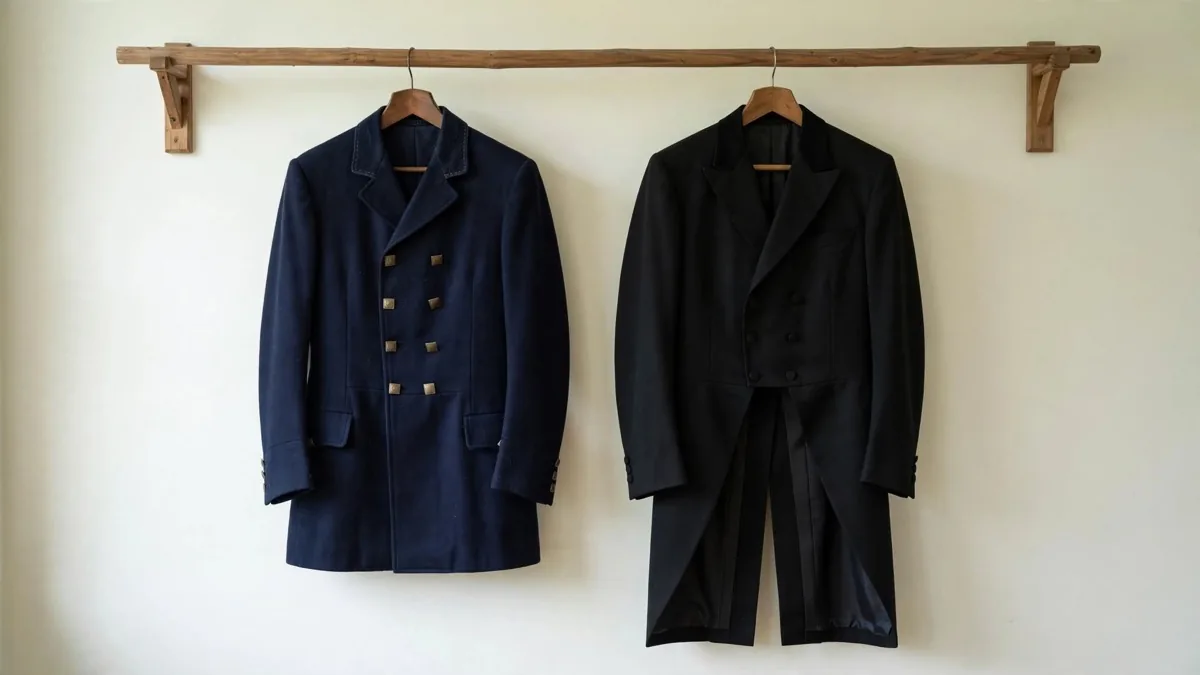
Retail listings use these words loosely. The rulebook is more precise. USEF dressage rule DR120.1.2 names a short riding jacket, a cutaway coat, and a tailcoat, and the difference between them is tail length and permission level, not quality.
| Shape | What the rulebook calls it | Where it is legal |
|---|---|---|
| Short jacket | “A short riding jacket” | Any dressage level |
| Cutaway, short tails | “cutaway coat (modified tailcoat) with short tails” | Any dressage level |
| Tailcoat, sold as a shadbelly | “A tailcoat” | Dressage above Fourth Level, plus the FEI test for seven year old horses and the FEI Junior tests, and eventing at Intermediate and Advanced. In the hunter ring it is a convention, not a rule: the word tailcoat does not appear in the USEF Hunter chapter at all |
The point for anyone buying pre-loved: a hunter tailcoat and a dressage tailcoat are cut differently. R.J. Classics, which sells both, separates them by tail: dressage tails are longer, straighter and often weighted so they do not flap, while hunter tails are lighter weight, free flowing and typically shorter. A weighted tail is meant to hang still. A light one is meant to move. If you are mapping out a full competition wardrobe rather than one garment, our guide to English horse riding apparel covers the rest of the kit.
The hunter coat colour list was replaced
In an earlier edition of the Hunter chapter the attire rule sat at HU128 and read: riders are required to wear conservatively colored coats (black, blue, green, grey or brown) which are free from adornment which in the judge’s opinion is overly distracting.
In the current chapter that colour list is gone and the attire rule is HU107. HU107.2 now reads:
Conventional attire following the tradition of fox hunting is encouraged and preferred. It is further recommended that the rider’s attire does not distract from the performance of the horse and rider. Judges shall not eliminate a rider for unconventional attire except for safety (see GR801). Shirts must have a choker, similar collar or tie. Breeches may be buff, canary, tan, rust or white.
Read the whole paragraph, not the first half of it. The shirt and breeches sentences carry over word for word from the retired HU128.2 and are still mandatory, breeches colour list included. What actually changed is the coat sentence: a list of permitted coat colours was replaced by an encouragement to follow convention.
Two further things are worth knowing. First, the colour prescription survives in one place. HU107.3 Formal Attire still requires scarlet or dark coats, white shirts with white stock, and white, buff or canary breeches. The change applies to ordinary hunter classes, not to formal ones.
Second, HU128 still exists in the chapter. It is now a judging rule rather than an attire rule, so a guide citing HU128 for coat colour is pointing at a paragraph about performance, way of moving and soundness.
Preferred still means preferred. Conservative colours remain the safe choice in a hunter class. But outside formal classes, the chapter no longer prescribes a coat colour.
When is a tailcoat permitted in dressage?
In all classes above Fourth Level, and in two named FEI test groups. DR120.1.2 is explicit:
A short riding jacket or cutaway coat (modified tailcoat) with short tails is permitted at any level of competition. A tailcoat is permitted in all classes above Fourth level, in the FEI test for 7-year old horses and in tests for FEI Juniors.
Read the rule itself and note the verb. Permitted. Not required. This matters because R.J. Classics tells riders in its own buying guide that “At higher levels, a shadbelly is eventually required.” No such requirement appears in the dressage, hunter, equitation, jumper or eventing chapters. You can ride Prix St Georges in a well cut short jacket and break no rule. Buy the tailcoat because you want it, not because a product page told you the rules changed at a level they did not.
On colour, dressage is stricter than the hunter ring. Any single colour jacket or tailcoat is permitted, with subtle pin striping, checks or tweeds allowed, while striped or multi-coloured coats are banned outright. And the coat only becomes optional at the bottom of the sport: only riders at Level 1 competitions or in Opportunity classes are exempt from wearing one.
What does eventing require across three phases?
Three different answers in one weekend, which is why an event rider cannot treat the show coat as a single purchase decision.
Dressage and show jumping are the jacket phases. At the lower levels, a jacket is not required at all, and if you wear one it may be any solid colour, tweed or pinstripe with tasteful discreet accents, piping and crystals. At Intermediate and Advanced a jacket is required, unless all three phases of a horse trials run over one day. Tailcoats are addressed in the dressage phase paragraph rather than the show jumping one.
Then comes the clause that is easy to miss. From Beginner Novice through Preliminary, the dressage phase paragraph of USEF Subchapter EV-9 states flatly:
Tailcoats are not permitted.
That is a positive prohibition rather than a silence, which is the whole point. A shadbelly bought for a Preliminary rider is not legal in that rider’s dressage test.
Cross country has no jacket requirement at all. The chapter calls for light weight clothing and a shirt of any colour with sleeves, alongside the headgear, gloves, breeches and boots rules for the phase. Your show coat is a two-phase garment at an event, not a three-phase one.
Equestrian show jacket rules by discipline: the comparison table
| Discipline | Is a coat required? | Tailcoat status | Rule |
|---|---|---|---|
| Hunter | Conventional attire encouraged and preferred, with no coat colour list in ordinary classes. Formal classes require scarlet or dark coats with white shirt and white stock | Not mentioned in the chapter. Worn by convention in derbies, classics and medal finals | HU107.2, HU107.3. Full breakdown in our hunter jumper attire guide |
| Equitation | Judges shall not eliminate a rider for inappropriate attire except for safety | Not mentioned in the chapter | EQ106.2 |
| Jumper | Three named tiers. Formal requires dark, muted or scarlet coats; Proper allows any colour; Standard requires no coat | Not mentioned in the chapter | JP111.11 |
| Dressage, USEF | Short jacket or cutaway at any level; coat optional only at Level 1 and Opportunity | Permitted above Fourth Level, FEI seven year old test, FEI Junior tests | DR120.1.2 |
| Eventing | Required at Intermediate and Advanced, optional below; none for cross country | Permitted at Intermediate and Advanced, prohibited in the dressage phase from Beginner Novice to Preliminary | EV-9.5.b |
| Dressage, FEI | Any single colour tailcoat or jacket approved by the athlete’s national federation; striped and multi-coloured not permitted | No level restriction on tailcoats, though Art. 431.2.2 requires a jacket at CDIP, CDICh and CDIYH | Art. 431.2.1 |
One note on that FEI line. The FEI still allows protective headgear formed as a top hat. What changed is that it must be certified protective headgear.
When are you allowed to ride without a jacket?
Not when you decide you are too hot. In USEF dressage the waiver belongs to the show, not the rider: competition management may publish in the prize list that jackets are waived, or announce it when extreme heat or humidity is forecast. Even then you still need a collared, sleeved shirt and no neckwear.
Eventing publishes an actual number. At temperatures above 85 degrees Fahrenheit, a heat index above 85, or at the discretion of the Ground Jury or the Organiser, Preliminary, Intermediate and Advanced riders may be permitted to compete without jackets in the dressage and show jumping phases. Pack the coat regardless. The decision is announced, and it may not go your way.
Will your show jacket fit over an airbag vest?
USEF dressage protects the rider who wears one: a body protecting or inflatable vest designed for equestrian sport may be worn in any division or class without penalty from the judge. In eventing, a body protecting vest is mandatory for the cross country phase and its warm-up, and an inflatable vest may be worn without a body protecting vest during the dressage and show jumping phases, which is exactly when the coat is on.
So the coat has to go over the vest, and it has to not interfere with it. Kerrits states that its Affinity Aero show coat is Freejump Airbag Compatible, meaning it can be worn over a FreeJump Airbag, and that as required by the CRITT Sport-Loisirs it has been tested to ensure the fabric does not slow the inflation speed required by airbag standard NF S72-800:2022. Read the scope: that is a claim about one airbag brand, not about airbags generally.
NF S72-800:2022 is a live standard, not a marketing number. Horse Pilot says all of its equestrian airbag vests are made in France and certified to it, and that an airbag must be inspected every two years or after every five deployments.
If you ride in an airbag, measure over it before you buy, and treat airbag compatibility as a stated specification rather than a marketing line.
Are mesh and vented show jackets legal in dressage?
Only if the panel is the right colour. R.J. Classics says its mesh show coats are extremely popular thanks to their breathability, stretch and silhouette. DR120.1.2 contains a clause that catches buyers out: the colour of stretch or breathable panels in a jacket may be black or the same colour as the garment fabric.
A navy coat with a grey mesh side panel is not legal in a USEF dressage test. A navy coat with navy or black mesh is. Check the panel colour on any pre-loved listing before you commit, and ask the seller if the photographs are not clear.
What to check when buying pre-loved
Show coats are breathable garments made from soft, light materials such as cotton, polypropylene, microfibres or softshell, and premium versions publish performance claims: R.J. Classics specifies its imported Italian jersey as quick-dry, with UPF 50 sun protection and pill resistance. Wool has not disappeared, though. Dover still lists it as a live material filter on its show jacket collection.
Then work through four checks:
- Size to your body, not your dress size. Show coats are cut to bust and waist, and length is chosen by height: Short under 5 feet 4 inches, Regular 5 feet 4 to 5 feet 7, Long 5 feet 7 and above.
- Check the panel colour against the dressage rule above if there is any mesh.
- Check the tails on a tailcoat. Weighted points to dressage, light to hunter.
- Ask how it was washed. Fundis advises washing show coats at 30 degrees Celsius on a delicate cycle, avoiding the spin cycle and stain removers.
On price, and that range reflects which garment you are looking at, a technical short jacket or a weighted tailcoat, rather than a quality ladder. Compare like with like before you compare numbers.
Frequently asked questions
What is an equestrian jacket called? A show coat or show jacket in general use. The USEF dressage rule distinguishes a short riding jacket, a cutaway coat with short tails, and a tailcoat. Retailers file the tailcoat under Shadbelly, which is how Dover Saddlery sorts its own collection.
What to wear for an equestrian show? Work from your discipline’s attire rule, not from a product filter. The table above gives the coat requirement for each ring. For the hunter and jumper rings specifically, including the three jumper tiers, see our hunter jumper attire guide.
What does a red jacket mean in show jumping? In the USEF jumper division, scarlet is simply one of the permitted colours under the Formal tier, where dark, muted or similar coloured, or red (scarlet) coats are required. Team or sponsored coats in other colours are also permitted at that tier.
What are the best equestrian jackets? Judge them on specifications you can verify: a rule-legal panel colour, a published fabric spec such as UPF 50 and pill resistance, machine washability at 30 degrees, and, if you ride in an airbag, a stated compatibility claim naming the vest it was tested with, as Kerrits does for the FreeJump airbag.
What should I wear to a dressage show? A coat is required at USEF levels other than Level 1 competitions and Opportunity classes. A short jacket or cutaway is legal all the way up. A tailcoat becomes an option in classes above Fourth Level, and in the FEI test for seven year old horses and the FEI Junior tests.
What colour show jacket for dressage? Any single colour, with subtle pin striping, checks or tweeds permitted and striped or multi-coloured coats banned. Breathable panels must be black or the same colour as the coat.
Find the right coat for your ring
A show coat is a rule-bound garment with a long second life, which is exactly the kind of thing that should not be bought new every time a rider moves up a level. Browse show coats and competition apparel from riders across the country, or if there is a shadbelly in your tack room that no longer fits the level you ride, list it and let it go to the rider who needs it.


