


The Ariat boot size chart is built on three numbers, not one: foot length, calf circumference and shaft height. Your shoe size only settles the first. Ariat gives foot length and calf width in both inches and centimetres on its US charts and publishes a tall boot grid on its Australian site too, where the figures do not always match the US ones, and the brands checked here each run their own system, so a Medium in one maker is a different number of centimetres in another. This guide puts Ariat, De Niro, Cavallo and Tredstep in one unit.
It also covers the part a single-brand chart cannot tell you: how to translate a second-hand boot’s label into your own measurements, and what to ask the person selling it.
The three measurements every riding boot size chart is built on
Foot length, calf circumference and shaft height are the three, and only the first behaves like a shoe size. That is where riders get caught buying tall boots at a distance.
Foot length moves in small steps. Ariat’s own US men’s chart puts a size 9 at 26.2 cm and a size 10 at 27 cm, so a whole size is eight millimetres of foot.
Calf is measured around the widest part of your calf with a flexible tape, in Ariat’s wording. Height, for Ariat, runs from the back of your heel on the ground up to the bend in your knee. De Niro’s UK operation asks for the same figure from the other end: measure from the base of your heel to the back of your knee crease, and that is the height you want the boots to be behind your knee.
For foot length itself, the American Podiatric Medical Association is blunt about the limits of the number on the box: “Shoe sizes, like clothes sizes, can vary from brand to brand.” It also notes that “Your feet are not usually the same size,” and that you should buy for the larger one.
Half chaps are sized on the same two leg figures, which is why Ariat publishes separate half chap charts of calf and height alongside its boot grids rather than folding them in.
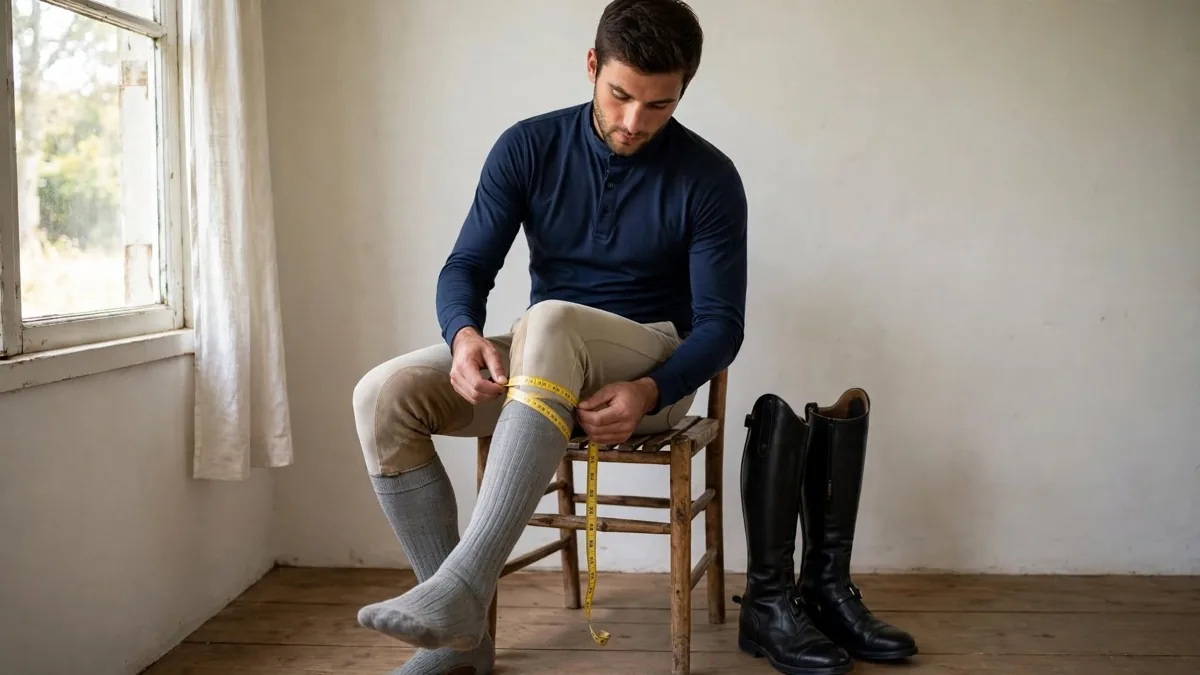
When you measure changes the number you get
The brands do not agree on how to take the measurement, and they do not even agree on whether you should be standing up.
| Brand | Posture | What you wear | Extra instruction |
|---|---|---|---|
| Ariat | Seated in a flat, straight chair, feet on the ground, legs at 90 degrees | Pants and socks similar to what you ride in | Add 1 inch to the height figure for drop allowance |
| Cavallo, standard boot | Standing, weight evenly distributed on both feet | Riding pants and riding socks | In the morning, calves are usually slimmer, while they may be slightly swollen in the evening |
Cavallo is worth reading carefully, because its standard and custom pages describe the measuring position differently. The standard boot notes put you on your feet. The custom fit instructions on the facing page say instead to make sure the leg is slightly bent, and define height as a measurement from the centre of the kneecap to just below the ankle to the floor, which is not the same line as heel to knee bend. One brand, two answers, so check which page you are reading.
The custom route asks for six measurements in total, including a calf circumference taken at a fixed height of 20 cm, and a height control measurement from the heel along the back of the calf to the knee crease, where the difference between the two readings should be between minus one and a maximum of minus three centimetres. That tolerance is a self-check. If your two numbers do not sit in that window, one of them is wrong. Cavallo also tells riders to take new measurements before each boot purchase rather than reuse last year’s.
If you tuck breeches inside the shaft, measure over them rather than over bare skin, because the fabric takes up room the chart does not know about.).
Ariat boot size chart: what the grid actually publishes
Start with the calf, because that is the figure Ariat leads with. The US charts give it in both units: men’s standard calf 13.75 to 15.25 inches, men’s full calf 14.75 to 16.25 inches, women’s standard calf 13.25 to 15.25 inches, women’s full calf 14.25 to 16.25 inches. The same page sets those four ranges in centimetres at 35 to 39, 37 to 41, 34 to 39 and 36 to 41.
Those ranges are only half of a tall boot. The rest is shaft height, and tall boots are sold against a second grid that bundles a width and a height into one code. Ariat’s Australian site publishes its men’s version of that grid in centimetres only, under the column headings WIDTH/HEIGHT. Here is the complete set of codes in the US 9 to 9.5 column, a column the same chart also labels UK 8 to 8.5, Europe 42 to 42.5 and Japan 27.5 to 28:
| Code | Width | Height |
|---|---|---|
| Short Slim | 35 cm | 47.5 cm |
| Short Reg | 37.5 cm | 47.5 cm |
| Med Slim | 35 cm | 51 cm |
| Med Reg | 37.5 cm | 51 cm |
| Med Full | 40 cm | 51 cm |
| Tall Slim | 35 cm | 54 cm |
| Tall Reg | 37.5 cm | 54 cm |
Three things fall out of that column. There are three height tiers, 47.5, 51 and 54 centimetres, not two. The width options run from 35 cm to 40 cm on identical feet, a five centimetre spread. And Slim is 35 cm in every height while Reg is 37.5 cm in every height, so width and height really are chosen independently, with Full offered only in the Med tier.
The grid is also larger than the code table suggests. A single model, the women’s V Sport zip tall boot, is listed in three heights and seven calf widths, which is twenty one shaft combinations before you have chosen a foot size.
How to read a code like Medium Regular or Media Corta
Every tall boot code is height plus calf, bolted onto a foot size. Once you know that, the Italian stops being intimidating.
De Niro names five stock heights: Extra Corta, Corta, Media Corta, Media Alta and Alta, which translate as extra short, short, short medium, tall medium and tall. Calf runs across eight codes, XXXS through XXL, with each step up in foot size adding half a centimetre to both height and calf. So 39/C/M reads as EU foot 39, Corta height, Medium calf.
Here is what those heights actually measure at EU 39 in a Medium calf, from De Niro’s own stocked size table:
| Height name | Shaft height | Calf |
|---|---|---|
| Corta | 43 cm | 35.8 cm |
| Media Corta | 45 cm | 35.8 cm |
| Media Alta | 47 cm | 35.8 cm |
Exactly two centimetres per step. The calf range at that same foot size is enormous: in the Corta height, XXXS is 30.5 cm and XXL is 40.7 cm, more than ten centimetres apart.
Tredstep runs a wider calf grid at model level. The Donatello III is sold in three shaft heights, Short, Reg and Tall, and nine calf widths: Xx Slim, X Slim, Slim, Med, Reg, Med Plus, Full, Reg Plus and Full Plus. That is nine where the Ariat V Sport offers seven, and the names overlap without matching.
The same word means different centimetres in different brands
This is the part a single-brand chart cannot do for you. “Medium” is not a measurement, it is a label, and the labels do not line up.
The rows below are each quoted at the foot size their own chart publishes them at, which is not the same foot size across brands. Read the foot size column before you compare the heights.
| Brand and code | Foot size | Shaft height | Calf |
|---|---|---|---|
| Ariat Short Reg, men’s chart | US 9 to 9.5, Europe 42 to 42.5 | 47.5 cm | 37.5 cm |
| Ariat Med Reg, men’s chart | US 9 to 9.5, Europe 42 to 42.5 | 51 cm | 37.5 cm |
| Ariat Tall Reg, men’s chart | US 9 to 9.5, Europe 42 to 42.5 | 54 cm | 37.5 cm |
| De Niro Media Corta, M | EU 39 | 45 cm | 35.8 cm |
| De Niro Media Alta, M | EU 39 | 47 cm | 35.8 cm |
An Ariat Med Reg is a 51 cm shaft. A De Niro Media Corta is 45 cm. Both carry the word medium. Those two rows sit at different foot sizes, but De Niro’s own table only adds half a centimetre of height per foot size step, so closing the gap from EU 39 to EU 42 moves the De Niro figure to about 46.5 cm. Still four and a half centimetres short of the Ariat. The brand names are not interchangeable at any size.
Cavallo’s standard chart works differently again, pairing a fixed shaft height with a calf range rather than a single calf figure, and publishing a separate range for the top of the boot alongside it. Its slim cut is narrowed by 1.5 cm in the ankle and calf area, and the brand asks you to lay the measuring tape loosely on the calf for that model specifically. A custom order only buys you a deviation from the standard of plus or minus 2 cm, and the maximum width in the size charts is a hard ceiling.
Why a boot can fit the calf and still bite at the knee
Because the top of the shaft is a separate measurement, and it is rarely published alongside height and calf. Cavallo does, calling it the finish measurement and specifying that it is taken just below the kneecap. Every calf range in its standard chart carries a top range printed directly underneath it, and across the chart that top range sits roughly two centimetres below the calf range at the same height.
UK retailer The Distinguished Rider puts the same relationship in one line. The knee circumference of a stock boot is 2 cm less than the calf circumference. If your leg does not taper by about that much between your widest calf point and just under your kneecap, a boot that measures correctly at the calf will gape or pinch at the top. Measure both points before you compare any chart.
Do Ariat boots run large or small?
Ariat’s fitting pages do not give a blanket up or down rule, and the common advice to size down contradicts the brand’s own fitting guidance. Farm House Tack states that “A good rule of thumb when fitting Ariat boots is that you should order a half-size smaller than your street shoe size.” Ariat’s fitting page says nothing of the kind. Its test is physical: remove the footbed, place your foot on it from heel to toe, and if you can place your thumb at the end of the toe area the length is right. For children, Ariat asks for at least a thumb’s width or half an inch of growing room.
Use the footbed test, not the rule of thumb.
Drop allowance, and why a pre-owned boot stops matching its label
Drop allowance is the extra shaft height a new tall boot carries so that it still reaches the right place once it has settled. Ariat’s instruction is explicit: after measuring heel to knee bend, add 1 inch to this number for drop allowance. New boots are supposed to start too tall.
How much they actually drop depends on who you ask, and the two De Niro sources do not agree. De Niro’s own UK site says that all riding boots will eventually drop lower, and on average boots will drop up to 1 cm. UK stockist Equiport, in its fitting guide for De Niro boots, puts it higher: “Boots can drop up to 2cm in height when worn in.” The two figures published for drop do not agree, so treat either as an estimate.
What both agree on is the direction, and that is enough to act on. A tall boot that has been ridden in may no longer measure what its own label says. The label describes the boot as it left the factory. The tape describes the boot you are about to pay for. When they disagree, the tape wins.
Three numbers to ask a seller for before you pay
Ask for measurements taken on the boot, with a tape, today. Not the box, not the label, not the brand’s chart.
- Foot length. Footbed removed, measured heel to toe, in centimetres. This mirrors Ariat’s own fit test and sidesteps the fact that sizes vary between brands.
- Calf circumference at the widest point of the shaft, tape laid flat around the outside, matching Ariat’s widest-point instruction for the leg.
- Shaft height at the back of the boot, from the bottom of the heel to the top edge. Set that against your own figure measured from the base of your heel to the back of your knee crease, which is the height De Niro’s UK operation asks you to state.
Ask for a fourth if the boot is a brand that publishes it: the circumference at the top of the shaft, just below where the kneecap sits. Then compare all four against your own figures, taken that week, using one consistent protocol.
Condition, zips, ankle creasing and which boots suit which ring are covered separately in our guide to hunter jumper attire, and paddock boots sit alongside tall boots in our overview of English riding apparel.
Frequently asked questions
How to find Ariat boot size? Take three measurements, then read them against the chart. Foot length using Ariat’s footbed test, calf at the widest point, and height from heel to knee bend with 1 inch added. The height and calf figures together give you the code, such as Med Reg.
Do you size up or down in Ariat boots? Ariat’s fitting pages do not give an up or down rule. Farm House Tack advises half a size down from your street shoe size, but that is a retailer’s rule of thumb and Ariat’s own pages instead ask you to remove the footbed and check for a thumb’s width at the toe. Use the footbed test.
What is the Ariat women’s size chart? On the US charts, women’s standard calf runs 13.25 to 15.25 inches and full calf 14.25 to 16.25 inches, which the same page also gives as 34 to 39 cm and 36 to 41 cm. One warning: the centimetre tall boot code grid on Ariat’s Australian site is published as a men’s chart, so do not read a women’s width and height code off it.
What is the Ariat boot size chart? It is a grid of foot size against a width and height code. Ariat’s US charts publish foot length and calf width in both inches and centimetres, the Australian site adds a men’s tall boot grid in centimetres, and a single model can be offered in three heights and seven calf widths.
How to size tall boots? Measure foot, calf and shaft height, then check the maker’s chart for that specific boot. Brands disagree on the method, so keep it consistent: Ariat measures seated with the legs at 90 degrees, and Cavallo measures a standard boot standing in riding pants and riding socks with weight evenly distributed.
How much height do Ariat boots give you? Ariat’s fitting pages do not quote an added-height figure. What they publish is shaft height, which at US 9 to 9.5 on the men’s Australian chart is 47.5 cm in the Short codes, 51 cm in the Med codes and 54 cm in the Tall codes, plus the instruction to add 1 inch of drop allowance because the shaft settles with wear.
Got your three numbers? Browse pre-owned tall and paddock boots on Reequestrian and message the seller for the tape measurements before you buy. If you have a pair sitting unworn because the calf was never right, list them and let them find the leg they fit.


