


Every good riding hairstyle does the same three things. It sits low, it stays where you put it, and it leaves your helmet sitting exactly where it was fitted to sit. Get those right and the rest is convention: a braid for schooling, hair up inside the helmet under a matching hairnet for hunters and equitation, a low bun for dressage, and bows only if you are young enough to be showing a pony. None of it is written into the rule book, which is exactly why it helps to know what everyone expects before you find out at the in-gate.
What follows is the whole subject in one place. Each style is explained step by step, every discipline and every hair type is covered, including textured and protective hair, and the rules are quoted as they are actually written rather than as people remember them. There is also a section on the things that go wrong, because a braid that works loose by the second class and a bun that slides out from under the helmet are the two most common complaints riders have, and almost nothing written about riding hair addresses either.
What are the best hairstyles for horseback riding?
The right hairstyle depends on three things: whether you are schooling or showing, which discipline you ride, and how much hair you are working with. The table below gives the short answer for each situation. Every style in it is explained in full further down.
| Situation | Hairstyle | Hairnet | Bows |
|---|---|---|---|
| Schooling, lessons, hacking | Low ponytail, then braided | No | No |
| Hunters | Up inside the helmet | Yes, matching hair colour | No |
| Equitation | Up inside the helmet | Yes, matching hair colour | No |
| Jumpers | Inside the helmet, or a low bun or braid | Usually | No |
| Dressage | Low bun below the helmet | Yes | Bun cover for juniors |
| Eventing, dressage phase | Low bun or inside the helmet | Yes | No |
| Eventing, jumping and cross-country | Inside the helmet or a secure low ponytail | Optional | No |
| Children on ponies, hunters and equitation | Two braids or pigtails | No | Yes, matching, on the ends |
| Western | Down or in a low ponytail under a hat | No | No |
If you only have time to learn one of these properly, learn to get your hair up inside your helmet under a net. It is correct in every English discipline, it is the one that judges notice, and it is the one that takes the most practice to get right.
What are the actual rules on hair for showing?
For hunter and equitation classes there is no written USEF rule about hair at all. The tradition is real, and judges do consider turnout, but the rule book itself never mentions it.
That is worth knowing precisely, because most guides gesture vaguely at “the rules” without ever having read them. The 2026 USEF Rule Book, Chapter EQ, rule EQ106 Appointments for Hunter/Jumping Seat Equitation covers headgear, attire, spurs and crops. On attire it says that “conventional attire following the tradition of fox hunting is encouraged and preferred” and that judges “shall not eliminate a rider for inappropriate attire except for safety.” On headgear it says helmets “must be free from non-traditional adornment.” Hair does not appear anywhere in it.
The only hair rule in the entire equitation chapter sits in the Western Seat Equitation section, and it says only that hair “must be neat and securely fastened if long so as not to cover rider’s number.”
So what does that actually mean when you are standing at the in-gate?
- In hunters and equitation, hair inside the helmet under a matching net is a long-standing expectation rather than a regulation. Equitation judges score the rider’s overall turnout, and a rider who ignores the convention looks unprepared next to the ones who follow it, even though no rule has been broken.
- A bow on the helmet itself is the one thing that might run into the “non-traditional adornment” clause. Bows belong on the hair, never on the hat.
- Your number has to stay visible. That is the one thing that can genuinely cost you, in any discipline. A braid or bun that covers the number is a real problem in a way that a stray flyaway never is.
Local and schooling shows are looser again. If you are not sure what a particular show expects, watch what the riders placing there are doing and copy it.
How should your hair sit under a riding helmet?
Your hair must not change where the helmet sits on your head. Anything on the crown, or high at the back, tilts the helmet, and a tilted helmet is no longer doing the job it was fitted to do.
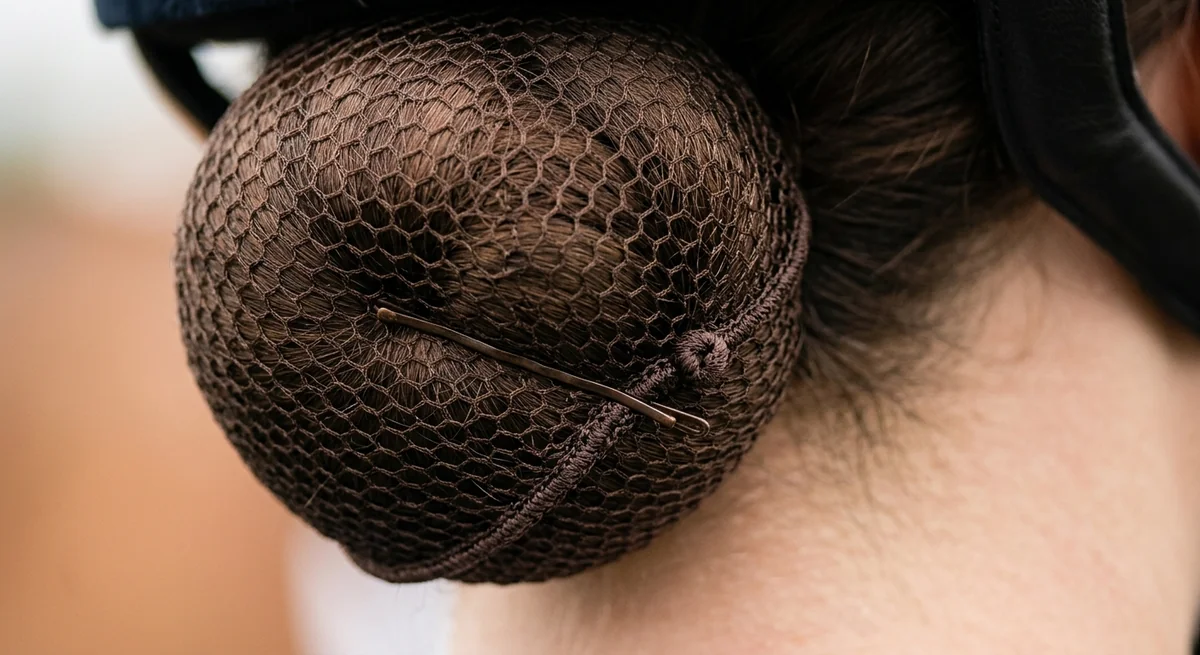
The mechanism is simple once you see it. A riding helmet is fitted to sit level, with the front edge just above the eyebrows and the rear cradle seated snugly against the back of the skull. A high ponytail or a bun on the crown lifts the back of the helmet, which tips the front down toward your eyes and pulls the rear cradle away from the bone it is meant to grip. The harness is still fastened. The helmet still feels as if it is on. It has simply stopped sitting where it protects you.
Two rules follow from that.
- Everything sits at or below the nape of the neck. A low ponytail, a low bun, a low braid. Nothing on the crown, ever.
- Fit your helmet with your hair the way you actually ride in it. If you school in a braid and show with your hair inside the helmet, those are two different head shapes, and the helmet fits them differently. Try both before you compete. Helmets with a dial adjuster at the back make switching between them much easier.
The complaint riders make most often, that the bun “plops out of the bottom of the helmet” halfway through a ride, is this same mechanism working in reverse. A bun that starts under the helmet edge gets pushed down by the helmet as you ride, until it has become a ponytail. The fix is in the troubleshooting section further down.
How do you do hunter hair?
Hunter hair means all of your hair inside the helmet, with nothing visible below the helmet edge except a fine hairnet that matches your hair colour. There are three ways to get there, and which one you use depends on how much hair you have.
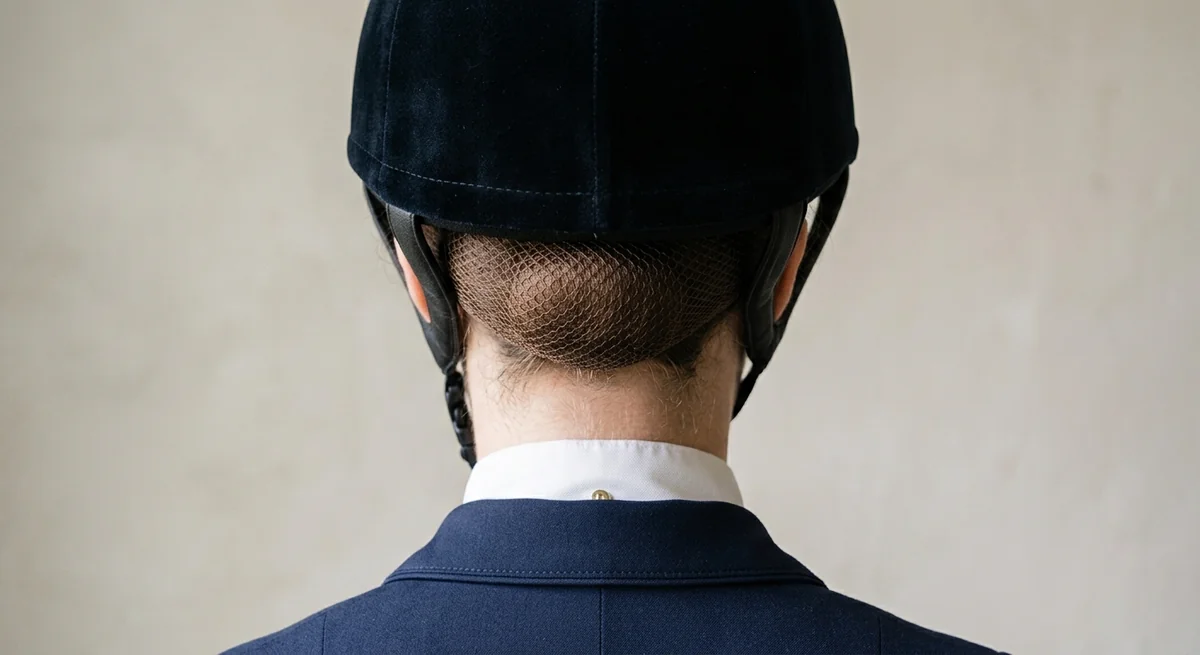
Knotted hairnet, for short to medium hair
A one-knot hairnet has a single knot at the back that gathers the hair into it, which is what makes it work on hair that is too short to gather on its own.
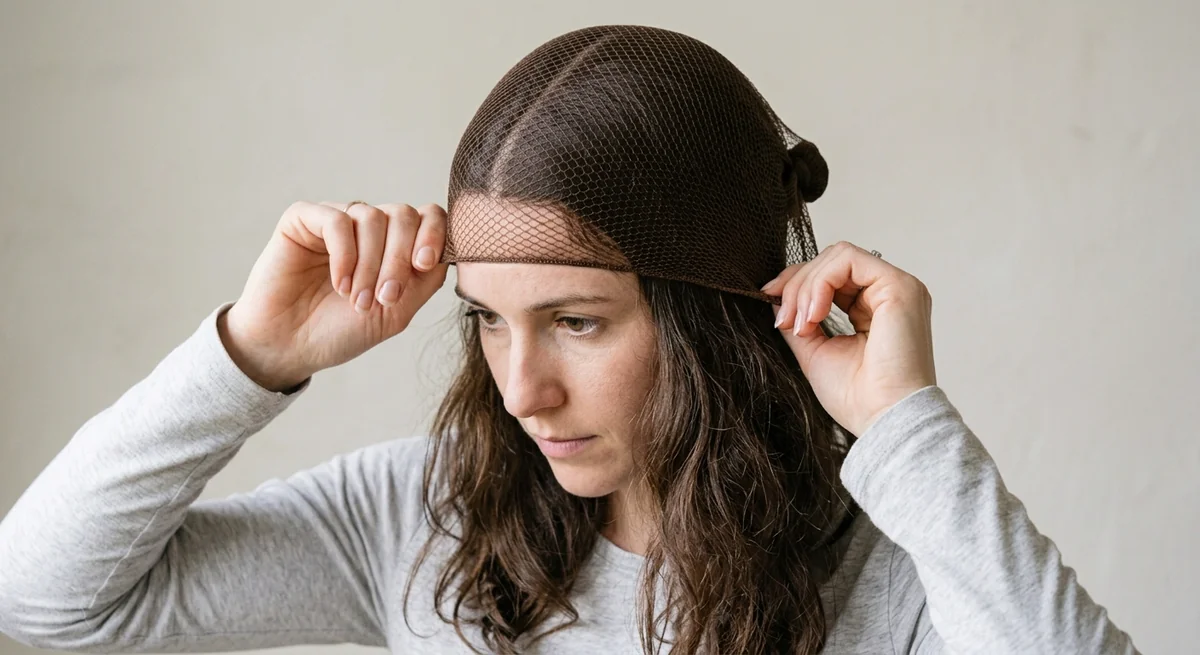
- Part your hair the way you normally wear it.
- With the knot at the back, lay the net over your head and pull it down to your nose, as if it were a cap.
- Smooth your hair back over your ears and gather it into the net, as though you were making a low ponytail.
- Slide the net back up to your hairline and settle the sides over your ears.
- Flip the gathered hair up over the back of your head, then put your helmet on from back to front so that the helmet holds the hair flat as it comes down.
- Tuck anything still showing below the helmet edge back up under the net.
No-knot hairnet, for long or thick hair
A no-knot net is a plain tube of mesh with no gathering point, which is what lets it spread thick hair flat across the head instead of bunching it into one lump.
- Open the net, put it around your neck like a collar, and pull your hair through it.
- Pull the net up and over your head so that it covers all of your hair.
- Settle the edge at your hairline, with the hair partly covering your ears.
- Flip your hair up and fan it out flat across the back of your head.
- Put your helmet on from back to front.
Double hairnet, for very thick hair
If one net will not hold it all, use two. The first net makes a low ponytail. The second goes over the whole head and holds the flipped-up ponytail flat. Heavy-weight nets exist for exactly this job and are worth owning if your hair is dense.
One thing to keep in mind for hunters and equitation: coloured nets, show bows, decorative bun covers and anything else that draws the eye are all wrong here. The whole point is that your hair looks neat and is otherwise invisible.
How do you do a horse show bun for dressage?
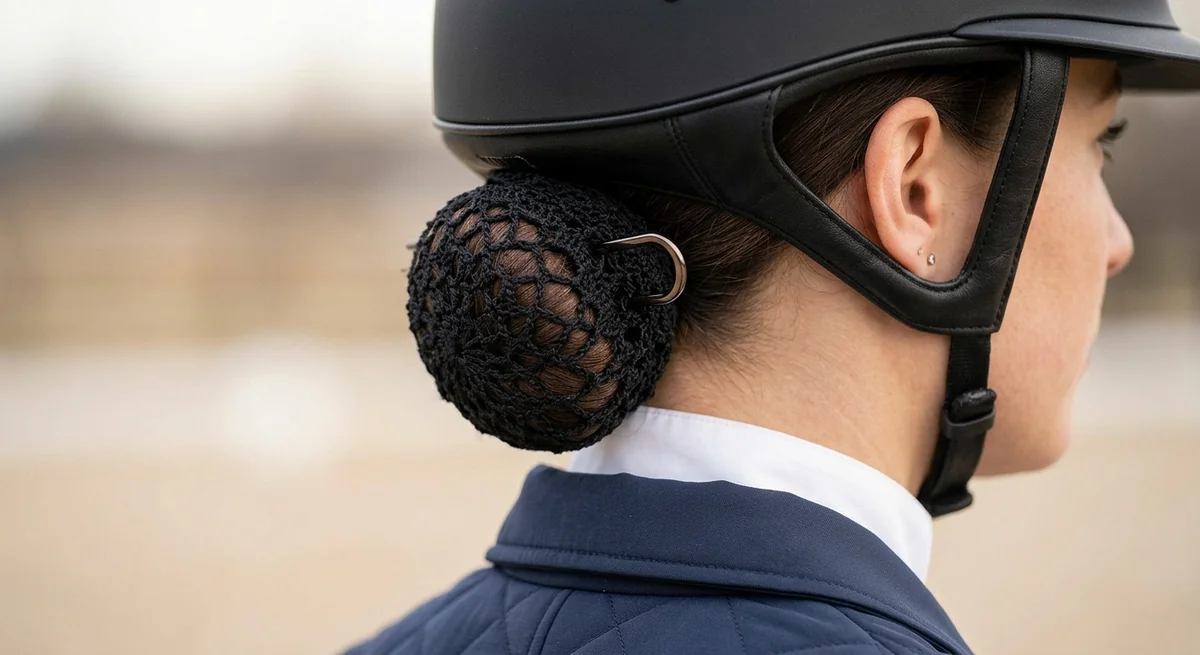
A dressage bun sits low at the nape of the neck, below the helmet edge, covered with a hairnet and pinned so that it cannot move. It has to look neat from behind, because for most of the test that is the view the judge has of you.
The basic low bun
- Brush the hair straight back and gather it at the nape, never on the crown.
- Make a low ponytail and secure it with an elastic that matches your hair.
- Twist the ponytail and wrap it around its own base.
- Pin it with bobby pins pushed in toward the centre of the bun. Use more than you think you need.
- Stretch a hairnet over the bun and tuck the edge underneath.
- Add a bun cover, a scrunchie or a show bow if you want one. They are common in dressage and expected on junior riders.
- Put the helmet on last and check the back in a mirror. The bun should sit just below the helmet edge without pushing it forward.
The braided bun, for long or thick hair
A twisted bun made from a lot of hair ends up large, and a large bun pushes the helmet forward. Braiding the hair first solves it.
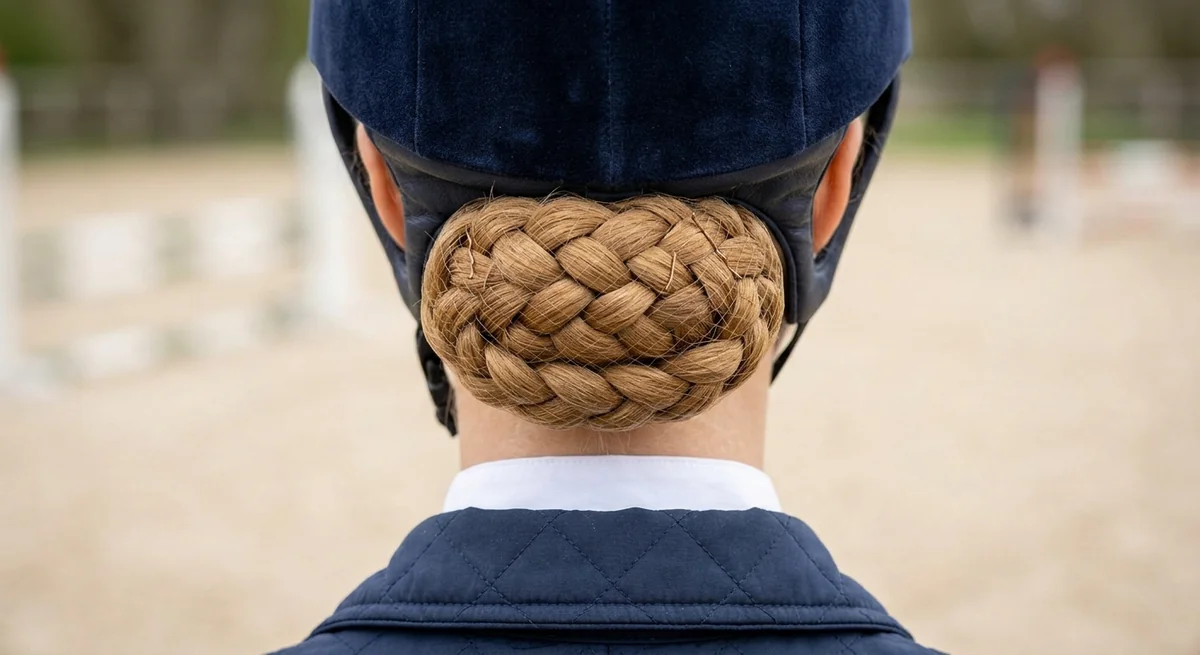
- Make the low ponytail.
- Split it in two and braid each half.
- Wrap the two braids around each other and around the base.
- Pin, net and finish exactly as above.
The braids give the bun structure. It sits flatter against the head, and it holds its shape over a long day where a twisted bun gradually collapses.
The donut bun, for short or thin hair
A hair donut is a foam ring that fills out a bun when there is not enough hair to make one on its own.
- Make the low ponytail.
- Slide the donut down to the base.
- Spread the hair evenly over the donut so that none of the foam shows through.
- Pin the ends underneath, then net the whole thing.
Choose a donut small enough that your shortest layers can reach all the way around it. If they cannot, the foam will show.
The snood, for hair that will not stay in a bun
A snood is a lace or crocheted pouch that holds the bun and anchors to the head with long pins. Riders with very long or very slippery hair use them because a bun inside a snood cannot fall out. It reads as slightly more decorative than a plain net, which makes it right for dressage and wrong for hunters.
What hairstyles work for schooling and lessons?
For everyday riding you want hair off your face, off your neck, and not tangling into anything. A low ponytail that is then braided down its length does all three, and it stays in better than either a plain ponytail or a plain braid on its own.
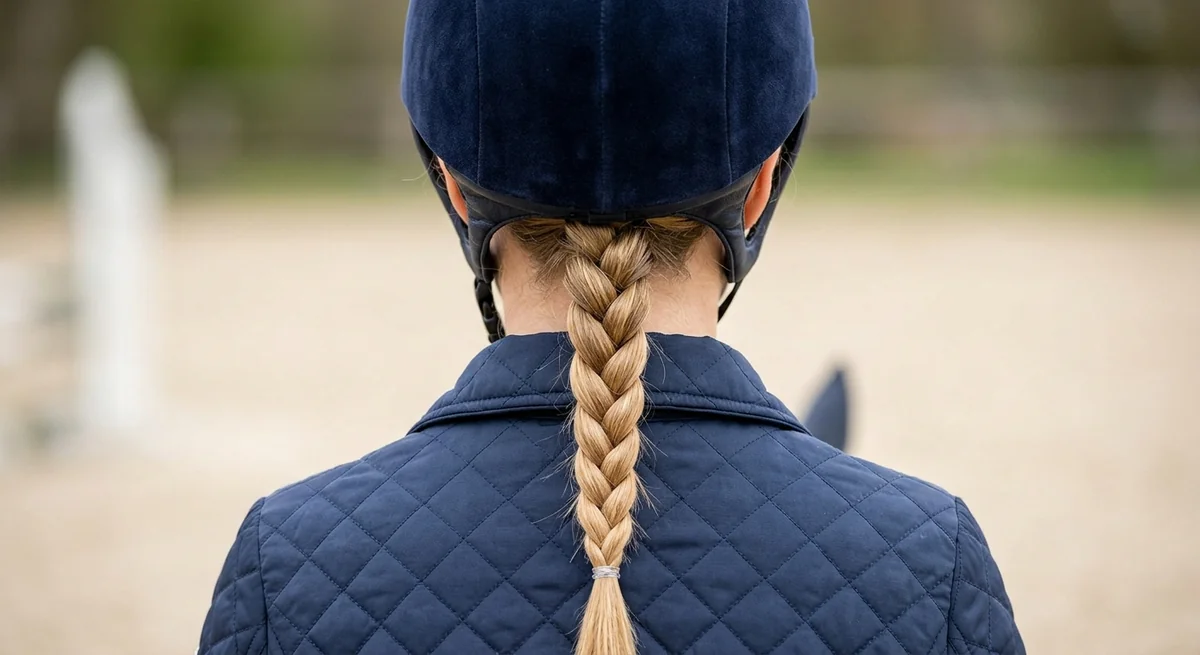
That last point is the one worth understanding. A braid on its own works loose from the top down, because there is nothing holding the top. A ponytail on its own tangles, because the length is free. Put the elastic in first and then braid the tail, and each one fixes the other’s weakness.
The French or Dutch braid starts at the crown and lies flat against the head, which means it fits under a helmet and holds layered hair in. The difference between the two is that a French braid passes the strands over each other and a Dutch braid passes them under, and the Dutch version holds fine hair slightly better.
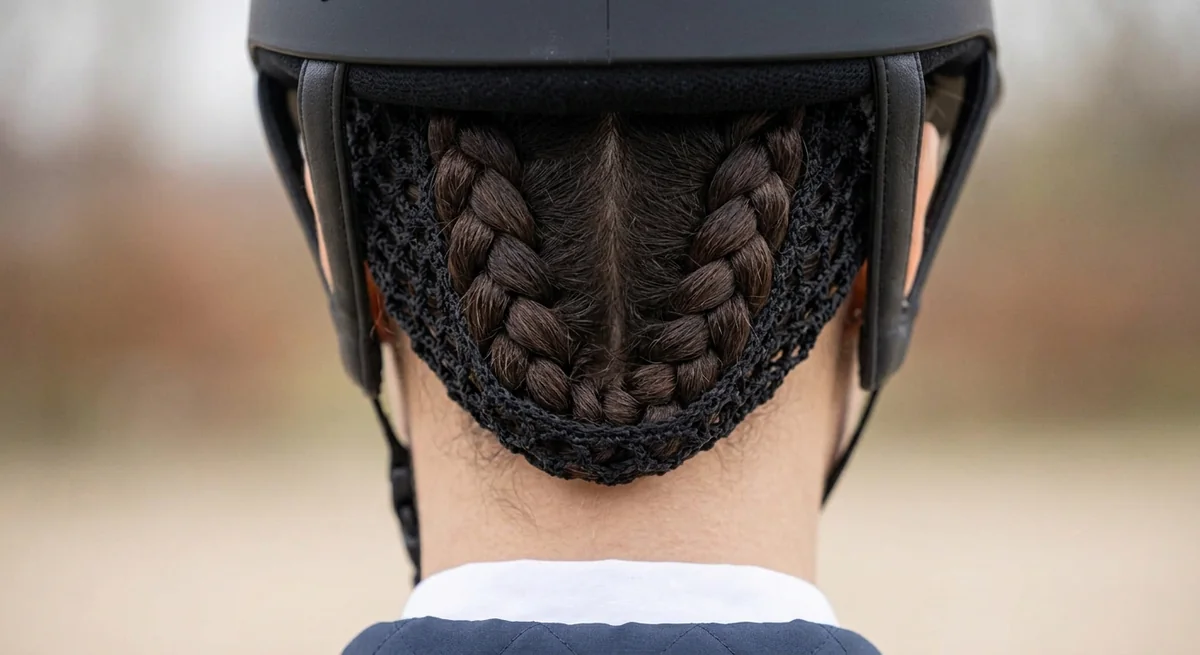
Two French braids crossed and pinned is the version for bad weather or a lot of layers. Braid each side, cross them at the nape, and pin each end up under the opposite braid. Everything stays flat and nothing hangs down to get wet or caught.
A plain low ponytail is fine for a short session with medium-length hair. With long hair it tangles, catches on jacket zips and works its way under your collar, which is why almost every rider with long hair ends up braiding it.
The fishtail braid is the one to skip. It looks good standing still and knots badly the moment you move. A regular three-strand braid is the answer for riding, every time.
How do you do hair for kids at a horse show?
Children on ponies wear two braids with a matching show bow on the end of each, or two pigtails with bows if the hair is too short to braid. It is the traditional look for the pony divisions in hunters and equitation, and it is the one place in English showing where bows belong.
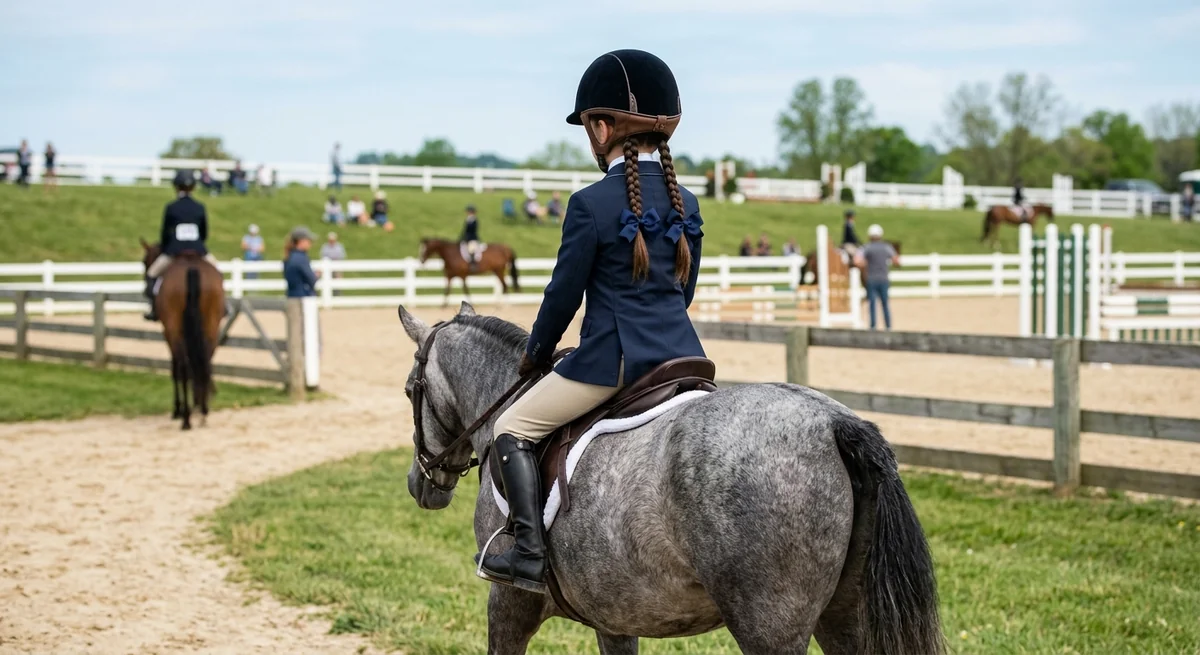
Two braids with bows
- Part the hair down the middle.
- Braid each side and tie off the ends with elastics.
- Clip or tie a bow onto the end of each braid. The two bows should be identical.
- If the braids are long enough to cover the number on the child’s back, fix the bows higher up the braid and let the tail hang below them.
Pigtails with bows are the version for shorter hair. Part down the middle, gather each side into a low pigtail, and add a bow to each.
Puffs with bows work for natural or textured hair. Part down the middle, wet and detangle each side, slick it back with gel, secure each side in a band, and add a bow to each puff. A leave-in conditioner keeps the curl defined through a long day.
Matching the bows to the rest of the turnout is expected. Bows usually match the show jacket or the pony’s browband, and a rider with several outfits usually owns a set for each one.
Knowing when the bows stop matters more than people expect. The convention is that bows belong to the pony divisions. When a rider moves up to the junior horse divisions, usually somewhere in the early teens, the hair goes up inside the helmet and the bows are retired. Keeping them past that point is the single most common tell of a family new to showing.
That timing is also what makes bows one of the better things to buy pre-owned. They are worn for a season or two, a handful of times each, and ribbon does not wear out. Show bows on Reequestrian are listed by families whose riders have already moved up.
What hairstyles work for each hair type and length?
Every hair type has a style that works and a style that will not, and the difference is usually in the details rather than the basic shape. The table is the short version.
| Hair | For schooling | For showing | Watch out for |
|---|---|---|---|
| Short, above the collar | Clips, or nothing | Fine hairnet under the helmet | Flyaways at the nape |
| Short-ish, collar to jaw | Low half-ponytail with clips | Knotted hairnet, hair flipped up | Too short for a bun, too long to ignore |
| Shoulder length | Low ponytail | Donut bun, or knotted hairnet | The hardest length for a bun |
| Long | Low ponytail then braid | Inside the helmet, or braided bun | Bun pushing the helmet forward |
| Very long, past the waist | Low ponytail then braid | Braided bun in a snood | A twisted bun collapsing |
| Thick | French braid | No-knot or double hairnet, braided bun | One thick twist makes a lump |
| Fine or slippery | Dutch braid | Texture spray, then any style | Pins sliding out |
| Layered | French braid | Hairnet over everything | Layers poking out of a braid |
| Curly | French braid or low bun | Low bun with gel, netted | Frizz at the edges |
| Textured | Two French braids | Braids crossed and netted, or a low bun | Bulk under the helmet |
| Braids, locs, twists | Low ponytail or bun | Flattened and netted under the helmet | Micro braids sit flattest |
A few of those rows need more than a table can hold.
The short-ish length is the one people ask about most and get the least help with. Hair that falls somewhere between the collar and the jaw is too short to bun and too long to leave alone. The knotted hairnet method described above is the answer, because it gathers hair that will not gather on its own, and once flipped up the section is short enough to sit flat inside the helmet.
Fine hair needs grip before it needs a style. Dry shampoo, texture spray or a little mousse worked into the roots gives the pins something to hold onto. Riders who have tried everything tend to settle on leave-in conditioner instead of hairspray, because it gives hold without stiffness and does far less damage over the course of a season.
Layered hair poking out of a braid is a grip problem rather than a braiding problem. A wax stick or braiding balm run along the braid before you tie it off holds the short pieces in place.
Textured and protective styles should be flattened rather than fought. Micro braids and small twists sit flattest under a helmet. Wet the hair, work in gel or mousse, flatten it, cover it with a heavy-weight net, and once the helmet is on, tuck any loose sections up under its edge. A leave-in conditioner afterwards stops the gel from drying the hair out.
Why does my braid fall out, or my bun drop out of my helmet?
Braids fall out because they are started too loosely at the top. Buns drop out because they are started too high. Both have simple fixes, and so do the other things that go wrong on show day.
A braid that works loose from the top needs an elastic at the top. Make a low ponytail first and then braid the tail, so the elastic holds the point where a plain braid always fails. If it still loosens, the hair needs grip: mousse or texture spray before you start, and a wax stick run along the finished braid.
Layers poking out of the braid need braiding balm or wax on the short pieces before you begin. A French or Dutch braid also catches layers that a plain braid lets go of.
A bun that “plops” out of the bottom of the helmet started too high. It began under the helmet edge, and the helmet pushed it down as you rode until it had become a ponytail. Start the bun lower, at the nape and clear of the helmet, then pin it more than feels necessary and net it. If you have a lot of hair, use the braided bun, which holds its shape where a twisted bun gives up.
A bun that collapses on very long hair is too heavy to hold itself. Twisted buns on waist-length hair almost always fail by the second class. Braid first, wrap the braids, and put a snood over the top anchored with long pins.
A bun that pushes the helmet forward has too much hair in one place. Use the braided bun instead of a twisted one, or take the hair inside the helmet instead of leaving it below.
A hairnet that shows or tears is usually the wrong net, worn the wrong way. A single thickness of net tears easily, so fold it double before it goes on. If it shows, the colour is wrong. Nets should match the hair, and a black net on brown hair is visible from across the arena.
A helmet that feels different at the show than at home was fitted with one hairstyle and is being worn with another. Fit it with the show hairstyle, or use a dial-fit helmet and adjust it on the day.
When should you do your hair on show day, and what should you pack?
Do your hair before you tack up, after the show shirt has gone on, and before the jacket.
Hair takes ten minutes when you are calm and twenty when you are not, and it is far easier standing at the trailer than crouched in a stall with a horse leaning on you. Doing it early also means the net has settled and any loose strands have shown themselves long before you reach the in-gate.
The order is shirt, then hair, then jacket. Pulling a jacket over a finished bun is fine. Pulling a shirt over one undoes twenty minutes of work.
Start with hair washed the night before rather than that morning. Freshly washed hair is slippery, and slippery hair will not hold pins or a braid.
The hair kit for the show bag should hold:
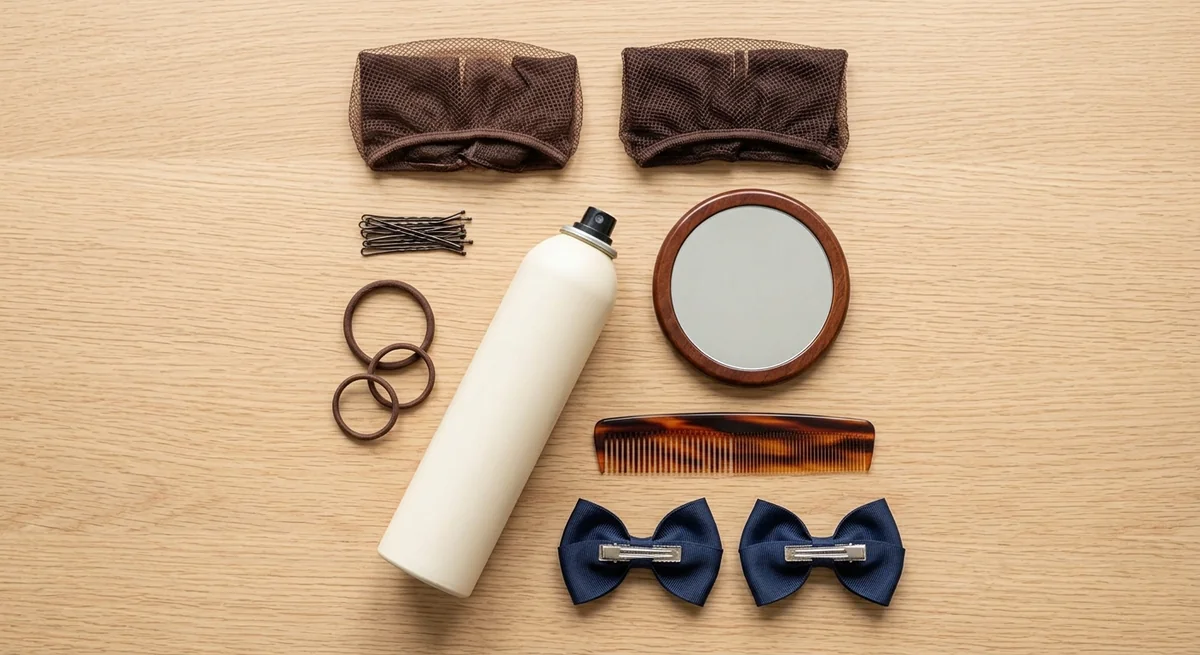
- Two spare hairnets in your colour, plus one heavy-weight net
- Hair elastics that match your hair
- Bobby pins, more than you will need, and long pins if you use a snood
- A brush and a comb
- Texture spray or mousse, and a wax stick for layers
- Hairspray, used before the net goes on and never after, because spray on a net makes it stiff and visible
- A small mirror for checking the back
- Spare bows if a child is showing, because one always goes missing
Before your next show
Learn to get your hair inside your helmet and learn the low bun, and then fit your helmet with whichever of the two you actually compete in. Keep two spare nets in the bag. Do your hair before you tack up. Most of what goes wrong on show day comes down to skipping one of those.
If you are shopping for a child’s first season, pre-owned show bows are usually worn only a handful of times before a rider moves up, and if yours has already moved up, the bows they have outgrown are worth listing for the next family. For everything below the hairline, our guide to English horse riding apparel for schooling and showing covers the rest of the outfit.


