


A winter horse riding jacket is chosen on three published numbers and one piece of geometry: a waterproof rating in millimetres, a breathability figure in g/m2/24h, an insulation fill weight in grams, and a cut that lets you lift your arms, follow the horse’s mouth and sit down in the tack. Several of the jackets compared below do not publish all four.
What follows is the detail a product grid does not carry. If you want the wider picture first, our guide to English horse riding apparel covers the rest of the wardrobe. This page is about outerwear only.
Why An Ordinary Winter Coat Fails On A Horse
An ordinary winter coat is designed for a body standing up, walking forwards, with its arms down. Bit of Britain states the problem plainly: “Winter coats for riders need to combine the dual functions of retaining warmth in extreme temperatures while still allowing effective athletic function.” The same page goes on to name several of the fixes, telling riders to “Factor in details like knitted cuffs, high necks, back vents, covered seams and secure pockets for keys and phones, and you have created the optimum in winter riding gear.” That is a feature list. What it does not tell you is which of those details matters at which workload, or what number to look for on a label.
Four pieces of geometry do the work. The hem has to clear the cantle instead of bunching under your seat, which is why Stierna cuts the Storm Rain Jacket with an “Asymmetrical shaped bottom hem fitted for riding”. The back has to open, which Redingote handles with a back zip that “can be opened to allow more flexibility when sitting in your tack” Redingote. The front has to open from the bottom as well as the top. And the hood, if there is one, has to go over a helmet, not under it, which is why the same Redingote jacket specifies an “Oversized, adjustable hood fits over a riding helmet”.
Dover Saddlery names three of those four in a single line: “Two-way zippers, removable hoods and rear vents keep you comfortable in the saddle.” The hem is the one it leaves out. The rest of that page’s written advice is grouped by season rather than by specification, which leaves the collection untriaged on the numbers that separate one coat from another.
How Hard Are You Actually Working? The Rider’s Heat Budget
Riding is not a sedentary activity, which matters when sizing insulation. The 2024 Adult Compendium of Physical Activities rates horseback riding at 3.8 METs at the walk, 5.5 for general riding, 5.8 trotting, 7.3 at canter or gallop and 9.0 jumping. The work before the ride is not light either: the same Compendium puts horse grooming, maintenance and saddling tasks at 4.5 METs, and grooming including feeding, cleaning stalls, bathing, brushing, clipping, longeing and exercising horses at 7.3.
A common winter pattern looks like this. You work in the aisle at 4.5 METs, keep everything on because it is cold outside, then sit on a horse at 3.8 METs in damp layers. The US National Institute for Occupational Safety and Health advises people working in the cold to “Wear several layers of loose clothing for better insulation”, and NIOSH also notes that “In regions unaccustomed to winter weather, near freezing temperatures are considered factors for cold stress”, which matters for riders in mild climates too.
There is one more load on the budget. You are a moving object in moving air. The National Weather Service describes wind chill as being based on the “rate of heat loss from exposed skin caused by wind and cold. As the wind increases, it draws heat from the body, driving down skin temperature and eventually the internal body temperature.” A ridden horse moves you through the air before the weather adds anything.
Waterproof Ratings In Millimetres, And What They Actually Tell You
The waterproof figure is a laboratory result, not a marketing adjective. It comes from the hydrostatic pressure method in ISO 811:2018, which applies to “all types of fabrics which are intended to be water resistant whether or not they have been given a water-resistant or water-repellent finish.” The number is the height of a water column the fabric held back: a specimen “is subjected to a steadily increasing pressure of water on one side of the fabric, under standard conditions, until penetration occurs in three places.”
Two caveats make the figure less impressive than it looks. The test is run on “an area of the fabric of 10 000 mm2 (100 cm2)”, so what is being measured is the fabric, not your finished coat with its seams, zips and pockets. And ISO 811 says the result “is immediately relevant to the behaviour of fabric articles which are subjected to water pressure for short or moderate periods of time.”
A European standard gives one reference point. EN 343, the standard for protective clothing against rain, sets Class 1 at 8,000 Pa, Class 3 at 13,000 Pa and its top Class 4 at 20,000 Pa. SATRA gives the conversion on the same page, noting that “1,000 Pa is approximately 102 mmH20”, which puts Class 4 at roughly 2,040mm of water column. A 10,000mm equestrian coat is a little under five times that. Here is how four jackets and one range wide minimum compare.
| Jacket | Waterproof | Breathability | Published insulation |
|---|---|---|---|
| OEQ Ladies Icon Winter Parka | 3,000, no unit printed | 3,000, no unit printed | 140g body, 100g sleeves |
| Shires Aubrion Equestrian Winter Coat | 10,000mm | 6,000 g/m2 | not published |
| Stierna EquTex range floor | 10,000 minimum | 10,000 g/m2/24h minimum | varies by garment |
| Stierna Storm Rain Jacket | 20,000mm | 20,000, printed as g/mm2/24h | not published |
| Redingote Winter Insulated Jacket 2.0 | not published | not published | 60g quilted lining |
Two notes on reading that table. The Aubrion figures appear identically at a second independent retailer, which tells you the specification is the manufacturer’s rather than a shop’s invention, and checking a second listing is always worth the minute. And the Storm’s product page prints its breathability unit as g/mm2/24h, which is a slip on the page itself: Stierna’s own range page uses g/m2/24h, the standard unit. The Storm is a two layer shell and its page publishes no insulation figure at all, which is why that cell reads as it does rather than as a zero.
Neither ISO 811 nor EN 343 maps a hydrostatic head figure to a riding use case, and none of the sources checked publishes one that does. The ratings are useful for comparing one garment against another, not for predicting how long you will stay dry on a given hack.
Breathability, And Why The Unit Matters
Breathability is measured in grams of water vapour passing a square metre of fabric in 24 hours. The spread across equestrian coats is wide, and the units are inconsistent. The OEQ parka prints only “3000/3000 Waterproof/Breathable” with no unit attached to the second figure, so it cannot be placed on the same scale as the others with any confidence. The Aubrion coat is breathable to 6000g/m2, and Stierna publishes a floor of 10,000 g/m2/24h across the EquTex range.
There is no published standard that maps a breathability figure to a rider’s workload. Compare the numbers against each other, insist on a unit before you treat a figure as meaningful, and treat a listing with no unit as a listing with no figure.
Matching Insulation Fill Weight To What You Ride
Of the jackets above, only two publish a fill figure, and they sit far apart: 140g in the body and 100g in the sleeves on the OEQ parka, against 60 grams of insulation in the Redingote. Those are different garments for different jobs, not a better one and a worse one.
| What you are doing | METs |
|---|---|
| Horseback riding, walking | 3.8 |
| Grooming, tacking up | 4.5 |
| General riding | 5.5 |
| Schooling at trot | 5.8 |
| Canter or gallop | 7.3 |
| Full barn work | 7.3 |
| Jumping | 9.0 |
Those MET values are published. What none of the sources checked publishes is a gram figure matched to a MET value, so no one can tell you that 60g is the right fill for schooling or 140g the right fill for walk hacking. Use the ladder above to rank your own activities against each other, and buy insulation for the end of the ladder you spend most of your winter on.
The Riding Cut: Vents, Two Way Zips, Hems And Hoods
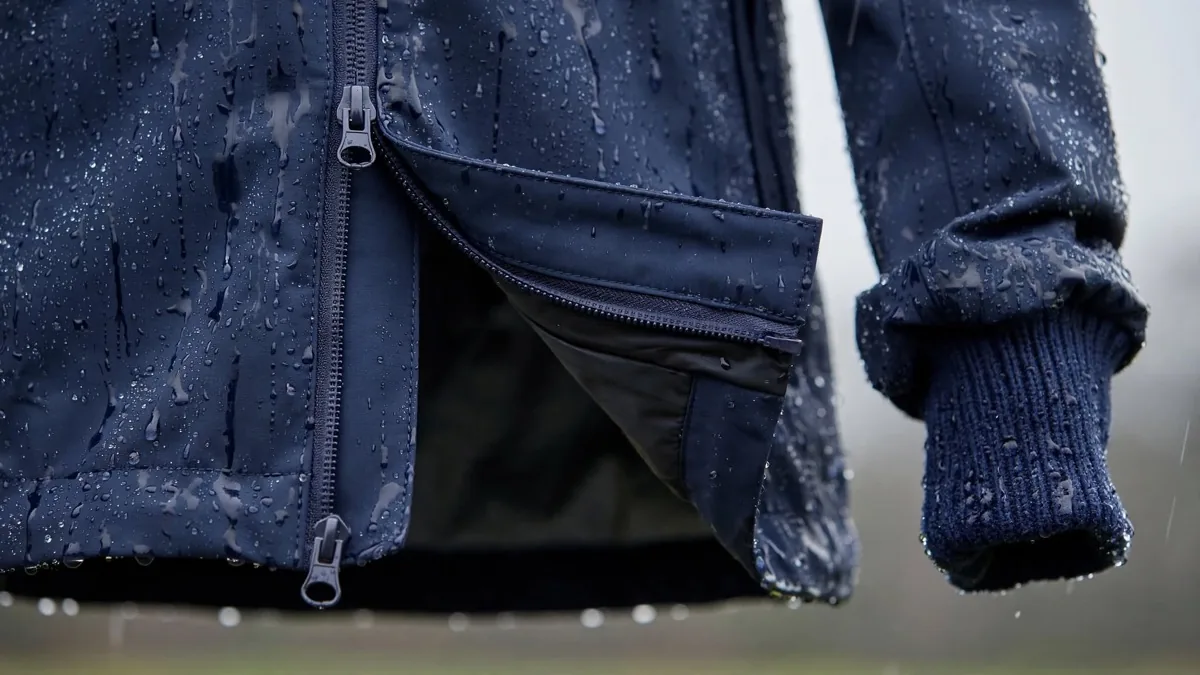
The riding cut is the part that cannot be retrofitted. The Aubrion coat lists a “two way front zip and hidden pleated rear rider vent”; the OEQ parka lists “Two zip riding vents to accommodate the saddle”. Both solve the same problem from different directions.
When you try a coat on, do it in a saddle position. Fold forwards as if following a horse’s mouth and check the shoulders do not pin your arms. Sit on something and confirm the rear vent or back zip opens wide enough to drape either side of the cantle rather than wedging underneath you. Raise both hands to rein height and watch whether the cuffs ride up your forearm. Redingote’s own sizing note is the right kind of line to look for on a listing: “Sized to layer over a standard riding outfit.”
Layering A Winter Horse Riding Jacket Over A Body Protector Or Air Vest
If you wear protection, it affects how the jacket should fit, and with an air vest it can rule a jacket out entirely. Start with the fitting. The British Horse Society puts the layering decision before the fitting rather than after it: “It’s important to think about how you will wear your body protector when you’re getting it fitted. For example, if you intend to wear it over a riding jacket, wear your jacket to your fitting.” The example in that sentence runs the opposite way round from the order most winter riders use, but the principle holds in both directions: be fitted in the clothing you will ride in, and in winter that means the winter coat, not the summer one.
Three more constraints follow.
- The certification label has to stay readable. The BETA 2018 standard requires that “The label must be easily accessible to view when worn and whilst mounted on a horse, to facilitate the checking of the standard by riding disciplines.” A coat worn over the top can create a checking problem at a venue. The same standard describes Level 3 as the level “considered appropriate for normal horse riding, competitions and for working with horses”.
- An air vest has to be able to inflate. Horse Pilot answers the question directly: a coat may go over an airbag “only if the garment is compatible with an airbag. It is essential that the airbag be able to deploy freely in the event of a fall.” The same manufacturer notes its airbags “comply with the NF S72-800:2022 standard, which sets performance requirements for equestrian airbags.”
- Eventers have no choice in the matter, so size the coat around the vest from the start. USEF Eventing requires that “A body protecting vest must be worn during the warm-up for and the Cross-Country phase”, with inflatable vests permitted in addition on cross country.
What The Rulebook Lets You Wear When It Is Freezing
In the USEF dressage division the rulebook makes an allowance for cold weather. The rules state that “when very cold weather conditions are forecasted on the date of a competition, competition management may publish in its prize list that windbreakers or parkas may be worn, rather than riding jackets, for the duration of the competition.” The same rule adds that “Competitors are permitted to wear a hat cover and a rain coat, with or without a riding jacket, in inclement weather.”
Vests are covered too: “Vests of any type are permitted but not required. Vests, including cooling vests, may be worn underneath or outside a riding jacket or when jackets are waived.” The general rules add the standard to look for on the label, recommending that a vest “pass or surpass the current ASTM standard F1937 or be certified by the Safety Equipment Institute.”
The practical upshot is that a windbreaker or parka can stand in for a riding jacket on a freezing morning in that division, if the prize list says so. Check the prize list. If you are building a show wardrobe alongside it, our guide to hunter jumper attire covers the ring side of the question.
Cuffs, Collars And Keeping Rein Feel In Your Fingers
Cuffs are rein equipment, not a comfort detail, and there is some recent evidence that dexterity starts to drop at a higher skin temperature than the older rule of thumb assumes. A 2025 paper from the US Army Research Institute of Environmental Medicine, published in Physiological Reports and described by its own authors as “An exploratory study”, tested 14 people, three of them female, and found that “Prior to rewarming, segmented regression revealed thresholds for greater dexterity loss during progressive cold strain occurred at skin temperatures of ~22.9°C (fingers), ~24.9°C (hand), and ~22.4°C (forearm) (all p ≤ 0.002). After rewarming, this threshold shifted upwards to ~25.7°C for the fingers (p ≤ 0.007).” The same paper notes that historically “15°C is typically regarded as the finger temperature threshold for marked decrements in dexterity”, and it states its own conclusion carefully, saying those thresholds “may be modified with rewarming”.
Fourteen participants does not overturn the older figure, and the paper does not claim it does. Treat it as a reason to take the cuff seriously rather than as a new number to aim at. Look for a cuff that closes properly against the wind, a sleeve long enough that it does not retreat up your forearm at rein height, and a collar high enough to stop air funnelling down your neck. Then check your forearm cover too, since that study found a threshold there as well.
Exposed skin has a harder limit. The National Weather Service pairs 0F air with a 15 mph wind to give a wind chill of minus 19F, at which point “exposed skin can freeze in 30 minutes.” On a day like that, the gap between glove and cuff is the thing that ends your ride.
What To Check On A Pre-Loved Winter Riding Coat
Buying pre-loved is where specification knowledge pays, because the published numbers let you compare a listing against anything new at the same price. Work through this list.
- Find the published specification online by exact model name before you buy, as both Aubrion retailers quoted above carry the same figures.
- Check the seam tape inside for any sections that have lifted.
- Open and close the two way zip from the bottom as well as the top, and check it runs the full length.
- Confirm the rear vent or back zip still runs cleanly and the fabric around it is not stretched.
- Hold the hood up to a helmet. A hood sized for a hat is no use to you.
- Check the cuff elastic or closure still grips.
- Ask the seller whether it was worn over a body protector, because that tells you how the fit was being used.
- Ask about any waterproofing treatment history, and ask how old the coat is. Neither the retailers nor the standards quoted here publish anything on how these garments hold their rating over time, so a published figure from the year of manufacture is the only number you have.
Browse what riders are listing in the Reequestrian shop, and if there is a coat in your tack room that no longer suits the way you ride, list it for sale rather than letting it take up a peg. For the wider winter picture beyond outerwear, start with our English horse riding apparel guide and the seasonal horse care checklist.
Frequently Asked Questions
What to wear for horse riding in winter? Work from your heat load outwards. Riding is rated between 3.8 and 9.0 METs depending on pace, so build something you can open and shed rather than one heavy garment. NIOSH advice for cold work is the same principle: “Wear several layers of loose clothing for better insulation.”
What is the best riding jacket for cold weather? The one whose published numbers match your riding. The published equestrian breathability figures run from 3,000 on one parka, with no unit printed, through 6000g/m2 on another, to a 10,000 g/m2/24h floor across the Stierna EquTex range. No published standard tells you which of those ratings suits which workload, so compare like for like and let your own riding decide.
What is the best winter coat for horseback riding? A coat built on riding geometry, not a general outdoor coat. The non negotiables are a two way front zip, a rear vent or back zip that lets you sit, a hem cut for the saddle and a hood that clears a helmet. Dover Saddlery names three of those four, everything but the hem: “Two-way zippers, removable hoods and rear vents keep you comfortable in the saddle.”
What is the warmest equestrian jacket available? There is no reliable published figure that answers this, because most brands do not print a fill weight at all. Of the jackets compared above, only two do: 60 grams of insulation in one and 140g in the body and 100g in the sleeves in the other. If a listing gives no gram figure, you have nothing to compare, and that is a reason to ask the seller.
What should I wear for winter horseback riding? Decide what protection you wear first, then size the coat around it. Take the coat to your body protector fitting, keep the certification label visible while mounted, and if you ride in an air vest, confirm the coat lets it “deploy freely in the event of a fall.”


