


Girths run in two inch steps, which is five centimetre steps. A 15.2hh horse in a jumping saddle usually takes a 46 or 48 inch long girth. The same horse in a dressage saddle usually takes a 26 or 28 inch short girth. Between two sizes, always take the larger one.
Here is the full chart in both units, the height guide, and the one thing that makes girth sizing confusing: there are two completely different ways to measure, they give answers twenty inches apart, and most guides do not tell you which one they are using.
Girth size chart in inches and centimetres
| Inches | Centimetres | Usually |
|---|---|---|
| 14″ | 35 cm | Small pony, short girth |
| 16″ | 40 cm | Pony, short girth |
| 18″ | 45 cm | Pony, short girth |
| 20″ | 50 cm | Small horse, dressage |
| 22″ | 55 cm | Dressage |
| 24″ | 60 cm | Dressage |
| 26″ | 65 cm | Dressage, most common size |
| 28″ | 70 cm | Dressage |
| 30″ | 75 cm | Dressage, larger horse |
| 32″ | 80 cm | Dressage, larger horse |
| 34″ | 85 cm | Pony, long girth |
| 36″ | 90 cm | Pony, long girth |
| 38″ | 95 cm | Small horse, long girth |
| 40″ | 100 cm | Long girth |
| 42″ | 105 cm | Long girth |
| 44″ | 110 cm | Long girth |
| 46″ | 115 cm | Long girth |
| 48″ | 120 cm | Long girth, most common size |
| 50″ | 125 cm | Long girth |
| 52″ | 130 cm | Long girth |
| 54″ | 135 cm | Long girth, large horse |
| 56″ | 140 cm | Long girth, large horse |
Note the overlap in the middle. A 34 inch girth is either a long girth for a pony or an unusually large dressage girth. The number alone tells you nothing until you know which type you are buying.
Manufacturers also quote a tolerance, commonly around two centimetres either way, so two girths labelled 120 cm from different makers will not be identical. That is another reason to size up rather than down.
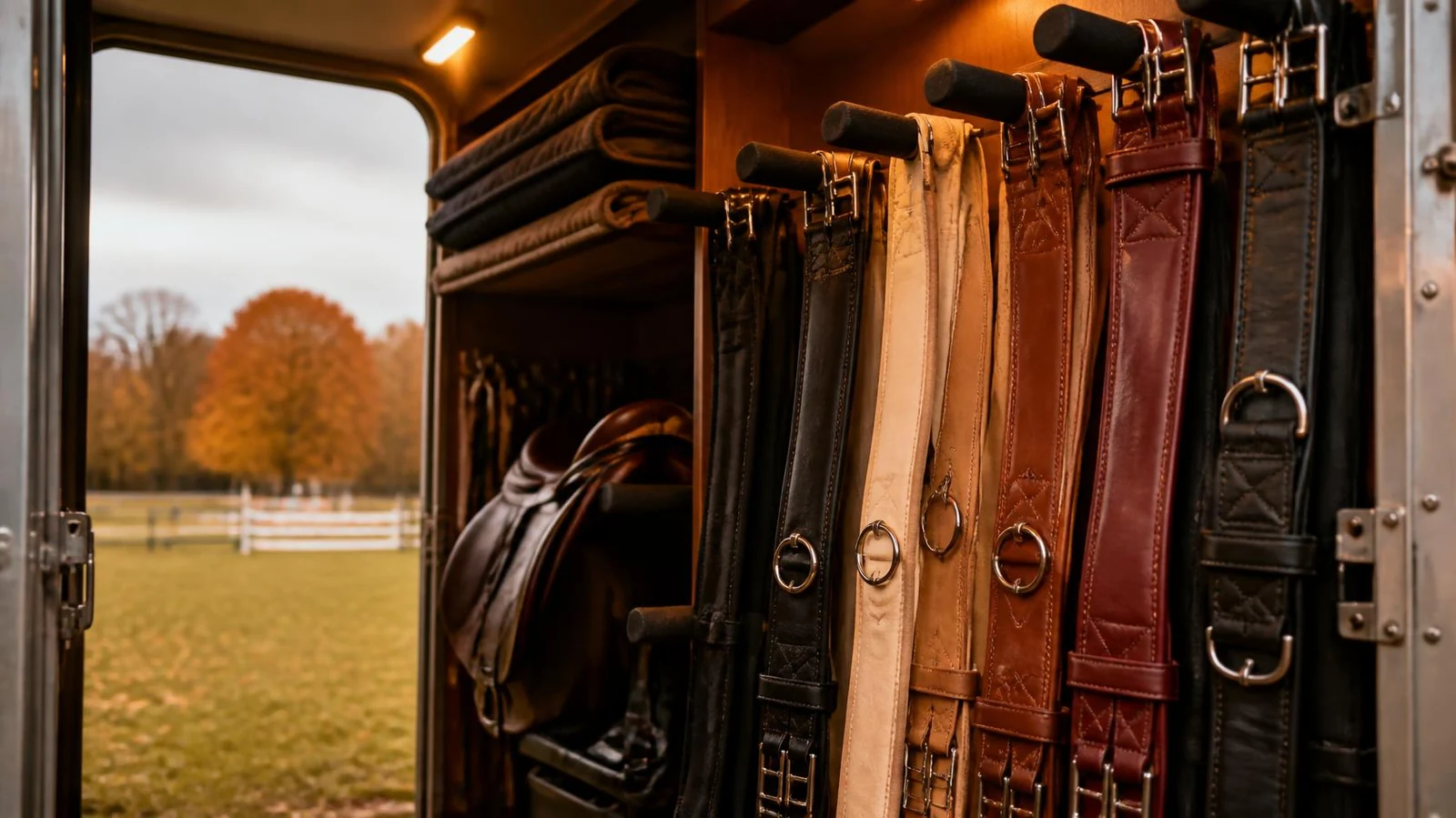
Girth size by horse height
Height is a starting point, not an answer, because girth size follows the saddle’s billets and the shape of the barrel rather than the horse’s height. A narrow thoroughbred and a round cob at the same height can sit four inches apart.
| Horse height | Dressage girth | Long girth |
|---|---|---|
| 13 to 14 hh | 18″ to 20″ | 38″ to 40″ |
| 14 to 15 hh | 22″ to 24″ | 42″ to 44″ |
| 15 to 16 hh | 26″ | 46″ to 48″ |
| 16 to 17 hh | 28″ | 48″ to 52″ |
| 17 hh and over | 30″ to 34″ | 50″ to 54″ |
Use this to sanity check a measurement you have taken, or to judge whether a girth in a listing is even close. Do not use it instead of measuring.
Why do two girth charts give completely different numbers?
Because there are two different measurements in circulation and they are not the same thing.
Heart girth is the full circumference of the horse’s barrel, right around the body behind the elbow. On a 15.2hh horse that is roughly 70 inches. It is the correct measurement for weight tapes and for blanket sizing. It is not your girth size.
Billet hole to billet hole is the distance the girth actually has to span, measured under the horse with the saddle on, from the middle billet hole on one side to the middle billet hole on the other. On that same 15.2hh horse it is roughly 48 inches. This is your girth size.
The difference is the saddle. The billet straps hang down each side and close most of the gap, so the girth only bridges the distance between them, not the whole way around the horse.
If you have ever found two charts that disagree by twenty inches, this is why. Any chart that maps a horse’s height straight to a girth size has quietly assumed a typical saddle and typical billet length on your behalf. That assumption is usually close, and it is still an assumption.
How to measure a horse for a girth
Put the saddle and pad on first. Measuring the bare horse gives you heart girth, which is the wrong number.
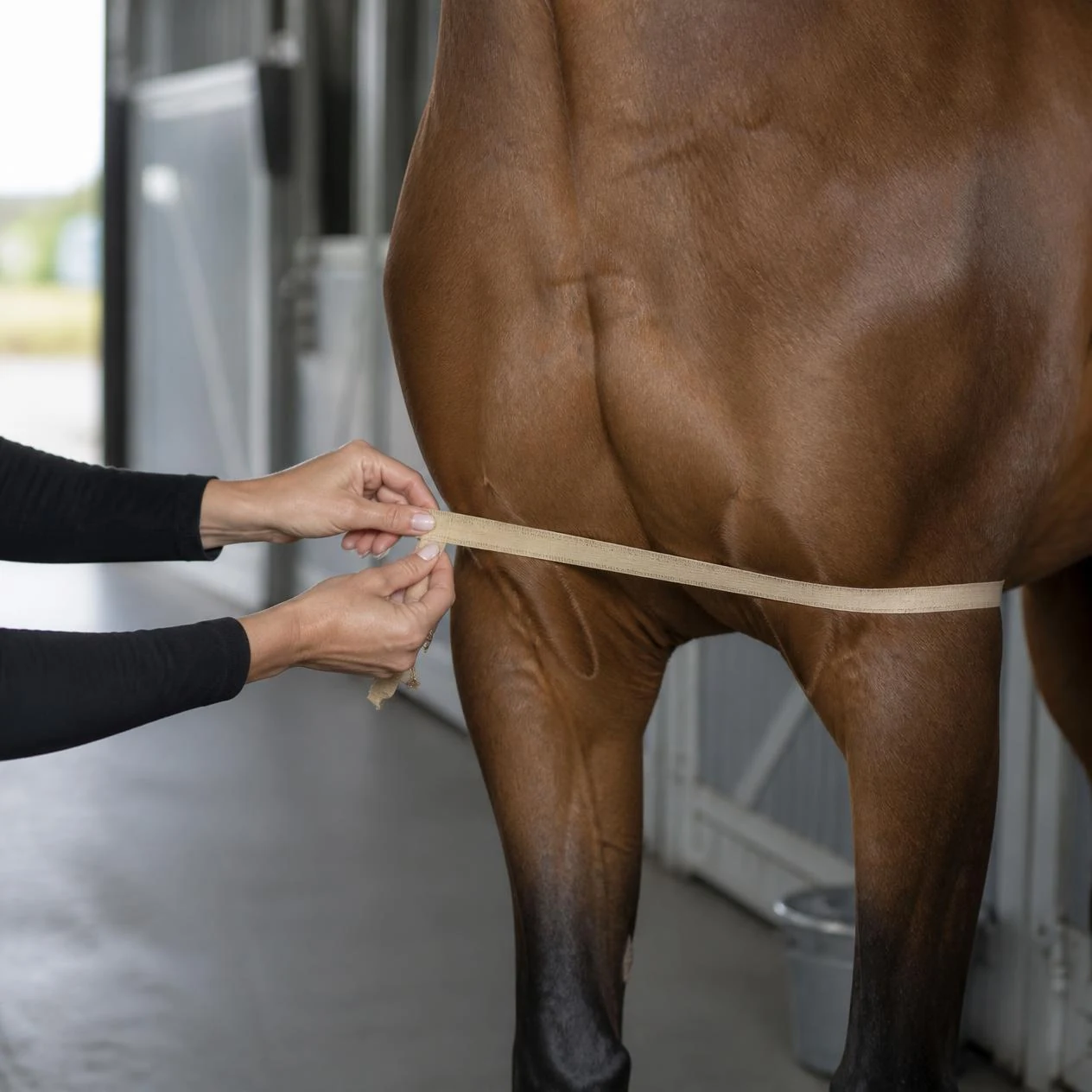
- Tack up as normal, saddle and pad on, girth off.
- Find the girth line, roughly a hand’s width behind the elbow, about four inches back. That is where the girth naturally settles, and it is a narrower part of the barrel than the point directly behind the foreleg.
- Start at the middle billet hole on one side. The middle hole matters: it leaves room to tighten as the horse warms up and to let out when it has been standing. Measure from an end hole and you buy a girth that only works on one setting.
- Run a fabric tape under the horse along the girth line to the matching hole on the other side. A helper makes this much easier. A strip of duct tape holding one end works if you are alone.
- Read the figure in inches. That is your girth size.
No tape measure? About sixty inches of baling twine works. Run it the same route, pinch it at both middle holes, then lay it flat against a rigid tape. This is genuinely how most people at a barn do it.
One detail that catches people out: girths are measured from the end of one buckle to the end of the other, so the hardware is already included in the number on the label. Do not add anything.
Long girth or dressage girth? The twenty inch rule
To convert between the two, add or subtract twenty inches.
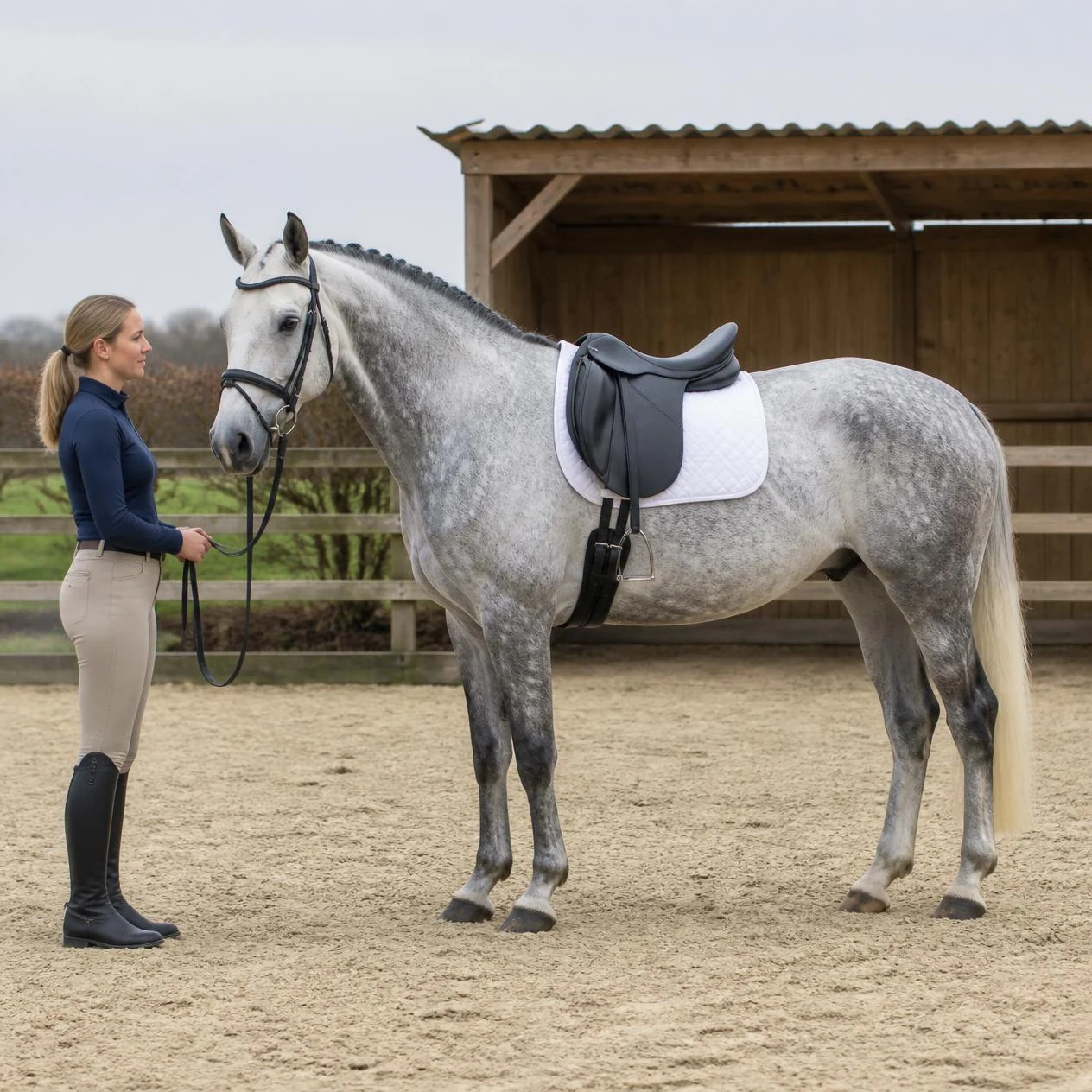
A long girth is used with jumping, hunter and general purpose saddles, which have short billets that leave the buckles sitting up under the rider’s thigh. A dressage girth is much shorter because dressage saddles have long billets that carry the buckles down the horse’s side and out of the way.
| Long girth | Dressage girth |
|---|---|
| 42″ | 22″ |
| 44″ | 24″ |
| 46″ | 26″ |
| 48″ | 28″ |
| 50″ | 30″ |
| 52″ | 32″ |
| 54″ | 34″ |
This is an approximation, because billet length varies between saddle makers. It is close enough to shortlist a size and far better than guessing. If you ride the same horse in both saddles, you need two girths.
What are the different types of girth?
Once you have the size, the material and shape decide comfort and how long the girth lasts.
Leather. The traditional choice and the one that lasts longest if it is cleaned and conditioned. Expensive new, which is why leather girths are one of the better things to buy pre-owned. Check the billet holes for stretching and the stitching at the buckles before you buy.
Synthetic and webbing. Light, cheap, machine washable, and the sensible everyday option. Wears faster than leather but costs a fraction of it.
Neoprene. Grippy and easy to wipe clean. Some horses sweat heavily under it, so it suits shorter schooling sessions better than long days.
String. Cotton or synthetic cords spread pressure and allow air to move. An old design that still suits horses who rub easily.
Fleece lined or fleece covered. Wool or synthetic fleece against the skin, used for horses prone to girth galls. The cover is usually removable and washable.
Shapes matter as much as material:
Straight girths are the plain traditional shape and fit most horses.
Anatomic or contoured girths are cut away behind the elbow so the horse’s foreleg has more room at full stride. Worth considering for a horse that is short behind the elbow or has rubbed before.
Crescent or asymmetric shapes are cut to sit further back and are used where the saddle tends to slide forward.
If a horse has ever come up sore or rubbed in the girth area, the shape is usually the thing to change, not the size.
How do you tell whether a girth fits?
Once it is on, the buckles tell you almost everything.
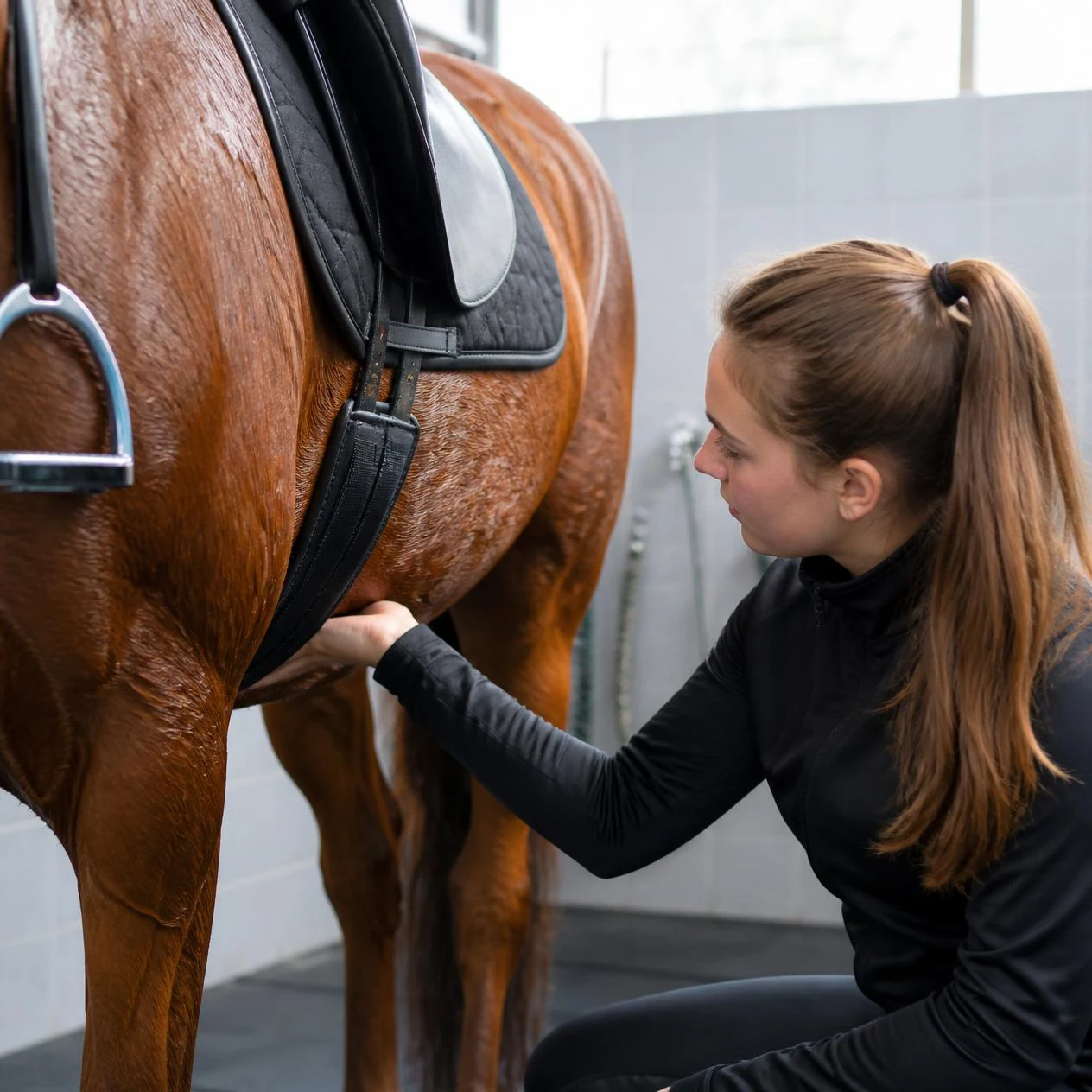
On a jumping or general purpose saddle, at working tightness the buckles should sit roughly halfway up the billets, with at least two holes above and one below. Buckles riding high enough to sit under your thigh mean the girth is too long. If you are on the very last hole just to do it up, it is too short and unsafe.
On a dressage saddle, the buckles should sit at the midpoint of the long billets, well below the saddle flap, with roughly three fingers of clearance between the bottom of the pad and the top of the girth.
Check the placement, not only the length. The girth should sit about four inches behind the elbow. If it has crept forward into the elbow, the horse will rub regardless of size, and that is usually a saddle position problem rather than a girth one.
Slide a flat hand under it. At working tightness your flat hand should go between girth and horse without being forced.
Check both sides are even. Uneven tension shifts the saddle sideways and creates pressure on one side.
Look for pinched skin. After fastening, run a hand under the girth and pull each foreleg forward in turn. Wrinkled skin or hair pushed the wrong way means the girth is pinching.
Check again after warming up. Most horses need a hole tighter after ten minutes of walking, as the saddle settles and they relax. Tighten in stages rather than hauling it up all at once.
Common mistakes
Measuring the bare horse. The most common error by far, and it gives you heart girth rather than girth size.
Measuring from the top or bottom hole. Gives a number that only works at one extreme of the adjustment.
Forgetting the buckles are included. A girth is measured buckle end to buckle end. Measuring only the fabric of an old girth and adding the hardware in your head puts you two inches out.
Assuming one girth covers both saddles. Dressage and jumping saddles on the same horse need girths twenty inches apart.
Buying on breed or height alone. Two 16hh horses can easily be four inches apart.
Frequently asked questions
How do you measure a horse for a girth?
Tack up, then run a fabric tape or a length of string from the middle billet hole on one side, under the horse about a hand’s width behind the elbow, to the matching hole on the other side. That figure in inches is your girth size. The buckles are already included in the labelled size, so add nothing.
What size girth does a 15.2 horse need?
Most often a 46 or 48 inch long girth, or around a 26 inch dressage girth. Treat that as a starting point. Girth size follows the saddle’s billets and the barrel’s shape, not height, so a narrow thoroughbred and a round cob at 15.2 can be four inches apart.
Is a girth measured in inches or centimetres?
Both. Girths run in two inch steps, which is five centimetre steps, so 48 inches is 120 cm and 26 inches is 65 cm. European makers usually label in centimetres, UK and US makers in inches.
What is the difference between a long girth and a dressage girth?
A long girth suits jumping, hunter and general purpose saddles, which have short billets. A dressage girth is much shorter because dressage saddles have long billets carrying the buckles down and out of the rider’s way. For the same horse the two differ by roughly twenty inches.
Is heart girth the same as girth size?
No, and confusing the two is the single biggest cause of ordering the wrong size. Heart girth is the full circumference of the barrel and is used for weight tapes and blankets. Girth size is the shorter distance between the billet holes with the saddle on.
What is the formula for calculating girth size?
There is not one. Any source offering arithmetic based on height or weight is estimating. Girth size depends on where your saddle’s billets fall and the shape of your horse’s barrel, so the only reliable method is to measure billet hole to billet hole.
What if my measurement falls between two sizes?
Take the larger one. A girth slightly too long can still be used on a higher hole. One slightly too short cannot be used safely at all.
How tight should a girth be?
Tight enough to slide a flat hand between girth and horse without forcing it, and no tighter. Tighten in stages and check again after a few minutes of walking, because most horses need a hole more once they have relaxed.
Can I use a western cinch instead?
No. A cinch attaches differently, is measured differently and is not interchangeable with an English girth. Everything on this page refers to English girths.
Buying a girth pre-owned
A girth is one of the better things to buy secondhand, because the failure points are all visible. Check the billet holes for stretching or tearing, check the stitching where the webbing meets the buckles, and on leather check for cracking at the fold.
The detail worth asking a private seller is which saddle the girth was used with. That tells you which billets it was sized against, which matters more for a girth than almost anything else.
Browse what riders are listing, or if you have changed saddles and been left with a girth in the wrong length, list it and put it toward the right one.


